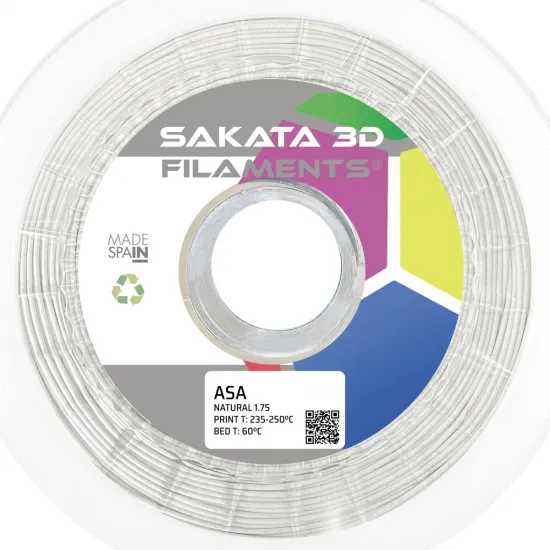


- Stock: 23
- Model: ASA 1.75mm

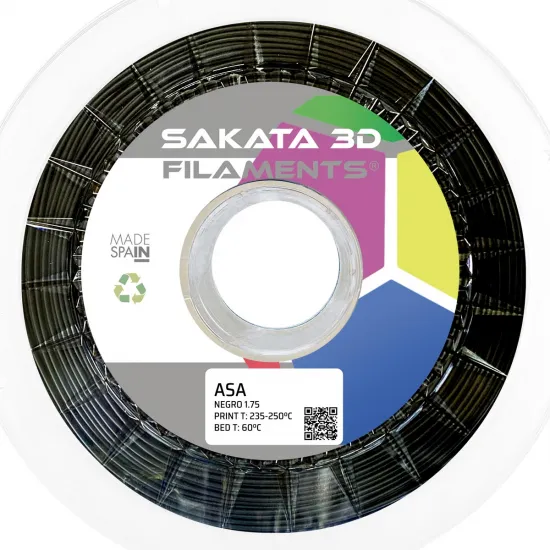
Sakata 3D ASA is a technical filament made in Spain for functional parts and outdoor components. It retains the mechanical and thermal characteristics associated with the ABS/ASA family while providing better UV-radiation and outdoor-ageing resistance than ABS.
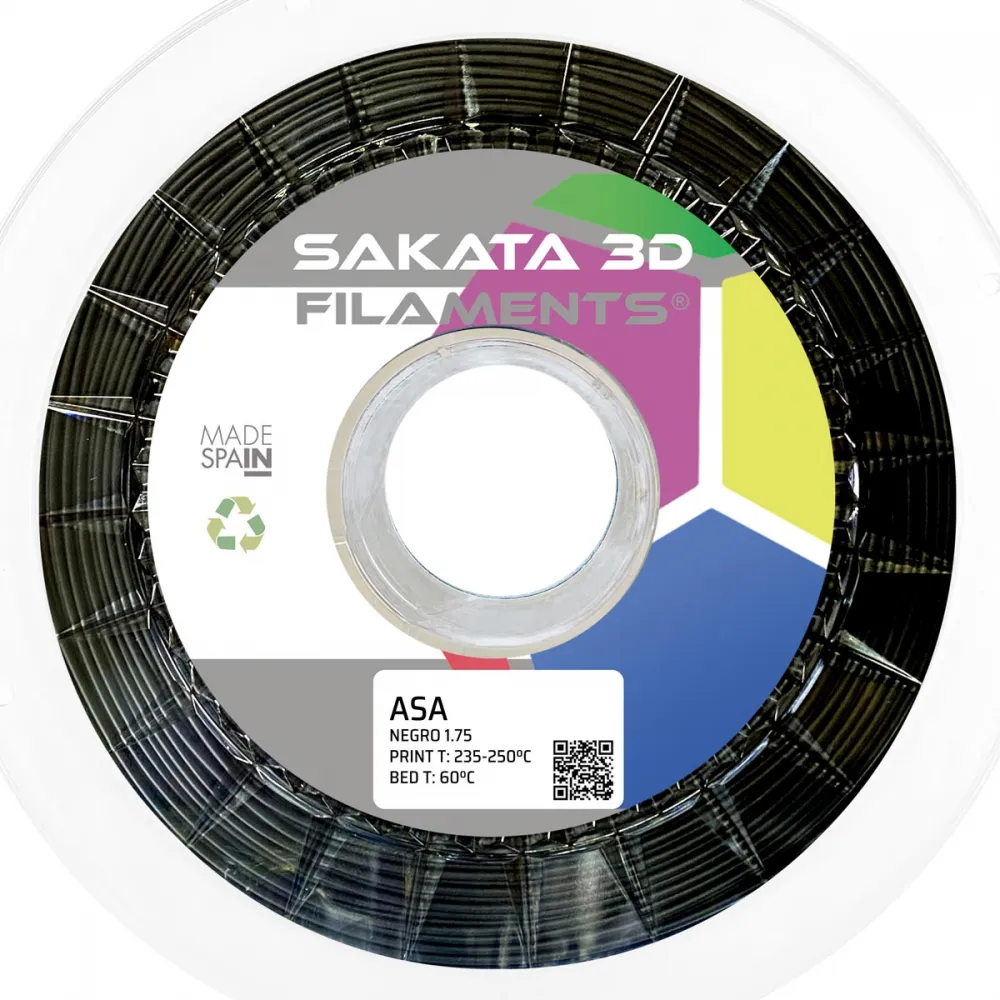
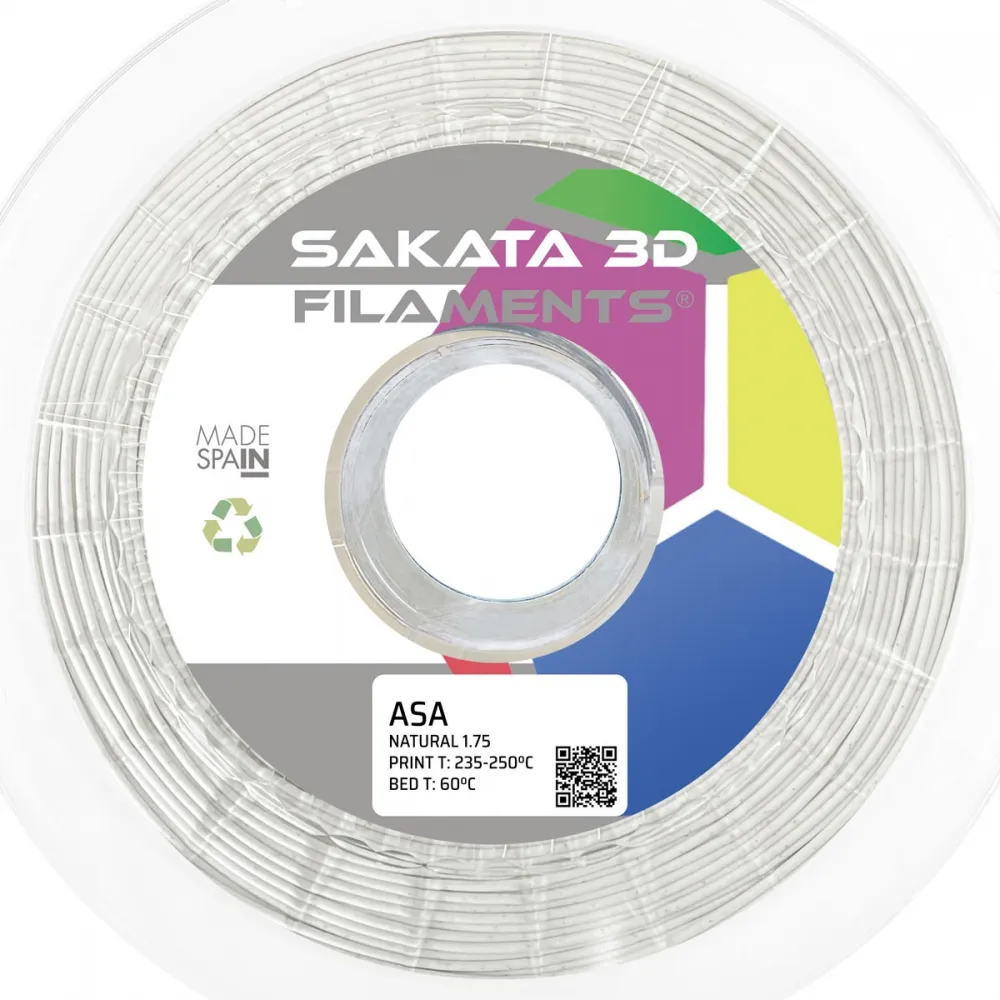
It is available in Natural or Black and on 850 g or 1 kg spools, depending on the selected option. Nominal diameter is 1.75 mm; the current technical data sheet for the 850 g format specifies a ±0.03 mm tolerance and a maximum roundness deviation of 0.03 mm.
Why choose ASA?
- Outdoor use: better resistance to UV radiation and environmental ageing than ABS.
- Functional parts: a stiff, impact-resistant material with good interlayer adhesion when printed correctly.
- Temperature: provides more thermal margin than easy-to-use materials such as PLA.
- Finish: suitable for housings, brackets, signs, tooling and durable prototypes.
- European manufacture: produced in Spain by Polimersia Global S.L. for Sakata 3D Filaments.
Technical specifications
| Feature | Value | Notes |
|---|---|---|
| Material | ASA | Acrylate, styrene and acrylonitrile |
| Diameter | 1.75 mm | Current 850 g TDS: ±0.03 mm |
| Formats | 850 g or 1 kg | Select before ordering |
| Colours | Natural or Black | Appearance may vary slightly by batch and display |
| Density | 1.07 g/cm³ | ISO 1183 |
| Nozzle | Brass | Unfilled ASA does not require a hardened nozzle |
Official print settings
| Setting | Classic printing | High speed |
|---|---|---|
| Nozzle temperature | 240-260°C | 260-280°C |
| Bed temperature | Above 90°C | |
| Speed | Below 90 mm/s | 100-300 mm/s, up to 27 mm³/s |
| Enclosure | Required | |
| Part-cooling fan | 0-20% | |
| Build surface | Glass or PEI with spray or glue-stick adhesive | |
| Layer height | 0.1-0.3 mm with a 0.4 mm nozzle | |
| Pre-drying | 4-6 hours at 70°C, recommended | |
These values come from the Sakata 3D technical data sheet revised on 21 November 2024 and are starting points rather than a universal profile. In high-speed printing, actual volumetric flow is the decisive limit: reaching 300 mm/s requires a hotend, extruder, nozzle and geometry capable of sustaining the flow without losing temperature or layer bonding.
3D printer compatibility
Compatibility is conditional on a 1.75 mm FDM/FFF printer maintaining the selected nozzle temperature, a bed above 90°C, an enclosure, a suitable build surface and a ventilated workspace. For high-speed mode, the complete hotend must be safely rated to 280°C.
- Bambu Lab X1 Carbon and P1S: may evaluate this ASA with a dedicated build plate and profile; do not automatically copy another manufacturer's settings.
- Creality K1, K1C and K1 Max: the enclosure may support thermal control, but the installed plate, hotend and workspace ventilation must still be checked.
- Prusa CORE One: may be used with a compatible surface and a dedicated profile tuned for this formulation.
- Voron 2.4 and Voron Trident: compatible when the individual build has a suitable hotend, bed, surface, enclosure and configuration.
- Ender-3, Prusa i3, 3DSteel and other open printers: not a direct recommendation because Sakata specifies an enclosure. Adding one also requires checking electronics, PSU, motors and internal printed parts.
These models are technical examples, not a manufacturer approval list. Validate the material with the actual printer, build surface and spool before a long or functional job.
Building a reliable profile
- Dry the spool after prolonged exposure or when popping, bubbles, stringing or a rough surface appear.
- Preheat the bed and enclosure long enough for the system to stabilise.
- Start within the classic range, tune temperature and flow, and check interlayer bonding.
- Tune retraction and Pressure Advance or Linear Advance instead of copying another ASA profile.
- Use little part cooling; increase it only when bridges or details need it and confirm that cracks do not appear.
- Use a brim when appropriate for large parts and avoid draughts during printing and cooling.
Marlin, Klipper and RepRapFirmware do not require an ASA-specific code: the material profile is mainly configured in the slicer. Keep thermal protections enabled and never raise firmware limits beyond the safe ratings of the installed hotend, sensor, heater, wiring and connectors.
Bed adhesion and part removal
Sakata recommends glass or PEI with an adhesive. You may use 3DLAC aerosol or 3DLAC Plus, following both the adhesive and build-surface instructions. On PEI, the intermediate layer may also aid removal and reduce the risk of excessive bonding.
Allow the bed to cool before removing the part. Do not force hot PEI or use tools that may scratch it. An excessively squashed first layer does not compensate for a cold bed or unstable chamber.
Reference mechanical and thermal properties
| Property | Standard | Official value |
|---|---|---|
| Tensile modulus | ISO 527 | 2,300 MPa |
| Elongation at break | ISO 527 | 9% |
| Flexural strength | ISO 178 | 70 MPa |
| Notched Izod impact | ISO 180/A | 14 kJ/m² |
| HDT at 0.45 MPa | ISO 75 | 97-105°C |
| Vicat | ISO 306 | 97-101°C |
These data were obtained from injection-moulded test bars. A printed part may perform differently because of layer orientation, moisture, temperature, infill, perimeters, geometry, load and exposure time. HDT and Vicat values are not guaranteed continuous-service temperatures.
This material is for you if
- You need non-critical outdoor housings, brackets, signs or components.
- You want better UV and thermal resistance than PLA or conventional ABS.
- You have a heated bed, enclosure and suitable workspace ventilation.
- You can tune the material and validate the part under its actual conditions.
This material is not for you if
- Your printer is open or its bed cannot exceed 90°C.
- You need an easy material without shrinkage control or workspace ventilation.
- The application requires food-contact, medical, flame-retardant, electrical or structural certification.
- You need a flexible part or guaranteed chemical resistance to a specific substance.
Safety, storage and use limitations
ASA printing may release vapours, including small quantities of styrene according to the TDS. Work with adequate air exchange or extraction; an enclosure improves thermal stability but does not replace ventilation.
Store the spool sealed and protected from moisture and heat. Official recommended drying is 4-6 hours at 70°C; for demanding jobs it may be maintained at 70°C in a compatible dryer or drybox. Confirm that both spool and drying equipment tolerate the cycle.
This filament is not certified for food contact or medical applications. ASA's improved UV resistance does not make every printed part suitable for structural, safety, automotive, aerospace or marine functions without dedicated design, testing and certification.
Other available ASA filaments
If you require different colours, formats or price ranges, compare it with WINKLE ASA made in Spain and GST3D ASA. Each formulation needs its own profile; do not automatically copy temperatures or speeds between brands.
Contents: 1 spool of Sakata 3D ASA 1.75 mm filament in the selected weight and colour.