
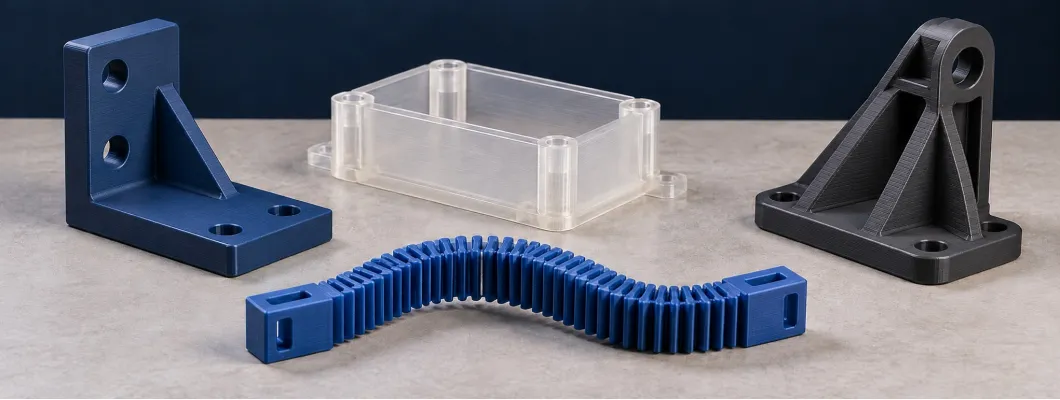
A well-printed part can still fail because its material was wrong for the job. A bracket that bends inside a hot car, a stiff clip that breaks during assembly and a hinge that does not survive repeated use share a lesson: print appearance is not enough to establish fitness for use.
This guide helps you choose which filament deserves a trial. Start with the selector or browse the material families. The essentials stay visible; the “A closer look” sections explain the mechanisms, compromises and details worth returning to later.
Go to a section
Quick starting pointMaterials selectorFive questionsPLA and variantsPETGABS and ASAFlexible materialsPA and PPCompositesFoaming materialsDecorative materialsSpecial functionsSupportsRecycled and transitionValidate a sampleA useful starting point before comparing spools
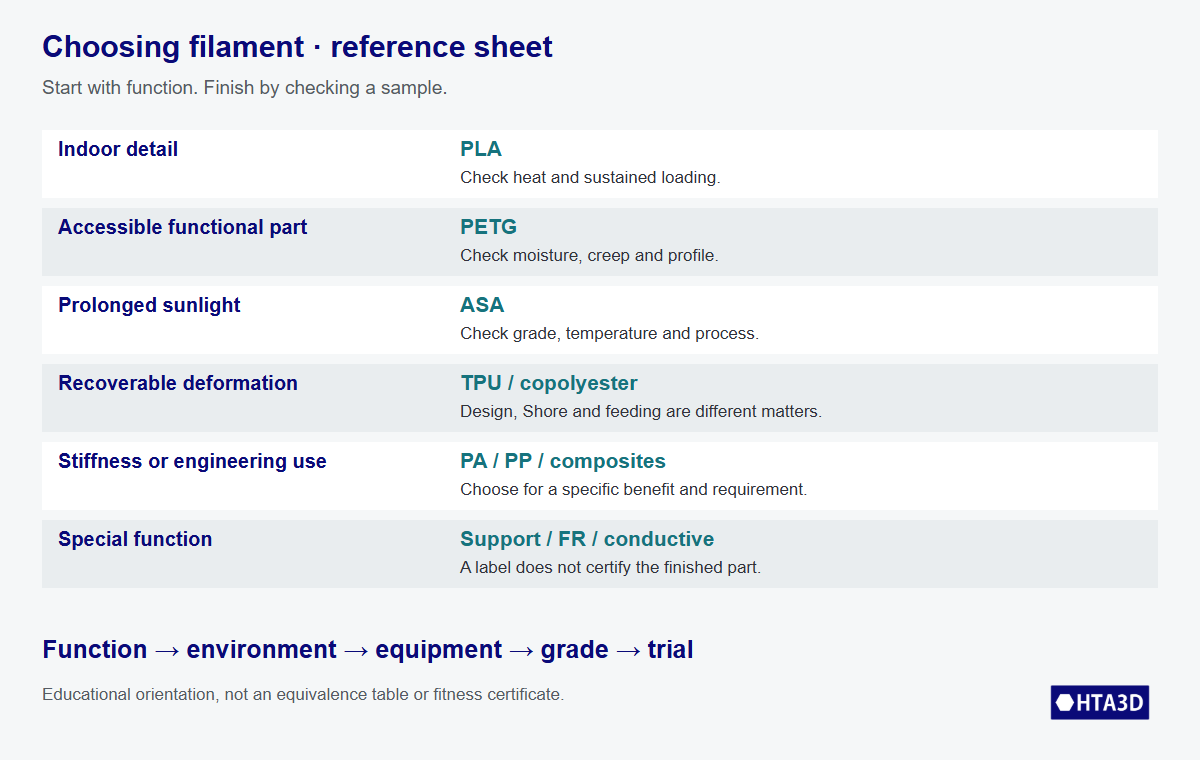
For an indoor model or visual prototype, PLA is often a convenient starting point. PETG deserves consideration for many functional brackets and housings. ASA is a common candidate for prolonged outdoor exposure; materials such as TPU become relevant when a part must deform and recover. PA, PP and composites offer more specific benefits, with requirements worth understanding.
These are starting points, not automatic substitutions. The choice combines material, design, printing process and service conditions. Well-printed PETG may solve geometry that prints poorly in ABS; a solid TPU part may feel firmer than expected. Adding fibre does not improve every property at once.
Find candidates for your part
Without filters, every material is visible. Selecting requirements changes the order and explains limitations. You can keep excluded candidates visible to understand the reasons. The tool does not use compatibility percentages or certify part strength.
What does your part need?
An empty field means unspecified, not confirmed hardware capability.
PLA
Detail, easy printing and indoor prototypes. Watch heat and sustained loading.
Open the explanation to understand its uses and limits.
Read explanation →PLA 850 / HR-870
PLA grades targeting particular properties. Check the grade and whether annealing is needed.
Open the explanation to understand its uses and limits.
Read explanation →PLA High Speed
Faster processing with a suitable profile. Speed does not prove heat resistance.
Open the explanation to understand its uses and limits.
Read explanation →PETG
A practical functional starting point: bonded layers and accessible processing. Watch moisture and creep.
Open the explanation to understand its uses and limits.
Read explanation →ABS
Housings and functional parts with controlled printing conditions. Standard ABS is not the UV choice.
Open the explanation to understand its uses and limits.
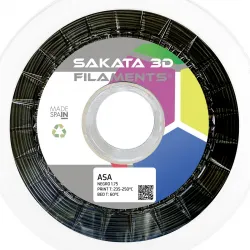
Read explanation →ASA
A common outdoor candidate. Actual temperature and loads still need checking.
Open the explanation to understand its uses and limits.
Read explanation →PETG-CF
Stiffness and a matte finish. Needs abrasion-resistant hardware; impact performance is not universally better.
Open the explanation to understand its uses and limits.
Read explanation →PA / Nylon
Mechanisms and parts needing toughness or controlled wear. Grade and moisture matter.
Open the explanation to understand its uses and limits.
Read explanation →PA-CF
Carbon-filled polyamide: stiffness and stability, with drying and suitable hardware.
Open the explanation to understand its uses and limits.
Read explanation →PA-GF20-FR
Glass-filled polyamide with a specific flame-retardant function. Not interchangeable with PA-CF or every PA-GF.
Open the explanation to understand its uses and limits.
Read explanation →PP
Low weight and repeated flexing. Bed adhesion needs a dedicated strategy.
Open the explanation to understand its uses and limits.
Read explanation →PP-GF
Glass-filled PP for stiffness. It does not retain the deformability of unfilled PP.
Open the explanation to understand its uses and limits.
Read explanation →Filaflex 95A · TPU
A reasonable entry into flexible printing. Profile and filament guidance still matter.
Open the explanation to understand its uses and limits.
Read explanation →Filaflex 82A · TPU
Softer within this range. A short, well-confined feed path is advisable.
Open the explanation to understand its uses and limits.
Read explanation →Filaflex 70A · TPU
Very soft filament for a suitable extrusion system and reduced flow.
Open the explanation to understand its uses and limits.
Read explanation →Filaflex 60A PRO · TPU
Soft and demanding. Assess feeding and geometry before committing to the job.
Open the explanation to understand its uses and limits.
Read explanation →FleX-920 · copoliéster
A flexible copolyester, not TPU. Hardness alone does not predict rebound.
Open the explanation to understand its uses and limits.
Read explanation →Filaflex 95A Foamy
Foaming elastic material for lower density. Expansion, flow and dimensions need joint calibration.
Open the explanation to understand its uses and limits.
Read explanation →Filaflex Foamy
A different foaming formulation. Do not transfer hardness data or profiles from 95A Foamy.
Open the explanation to understand its uses and limits.
Read explanation →PLA-LW
Foaming PLA for lightweight parts. Lower mass can involve mechanical trade-offs.
Open the explanation to understand its uses and limits.
Read explanation →PLA Wood
A natural-fibre finish. Check the product’s minimum nozzle diameter.
Open the explanation to understand its uses and limits.
Read explanation →PLA Cork
A decorative particulate texture. Appearance does not prove higher strength.
Open the explanation to understand its uses and limits.
Read explanation →PLA V-0
A grade with declared flame behaviour. Check test, thickness and application.
Open the explanation to understand its uses and limits.
Read explanation →PET-G V0
Flame-retarded PETG. A material test and final-product certification are different things.
Open the explanation to understand its uses and limits.
Read explanation →rPETG FR
Check the classification and its scope. Do not treat it as equivalent to UL 94.
Open the explanation to understand its uses and limits.
Read explanation →Filaflex Conductive
Conductive TPU for signals and sensors. Measure the resistance of the finished part.
Open the explanation to understand its uses and limits.
Read explanation →Antibacterial PLA
Surface activity under test conditions. Not sterility or medical-device validation.
Open the explanation to understand its uses and limits.
Read explanation →PVA
Water-soluble support for inaccessible geometry and compatible material pairings.
Open the explanation to understand its uses and limits.
Read explanation →HIPS
Solvent-removable support when the material pairing and process allow it.
Open the explanation to understand its uses and limits.
Read explanation →PLA 450 Easy Off
Breakaway support, not soluble. Check adhesion and compatibility with the part’s PLA.
Open the explanation to understand its uses and limits.
Read explanation →Screening is indicative by family or grade. A candidate deserves a trial; its use has not been validated. Price and ease are preferences and cannot offset an unmet requirement.
Prepare an enquiry with these criteria →Five questions that make the choice clearer
- What must the part do? A cover, assembly fixture and hinge need different things. Describe what would happen if it failed.
- What loads act on it, and for how long? An impact, permanent weight and thousands of bending cycles are different problems.
- What is its environment? Consider the part’s own temperature, sunlight, moisture and substances it touches.
- How much deformation is acceptable? You may need stiffness, yielding without fracture, or recovery after deformation.
- Can you print the grade properly? Temperature, feeding, nozzle, drying, build surface and thermal environment must suit it.
A closer look · Stiffness, hardness, impact and sustained loading
“Strong” can mean several different things
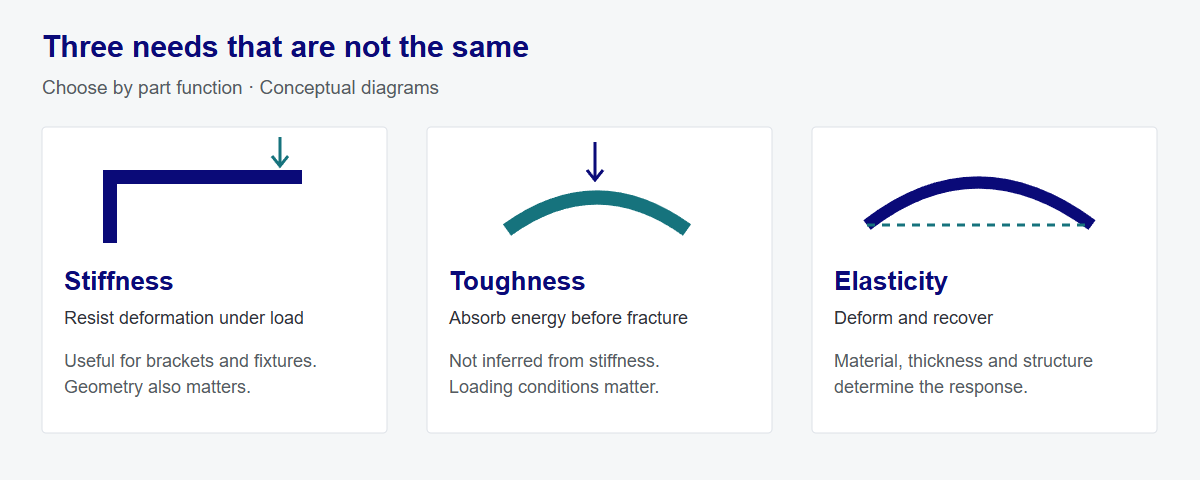
Stiffness describes resistance to deformation under load. Strength at failure concerns the stress sustained before failure under defined test conditions. Toughness relates to the energy absorbed before fracture, while impact testing studies rapid loading. A part can be stiff yet break with little warning deformation.
Ductility is the ability to undergo plastic deformation before fracture. That deformation need not disappear when the load is removed. Elasticity concerns recovery. A clip assembled once and a tongue that must return to its position thousands of times can therefore need different materials and designs.
Hardness measures local resistance to indentation using a defined method. A Shore number does not calculate how much a finished part bends. Thickness, shape, walls and infill all influence the result.
Another failure mode is creep, progressive deformation under sustained load. A bracket may pass a short test and move out of position after weeks. Heat can accelerate the process. Hanging a weight briefly is not sufficient validation for permanent service.
Replace “I need a very strong plastic” with a specific statement: “this bracket must keep the component aligned”, or “this latch must bend during assembly and recover”. That lets you compare relevant behaviour rather than search for an absolute winner.
PLA: easy printing, detail and different formulations
Conventional PLA is convenient for figures, models, visual prototypes and many moderately loaded indoor parts. It generally provides good detail and low warping without a heated chamber. Its stiffness is useful, but should not be confused with impact or heat resistance.
Reconsider the approach for elevated temperatures, prolonged outdoor exposure or persistent loading near the part’s limit. In a car parked in the sun, for example, the part can become much hotter than ambient air. A perfect appearance after printing does not show that it will retain its shape there.
PLA
Specific examples HTA3D:
Sakata PLA 850Sakata PLA HR-870Sakata PLA High Speed PRO
A closer look · Engineering PLA, high-speed grades, annealing and plant origin
PLA is a family, not a single recipe
Resin selection and formulation affect behaviour: modifiers, pigments, fillers, moisture and filament manufacturing all matter. The crop supplying the sugar does not, by itself, explain a spool’s toughness or quality. Renewable feedstock also does not mean a printed object will rapidly biodegrade in a garden or the sea.
Modified PLA formulations, including products based on Ingeo 3D850 or 3D870, can extend applications beyond particular conventional PLAs. Check which property improves, how it was tested and what treatment was applied. These grades are not equivalent to ABS for every application, and different commercial formulations are not necessarily identical.
Annealing can promote crystallisation in suitable PLAs and alter thermal behaviour. It can also cause shrinkage and distortion. Where a datasheet requires treatment to achieve its results, those results cannot be assigned to an untreated print. For mating parts, dimensional change may matter as much as a thermal improvement.
High-speed PLA follows another priority: enabling faster processing with appropriate conditions. It does not automatically establish better toughness, lower stringing or higher heat resistance. Material, hotend and volumetric demand still determine the usable process; a commercial name does not remove that relationship.
Compare the specific filament documentation and distinguish moulded specimens, printed specimens and treated results. A simple indoor model may not justify extra processing. For a functional part, a representative sample is more informative than the word “PRO”.
PETG: a practical starting point for functional parts
PETG deserves an early assessment for brackets, housings, fixtures and functional prototypes. A relatively accessible process can produce well-bonded layers, while avoiding some of the thermal difficulties of ABS on large or complex geometry.
It is not a flexible like TPU, nor a universal answer to heat, outdoor exposure or sustained loading. Typical process issues include stringing, material collecting on the nozzle and moisture-related defects. Resolving them matters as much as choosing the spool.
PETG
A closer look · The printed part matters more than an ideal comparison
Nominal material properties and manufacturing results
Datasheet comparisons cannot capture every process defect. An ABS part with insufficient interlayer bonding may fail before a well-made PETG equivalent, even if ABS performs better in a different test. This is not universal superiority for PETG: the selected process must manufacture the actual geometry reliably.
PETG belongs to the copolyester family related to PET. Its formulation changes crystallisation tendency and processing behaviour. It should not simply be identified with a drinks bottle, nor should that analogy establish food-contact suitability for a print.
Natural filament may be transparent, but line interfaces, voids, geometry and pigments strongly influence a finished object. Transparent feedstock does not guarantee optical transparency in FDM.
Watch moisture condition, suitable printing temperature and sustainable flow. Changing retraction without checking moisture can make you chase a problem that is elsewhere. Drying is not a generic temperature setting either: follow the grade and spool requirements.
PETG can be useful for certain replacement parts on open printers where design and temperature allow it. Do not extend that idea to ducts near the hotend or components operating inside a heated chamber. Location and loading are part of the specification even when two replacement parts look similar.
ABS and ASA: control the process and consider the environment
ABS remains useful for housings and functional components when its properties justify a more demanding process. ASA is a common candidate where sunlight and weathering matter. UV performance does not remove the need to study temperature, loads and ageing.
Both need attention to shrinkage, adhesion, layer bonding and draughts. An enclosed printer can help stabilise printing conditions. Enclosure and emissions management are separate issues: having the former does not establish the latter.
A closer look · Warping, delamination and different kinds of ventilation
Why deformation starts before printing finishes
Cooling material contracts. Uneven cooling, or restraint from a broad base, introduces stresses that may lift corners, bend walls or contribute to interlayer cracks. Adhesion helps hold the base but does not, on its own, correct the part’s thermal state.
Consider bed, adhesion, environment, orientation and geometry together. Long bases, abrupt thickness changes and sharp corners can make the job harder. A fillet or different orientation may help more than repeatedly adding adhesive without understanding the cause.
The part-cooling fan cools deposited material; room ventilation or extraction manages emissions. They are different functions. Too much local cooling can damage bonding or cause distortion, while particular bridges may require targeted adjustment. Avoid universal always-on or always-off rules.
ASA is not merely ABS with an outdoor label: the polymer formulation differs. Nor do all ABS grades respond identically to sunlight; stabilised formulations and protective coatings exist. For a straightforward choice, ASA deserves consideration where UV is a requirement, while standard ABS should not automatically be treated as UV resistant.
Custom duct adapters illustrate the freedom of FDM geometry, but their function may also require checking gases, chemicals and temperature. Making an adapter is not a service-life test for every installation. Similarly, assess an HPRO configuration by its actual equipment rather than transfer every option’s capability to an entire range.
Flexible filaments: TPU and copolyesters with distinct behaviour
For deformation and recovery, consider a flexible. Within Filaflex, 95A is a more accessible starting point than very soft grades; 82A, 70A and 60A progressively demand closer attention to feeding. “Direct drive” alone is insufficient: the path must be properly guided.
FleX-920 is a flexible copolyester, not TPU. Shore numbers alone cannot establish which material rebounds better, resists a chemical or survives more cycles. Part design remains extremely influential.
Filaflex 95A · TPUFilaflex 82A · TPUFilaflex 70A · TPUFilaflex 60A PRO · TPUFleX-920 · copoliéster
A closer look · Shore hardness, Bowden feeding, flow and recovery
Filament must transmit force before it becomes the part
The extruder pushes material towards the hotend. Soft filament may compress, buckle or escape through a gap before transmitting the required pressure. The harder it is to melt and force through the nozzle in those conditions, the more important confinement and a low-resistance path become.
A Bowden system adds length and friction. Firm flexibles such as 95A can work in suitable Bowden arrangements, but that does not support a recommendation for every machine or for 70A and 60A. Study extruder, guidance, hotend and profile carefully for these grades. A manufacturer’s recommendation for one configuration does not certify a different setup.
Shore A hardness measures indentation resistance using a defined method. Within a range it helps describe softness, but it is not a universal elasticity scale. Elongation at break does not mean all that strain is recoverable. Seals, wheels and bump stops may additionally depend on compression set, fatigue, abrasion or dynamic behaviour.
Geometry can dominate feel: thickness and walls can make a soft material into a firm component, while a lattice permits deformation through a different structure. Copying hardness and infill from another object does not reproduce its response in a new shape.
Sustainable flow depends on feeding, viscosity, nozzle and temperature. Increasing speed can raise pressure until the filament becomes unstable before the hotend exhausts its thermal capacity. Adjust for flow and quality rather than assign a universal speed to a Shore number. Moisture can also disrupt extrusion; storage and grade-specific drying belong to the process.
For FleX-920, separating hardness, toughness and rebound avoids misleading promises. Without a restitution test, a rebound coefficient or superiority over every TPU cannot be claimed. Compare equivalent geometry and a defined function, not just a piece of filament between your fingers.
PA and PP: choose them for a specific benefit
Polyamides, commonly called nylons, are relevant to mechanisms, wear components and parts where a particular grade offers useful toughness. The family includes different behaviours; moisture and drying are central considerations.
PP deserves attention for low weight, repeated flexing or a specific chemical compatibility. Bed adhesion needs a suitable strategy and shrinkage can be demanding. It is not simply “slightly flexible ABS”.
A closer look · Moisture, fatigue and chemical resistance need conditions
Two engineering families, several things to verify
PA6, PA12 and copolyamides do not have identical moisture uptake, stiffness or thermal requirements. Water in filament during extrusion can cause bubbles and harm finish and properties. Moisture conditioning of an already printed part can alter stiffness and ductility. These are related but different situations.
Drying before printing and protecting the supply throughout a long job may be necessary. Follow the manufacturer’s time and temperature. A desiccant box preserves condition but is not always an effective drying process; check the spool’s limits too.
For gears, bushes and guides, wear resistance is not reduced to “choose nylon”. Mating surfaces, loading, speed, temperature, lubrication and finish matter. A fibre that improves stiffness does not necessarily improve every sliding contact.
PP is semicrystalline, and shrinkage and low surface energy make adhesion particularly important. Some formulations use dedicated surfaces or primers under conditions unlike another commercial PP. Shared initials do not justify copying a bed profile.
A living hinge shows the interest in repeated flexing. Yet selecting PP does not establish its service life: thickness, radii, orientation and continuous toolpaths influence strain concentration. A sample undergoing the real motion can reveal weaknesses before the whole component is made.
Chemical resistance needs a substance, concentration, temperature, contact duration and stress state. Neither PA nor PP should be recommended for an unidentified chemical by a general selector. Familiar use of PP in packaging does not validate food-contact or orthopaedic suitability of a print.
Composites: adding fibre changes the balance
Specific PETG-CF, PA-CF, PA-GF and PP-GF grades can offer stiffness and dimensional stability for brackets, fixtures and components where low deformation matters. The matte finish of many composites is attractive too.
Trade-offs include abrasion and possible reductions in elongation at break or other properties. Use suitable nozzle hardware, check minimum diameter and consider feeding. Stiffer does not automatically mean tougher.
A closer look · Matrix, fibres, orientation and nozzle selection
Fibre does not replace the base polymer
A composite combines a polymer matrix and a filler. Carbon-filled PETG still has a PETG matrix; carbon-filled PA retains requirements associated with its polyamide. Fibre alone cannot establish service temperature, a drying profile or universal chemical resistance.
Many FDM filaments contain short fibres. Their orientation during processing contributes to directional behaviour, while the print retains layer interfaces. A strong test result does not prove the same properties in every axis or around a screw near a thin wall.
Stiffness can increase while elongation at break decreases. That explains why a bracket may benefit while a flexible latch does not. Fibre percentage alone does not identify a superior formulation: matrix, fibres, distribution, bonding and processing all matter.
PETG-CF may offer an accessible engineering route where stiffness is useful without automatically taking on all PA-CF requirements. Some geometries print and finish conveniently. This practical observation does not make every PETG-CF identical or establish better bridges and bonding in every profile.
For a nozzle, check wear resistance and the hotend’s mechanical interface separately. A hardened nozzle of the wrong geometry remains incompatible. Minimum diameter depends on the product and particles, not a universal rule for every filled filament. Also inspect the drive system; an “abrasion-resistant nozzle” checkbox cannot describe the whole configuration.
Foaming materials: lower density needs different calibration
Filaflex Foamy and 95A Foamy address elastic foamed parts; PLA-LW targets lightweight, relatively rigid parts. They are not interchangeable: identify product and formulation first.
Expansion increases apparent volume without creating polymer mass. Temperature, residence time and flow change the result. Keeping dimensions requires joint calibration and checking the finished part.
A closer look · Expansion, weight savings and controlling flow
Expanding by 50% is not saving 50% of the weight
Imagine the same mass occupying 1.5 times its original volume. Filling the original volume would ideally require mass divided by 1.5: roughly a one-third reduction, not half. This is a geometric relationship, not a guaranteed spool result. Walls, infill and required properties can change the actual saving.
A foaming filament can be relatively firm before the hotend and produce a softer part after expansion. This can help feeding, but does not establish a proportional gain in maximum flow or productivity. Melting and foaming need suitable conditions.
Oozing is a common challenge: material can keep leaving the nozzle after the extruder stops pushing. Temperature and expansion, toolpath continuity, retraction and travel must be adjusted together. Faster travel can reduce oozing time within machine capabilities; it does not correct an unstable profile on its own.
At HTA3D, our work on podiatry insole manufacturing has used 95A Foamy, rather than traditional Foamy. That distinction matters for profiles and properties. Describing fabrication and parameter development does not demonstrate clinical benefit or certify each finished component.
PLA-LW presents other compromises. Low weight may help model aircraft or display models, but walls, joints and loads need assessment. A lighter object with the same outer shape does not necessarily retain solid-material strength. Calibrate and check before extrapolating to more consequential parts.
Decorative materials: wood and cork offer appearance
Filaments containing wood or cork particles create particular finishes for models, figures and interior objects. Their value is mainly texture and appearance. A PLA matrix does not lose its service limitations merely because it resembles wood.
A closer look · Particles, geometry and thin walls
Fillers can make passage through a small nozzle harder and alter finish or cohesion. Check the product’s minimum diameter and instructions. Decorative materials do not all use the same particle size or wear hardware like carbon- or glass-filled composites.
Thin walls and concentrated loads deserve attention. Geometry that works in unfilled PLA can be more fragile in another formulation. An attractive finish does not make a structural reinforcement. Print a sample with similar detail and wall thickness to check extrusion, appearance and handling.
Specialist functions: the documentation belongs to the choice
Some filaments are chosen for flame behaviour, conductivity or antibacterial activity. The question becomes “which documented result do I need, and under what conditions?” rather than “which polymer is best?”
Winkle PLA V-0Sakata PET-G V0Winkle rPETG FRFilaflex ConductivePLA antibacteriano / Antibacterial PLA
A closer look · Flame behaviour, conductivity and antibacterial activity
An additional property does not certify a part
A flame-retarded material is not incombustible. A UL 94 result and an EN 13501-1 classification address different evaluations and are not interchangeable. Test, thickness, configuration and scope matter. Additives may also alter processing; do not assume the unmodified polymer’s profile applies.
Fire resistance, thermal behaviour under load and final-product suitability are different matters. A favourable filament classification does not establish certification of a device, enclosure or installation. For a regulated use, the applicable document and its scope belong in the project.
A conductive TPU can support investigation of resistive sensors or low-current signals. It does not replace metallic wiring: geometry, contacts and print orientation affect effective resistance. Measure the finished component and design around the result; do not extend the idea to power wiring or safety-critical electrical connections.
Measured antibacterial activity does not mean sterility, efficacy against every organism or universal protection in use. Nor does it remove cleaning, hygienic design or medical-application evaluation.
The selector therefore treats these as specialist enquiries. Price or ease cannot turn an undocumented function into an affirmative recommendation. If you need certification, identify which one and for which component before choosing a commercial label.
Supports: soluble and breakaway are different
PVA is used as a water-soluble support with compatible combinations. HIPS can be solvent-removed where pairing and process permit. PLA 450 Easy Off is breakaway, not soluble. They should not appear as a single equivalent material.
PLA and PETG may also be useful as interface materials in appropriate multi-material printing. Low adhesion that helps separation can also let an interface detach too early: the pairing needs adjustment, not an assumption.
A closer look · Geometry, purging and support removal
First ask whether the support is accessible. Mechanical access may make orientation or a breakaway interface sufficient. An enclosed cavity may justify soluble support and additional processing. Choose support alongside the main material.
Using a second material only at the interface can avoid making all support from a specialist filament. But the machine must perform the required changes and purge properly: contamination can weaken the part’s own layer bonding. The ability to pause a print does not solve every multi-material geometry.
Check both materials’ temperatures, adhesion throughout printing, moisture condition and removal procedure. Solvent-removable support also requires assessment of handling safety and used-bath disposal. Solubility is not an instruction to handle a chemical without its safety documentation.
Easy Off needs compatibility with the actual PLA; PVA needs particular moisture and storage attention. “Support” describes a manufacturing function, not a family with one common behaviour.
Recycled and transition filaments: decide what you do not need
If colour is unimportant, recycled and colour-transition products can be interesting for trials, fixtures and internal parts. They are not new chemical families: choose PLA, PETG or another material first, then assess the commercial alternative.
A closer look · Origin, formulation and variable colour
Recycled material may come from manufacturing recovery, unlike material reclaimed after consumer use. Identify origin and product control rather than assume every recycled grade exactly retains a virgin counterpart’s properties.
Colour transition happens while changing colour during production. Where colour is the only deviation and the spool meets its formulation’s specifications, the corresponding profile may be appropriate. This is different from mixing unrelated polymers.
Ask whether you need a specific, repeatable colour. It may not matter for a hidden part, but it may matter for a visible series or matching replacement. Savings and material recovery can be benefits without inventing a quantified environmental impact or universal mechanical equivalence.
A useful sample before making the complete part
- Pick one or two candidates and record why you are testing them.
- Print a representative feature: thin wall, fit, joint or flexing path that actually constrains the design.
- Keep orientation, walls and process similar to the intended part. A different specimen can hide the problem.
- Check dimensions, deformation, assembly and response under conditions you can safely reproduce. A short test does not validate ageing or permanent loading.
- Record material, batch where relevant, drying and profile, so the result can be understood and repeated.
View or download the summary PDF (A4) ↗
What is worth remembering
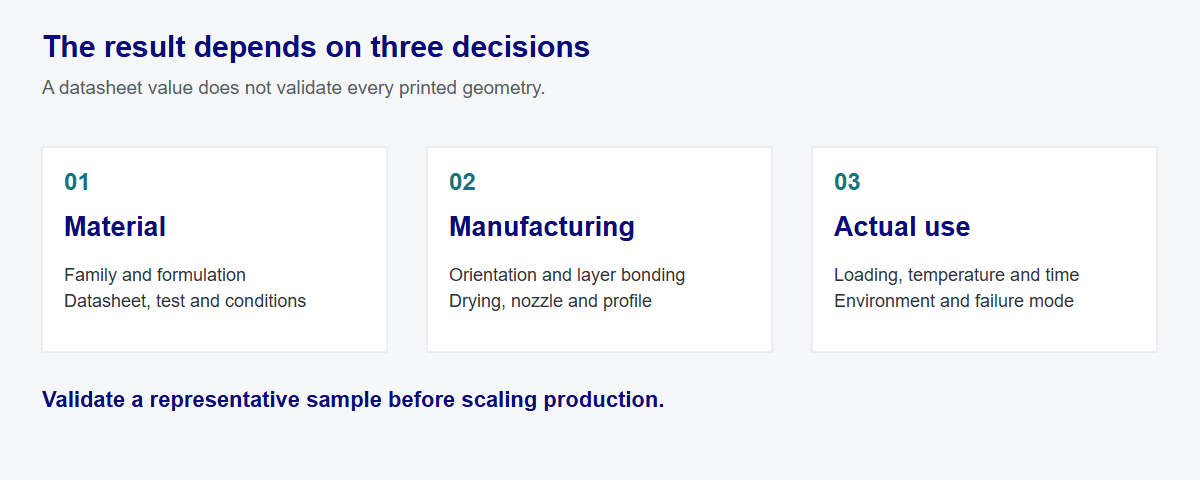
- Printability and service performance are different axes.
- Stiffness, impact, hardness and elasticity are not synonyms.
- The specific formulation matters more than a generic label.
- Printer and profile must be able to make the chosen geometry properly.
- An indicative recommendation ends with a sample and a check, not an automatic guarantee.
For advice, describe function, dimensions, loads, temperature and available equipment. Those details help us study an option or assess a manufacturing service far more usefully than simply asking for “the strongest plastic”.
Related Products
Leave a Comment