

- Stock: 33
- Model: 36HS1718

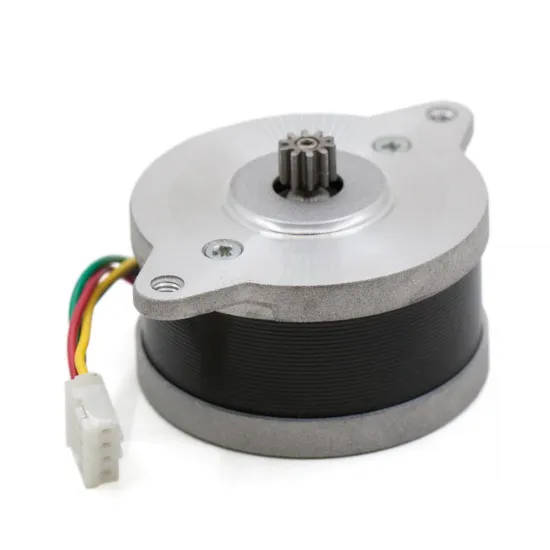
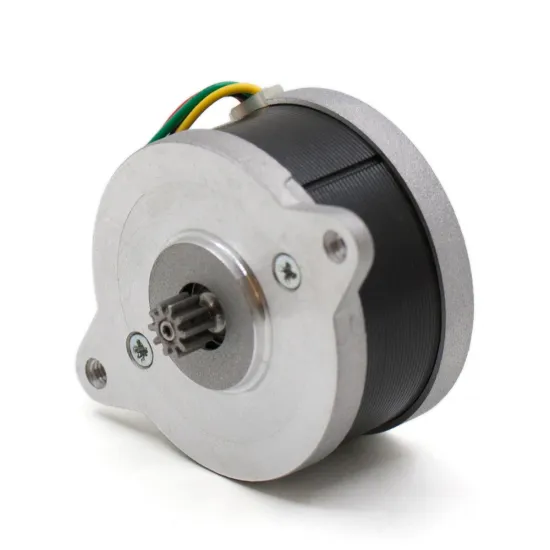
HTA3D NEMA 14 36HS1718 bipolar stepper motor with a compact round pancake body and an integrated 10-tooth straight pinion. It is intended for geared extruders whose gearing, mounting pattern and electrical requirements match this exact motor.
The pinion is part of the motor shaft and drives the mating extruder gear. It is not a GT2 pulley or a hobbed drive wheel that feeds filament directly.
Specifications
| Feature | Value |
|---|---|
| Brand and model | HTA3D 36HS1718 |
| Type | 2-phase, 4-wire bipolar stepper motor |
| Frame | Round pancake NEMA 14 |
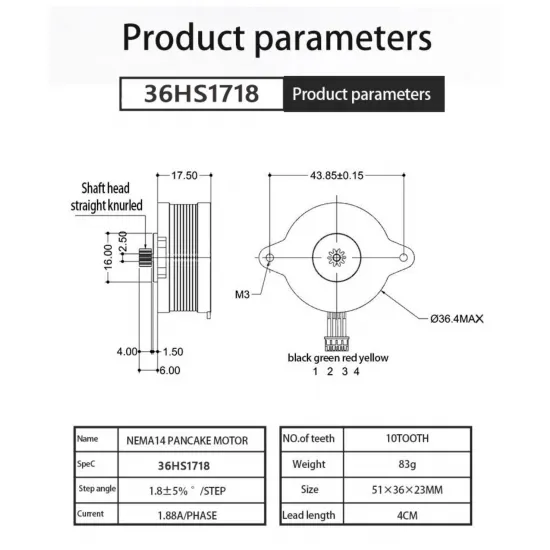
| Step angle | 1.8° ± 5% per step; nominally 200 full steps per revolution |
| Rated current | 1.88 A per phase |
| Pinion | 10 straight teeth, integrated into the shaft |
| Motor body | Ø36.4 mm maximum; stated axial body length 17.5 mm |
| Mounting | 2 M3 threaded holes on 43.85 ± 0.15 mm centres |
| Approximate overall size | 51 × 36 × 23 mm |
| Weight | 83 g |
| Shown wire order | 4 wires; positions 1 to 4: black, green, red and yellow |
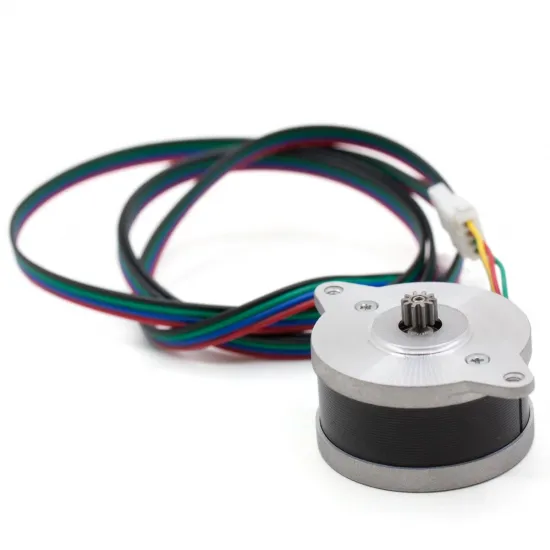
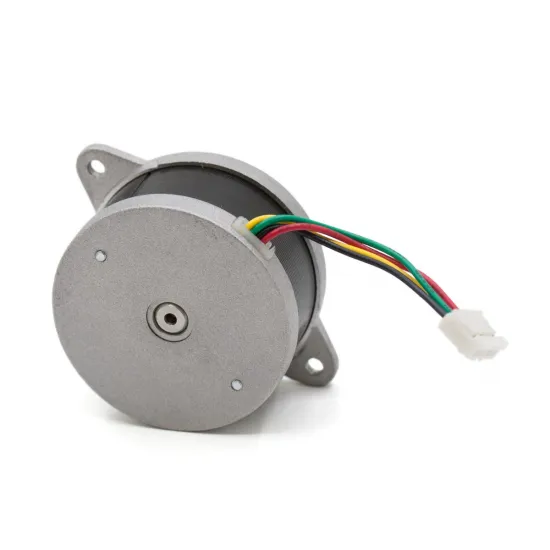
| Supplied cables | Approximately 4 cm motor lead and approximately 70 cm extension cable |
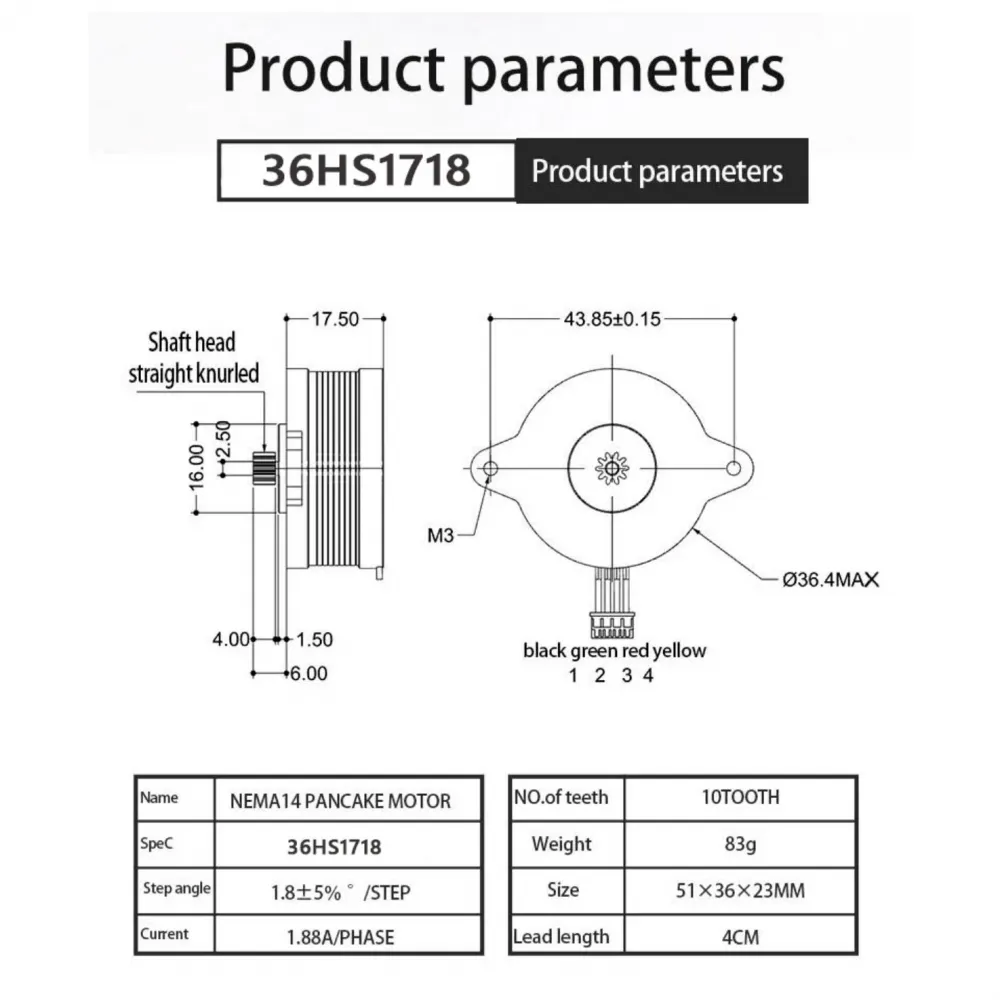
Check the extruder before replacing its motor
Another motor being NEMA 14 or having 10 teeth does not make it interchangeable. Verify all of the following before installation:
- Pinion tooth profile, module or pitch, width and axial position.
- The mating gear, shaft centre distance and extruder reduction ratio.
- The two M3 mounting holes on 43.85 mm centres and clearance for the round Ø36.4 mm body.
- Driver current capability and available cooling.
- Coil pairs, pin order and connector.
This model is not a direct replacement for a NEMA 17 motor either. The mounting dimensions, body, shaft, available torque and electrical characteristics are different.
Extruder configuration
There is no universal steps-per-millimetre or rotation_distance value for this motor. The result depends on the reduction ratio, the effective diameter of the filament drive wheel, microstepping and the extruder mechanics.
- Marlin: measure actual extrusion, correct the value with
M92 E...and useM500only when the configuration should be stored in EEPROM. - Klipper: use 200 full steps per revolution for the 1.8° motor and calibrate
rotation_distanceon the assembled extruder. - RepRapFirmware: configure the actual microstepping and adjust
M92 E...inconfig.gafter measuring extrusion.
1.88 A per phase is the motor rating, not a universal driver setting. Controllers may specify RMS or peak current and have different thermal limits. Start conservatively, check available torque and monitor both motor and driver temperature.
Installation and first test
- Switch off and unplug the machine completely before handling the motor.
- Identify both coil pairs with a multimeter and compare the pinout with the controller. Do not rely only on wire colours or connector shape.
- Check the mesh by hand: the pinion must turn without tight spots, excessive backlash or side load on the shaft.
- Use conservative current, speed and acceleration settings for the first test.
- Command a short extrusion, verify direction and calibrate the delivered length before printing.
- Check temperature during a progressive test and stop the machine if the motor skips, makes abnormal noise or the filament jams.
Never connect or disconnect the motor while its driver is powered: energy stored in the windings can produce voltage spikes that damage the controller.
Related accessory
The NEMA 14 aluminium motor heatsink is only a possible accessory when its contact surface, attachment method and available clearance fit this round body and the selected extruder.
Package contents
- 1 HTA3D NEMA 14 36HS1718 stepper motor with integrated 10-tooth pinion.
- 1 extension cable, approximately 70 cm long.