Menu
Your Cart

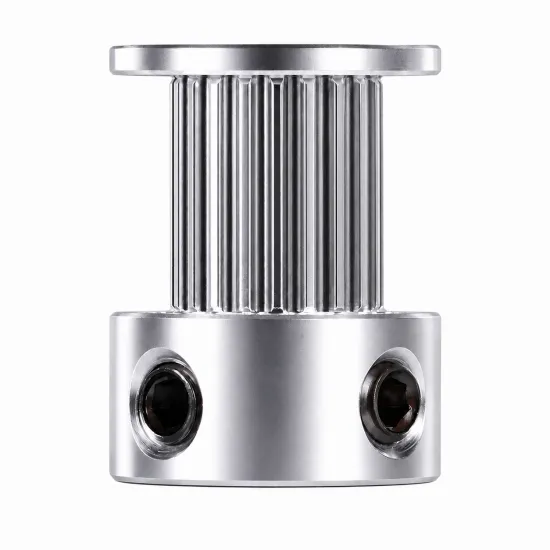
Mellow 1.5GT 21T Drive Pulley for 10 mm Belts · 5 mm Bore

Mellow 1.5GT 21T Drive Pulley for 10 mm Belts · 5 mm Bore
New
Mellow 1.5GT 21T Drive Pulley for 10 mm Belts · 5 mm Bore
4.95€
Ex Tax: 4.09€
  • Stock: 10
  • Model: MELLOW-15GT-21T-10-5

Mellow Pulley

1.5GT 21T Drive for 10 mm

1.5GT 21T Drive for 10 mm

1.5GT 21T Drive for 6 mm

1.5GT 21T Drive for 6 mm

1.5GT 27T Drive for 10 mm

1.5GT 27T Drive for 10 mm

1.5GT 27T Drive for 6 mm

1.5GT 27T Drive for 6 mm

1.5GT 27T Toothed Idler for 10 mm |5 mm

1.5GT 27T Toothed Idler for 10 mm |5 mm

1.5GT 27T Toothed Idler for 6 mm |5 mm

1.5GT 27T Toothed Idler for 6 mm |5 mm

GT2 20-Tooth Drive for 6 mm

GT2 20-Tooth Drive for 6 mm

GT2 20-Tooth Drive for 9/10 mm

GT2 20-Tooth Drive for 9/10 mm

Smooth Idler 10 mm | 5 mm

Smooth Idler 10 mm | 5 mm

Smooth Idler 6 mm | 5 mm
Smooth Idler 6 mm | 5 mm
Fast shipping from Spain
Delivery from 24 hours and free shipping available in mainland Spain.
Stock on hand
Shipped quickly from Spain, with a full VAT invoice.
Secure & flexible payment
Pay by card, PayPal or bank transfer.
Expert technical support
Over 10 years helping customers with components and compatibility.

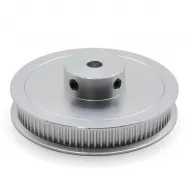
The Mellow 1.5GT 21T drive pulley for 10 mm belts transfers motor rotation to a synchronous belt with a 1.5 mm pitch. Its aluminium body and shaft-fixing hub make it suitable for a matched 1.5GT drive in a 3D printer, small CNC motion system or custom automation project.

This is a motor drive pulley, not an idler. It locks to the shaft using set screws and must turn with the motor. Use a belt and toothed mating components of the correct 1.5GT profile: a 2 mm-pitch GT2 / 2GT belt is not compatible with these teeth.

What does the finer 1.5GT profile offer?

The closer tooth spacing can help make belt engagement more regular in a well-designed drive. This is useful when refining motion quality and investigating small periodic surface marks associated with belt engagement. The interest is in the complete transmission: a finer pitch is not, by itself, a guarantee of better dimensional accuracy or finer motor-step resolution.

Mellow specifies CNC-machined aluminium for this family. A consistent tooth profile, concentric rotation and reliable shaft fixing matter because the belt needs repeatable engagement as the pulley rotates. Correct alignment and tension are equally important. A pulley cannot compensate for a slipping set screw, a damaged belt or an unsuitable motor configuration.

Changing the profile may help reduce belt-related excitation and artefacts, but does not universally eliminate VFA, ringing or every source of vibration. Any special RF treatment belongs to the selected belt, not to this aluminium pulley. The performance also depends on motors, guides, structure, speed and print settings.

Why choose 21 teeth?

The 21T format provides 31.5 mm of travel per motor revolution. Compared with 27T, it gives a shorter advance for each motor step and a smaller effective radius. This can suit a design seeking compact toothed geometry or greater tangential force for the same available motor torque; actual speed and acceleration depend on motor torque at the operating RPM, load and transmission losses. It is not automatically the better choice for every printer.

A 27T idler does not require a 27T motor pulley. Idlers guide the belt; the drive pulley determines the travel per motor revolution. Select the drive tooth count according to the machine design and firmware calculation.

Dimensions and belt selection

CharacteristicNominal value
FunctionMotor drive pulley
Tooth profile / pitch1.5GT / 1.5 mm
Teeth21
Belt width10 mm
Shaft bore5 mm
Body materialAluminium alloy
Shaft fixingHub with set screws
Direct belt travel per revolution31.5 mm
Overall height20 mm
Toothed track width11 mm
Flange outside diameter15 mm

The toothed outside diameter is not the pitch diameter: calculate belt travel from tooth count and belt pitch, not from a caliper measurement of the outside.

Conversion from a 16T 2GT drive

A 21T 1.5GT drive gives 31.5 mm per revolution, compared with 32 mm for a 16T 2GT drive. These values are close but not identical. This is an option for a complete profile conversion, not a drop-in pulley swap while retaining a GT2 belt.

  • Replace the belt and all pulleys that engage its toothed face with the appropriate 1.5GT components.
  • Check toothed clamps and anchors, belt width, shaft bore, flange clearance and the belt centreline.
  • Check overall mounting height and usable shaft length. A matching 5 mm bore alone does not confirm installation.
  • Keep smooth idlers only if their contact face, diameter and mounting remain suitable for the selected belt and its bending requirements.
  • Recalculate the motion scale for the actual motor pulley, configured microsteps and any mechanical reduction.

For a Voron 2.4, Trident or another CoreXY project, verify the specific conversion design and its shaft and belt layout. The printer name alone is not a compatibility guarantee. For belt direction changes, consider the Mellow 1.5GT 27T toothed idler for 9/10 mm belts, checking its mounting bore, height and spacers independently.

Mounting and alignment

  1. With the machine switched off, check that the pulley fits the correct shaft without forcing it.
  2. Align the toothed track with the rest of the belt path and leave clearance from the motor body or support.
  3. If the shaft has a flat, position one set screw against it. Tighten the fixing screws evenly with the correct tool; avoid excessive force.
  4. Check that the pulley is locked to the shaft, rotates without rubbing and does not wobble visibly.
  5. Tension the belt according to its manufacturer's recommendation, then test short, slow movements before normal operation.

The flanges help keep the belt within the track, but should not be used to correct persistent misalignment. Continuous rubbing against a flange is a reason to review the belt path. After initial use, check shaft fixing and belt tension again.

Firmware: calculate the actual motor drive

For direct belt drive, travel per revolution = drive teeth × belt pitch. Steps/mm = full motor steps per revolution × configured input microsteps / travel per revolution. Include the real mechanical ratio if there is a reduction. Driver interpolation to 256 microsteps is not the same as configuring 256 input microsteps.

Drive / beltmm / rev1.8° · ×160.9° · ×16
2GT · 16T32100200
1.5GT · 21T31.5101.587302203.174603
2GT · 20T4080160
1.5GT · 27T40.579.012346158.024691

The table assumes no reduction and ×16 input microsteps. A 1.8° motor has 200 full steps/revolution; a 0.9° motor has 400. The examples below apply specifically to 1.5GT 21T drives, 1.8° motors and ×16 microsteps on both XY drives. Do not change Z or the extruder when converting only XY.

Marlin

M92 X101.587302 Y101.587302

Apply only to the converted axes. After verifying motion, use M500 if EEPROM storage is enabled. Otherwise update the relevant entries in DEFAULT_AXIS_STEPS_PER_UNIT and recompile, preserving other axes. Existing EEPROM settings may override compiled defaults: check the effective configuration after restarting.

Klipper

Edit the active [stepper_x] and [stepper_y] sections without adding duplicates:

rotation_distance: 31.5

Keep microsteps and full_steps_per_rotation appropriate for the drivers and motors. This direct-drive example assumes no gear_ratio; account for the actual reduction if one exists. Save the active file and use RESTART.

RepRapFirmware

Update the existing XY M92 in sys/config.g, accounting for the configured microsteps. For the ×16 example:

M92 X101.587302 Y101.587302

Save the file and restart safely. Do not rely on M500 to preserve these steps/mm. If microstepping is configured with M350, place the calculated M92 after that setup. With external drivers, verify the actual hardware input microstep setting.

Checks after conversion

Back up the configuration before changing it. Check shaft fixing, free movement, belt alignment and endstops, then measure slow commanded moves. Use matched XY drives and coherent settings in a conventional CoreXY. Recheck homing, sensorless homing if used, belt tension and resonance compensation / Input Shaper after mechanical changes. Establish the scale from the drive geometry; do not use a printed cube to compensate for unrelated extrusion or material shrinkage errors.

Is it right for your project?

It is for you if your design uses a 21T 1.5GT motor drive, a compatible 10 mm belt and a suitable 5 mm shaft, with the mounting and firmware checked.

It is not for you if you need an idler, want to retain a GT2 / 2GT belt, need a different shaft bore or expect a single pulley to eliminate every printing defect.

Package contents

One Mellow 1.5GT 21T drive pulley for 10 mm belts. Belt, motor, idlers and assembly tools are not included.

Write a review

Note: HTML is not translated!
Bad Good
Captcha