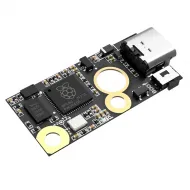


- Stock: 6
- Model: Eagle-MKS

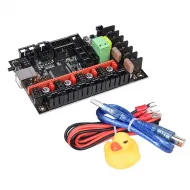
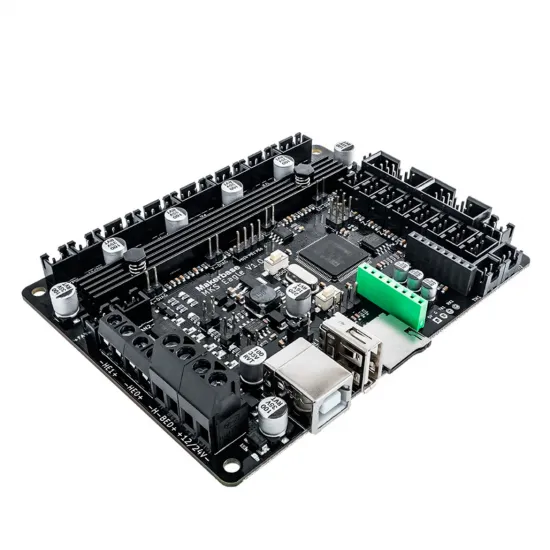
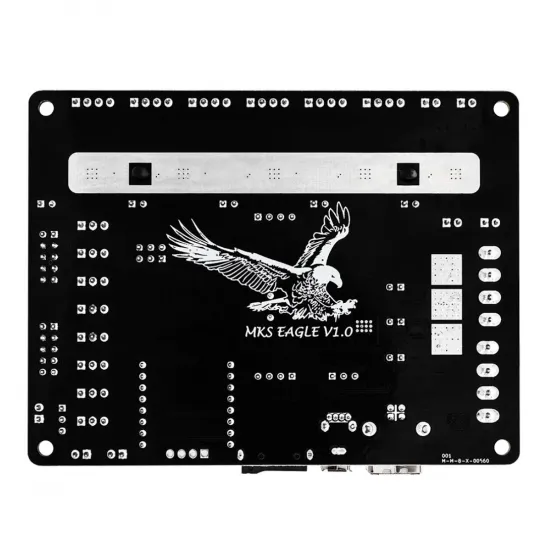
The Makerbase MKS Eagle V1.0 is a 32-bit controller board for 3D printers and custom machines with five on-board TMC2209 drivers connected through UART. It combines a 168 MHz STM32F407 microcontroller, expanded storage, dual-extruder connections and official support for Marlin 2 and Klipper.
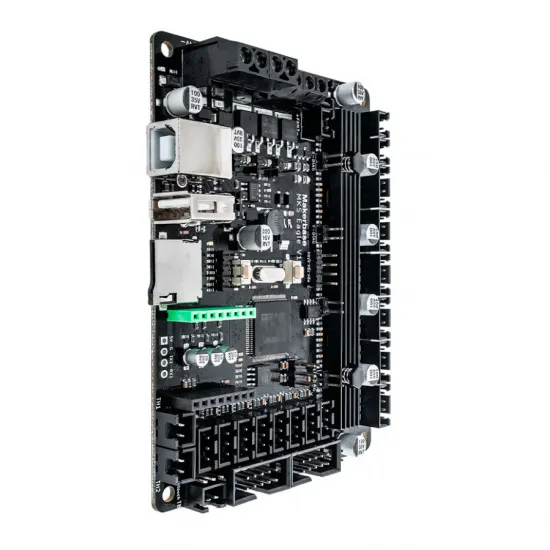
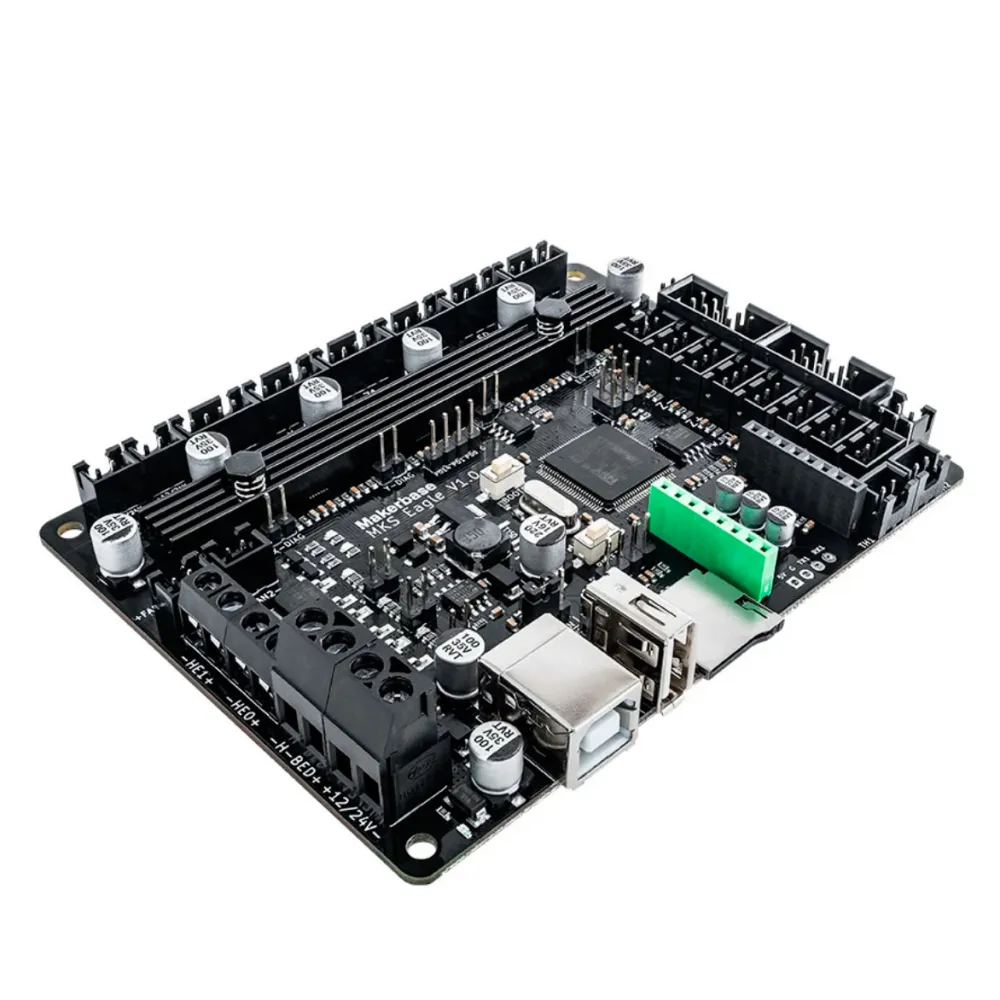
Its design is based on the MKS Robin Nano V3, but replaces removable StepStick sockets with soldered TMC2209 drivers and a common heatsink. This simplifies wiring and assembly, but the drivers are not replaceable and the electronics still require properly planned airflow.
Main features
- STM32F407VET6: 168 MHz ARM Cortex-M4 core with FPU.
- Five integrated TMC2209 drivers: UART control for X, Y, Z, E0 and E1.
- Six motor connectors: X, Y, Z1, Z2, E0 and E1; Z1 and Z2 share one driver.
- 12 or 24 V DC input.
- Four-layer PCB and common heatsink for improved thermal distribution and interference resistance.
- Three heater outputs: heated bed, hotend 1 and hotend 2.
- Three temperature inputs: bed, TH1 and TH2.
- Two PWM fan outputs and an auxiliary PWM/TTL output.
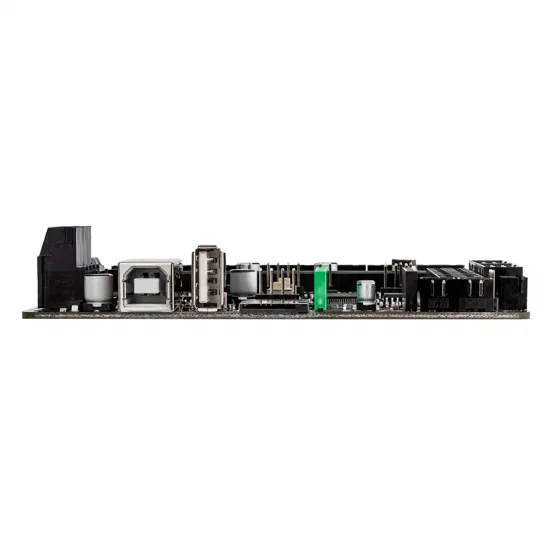
- microSD, USB device and USB host for a USB drive with compatible firmware.
- EXP1/EXP2, BLTouch/3DTouch, filament sensors, WiFi, USART3, SWD and DFU.
Technical specifications
| Feature | Value |
|---|---|
| Manufacturer and model | Makerbase MKS Eagle V1.0 |
| Microcontroller | STM32F407VET6, 168 MHz Cortex-M4 with FPU |
| Memory | 512 KB Flash and 192 KB RAM |
| Additional storage | 4 KB AT24C32D EEPROM and 8 MB SPI Flash |
| Input voltage | 12/24 V DC |
| Drivers | 5 × integrated TMC2209 in UART mode |
| Motors | 5 channels and 6 connectors: X, Y, shared Z1/Z2, E0 and E1 |
| Heaters | Heated bed, HE0 and HE1 |
| Temperature inputs | TB, TH1 and TH2 |
| Fans | 2 PWM outputs |
| Storage | microSD/TF over SPI3 and USB drive with compatible firmware |
| Communication | USB, USART3 and MKS Robin WiFi socket |
| Displays | MKS TS35, MKS MINI12864 V3, MKS H43, LCD12864 and LCD2004 according to Makerbase |
| Declared protection | Power-input TVS and reverse-polarity protection |
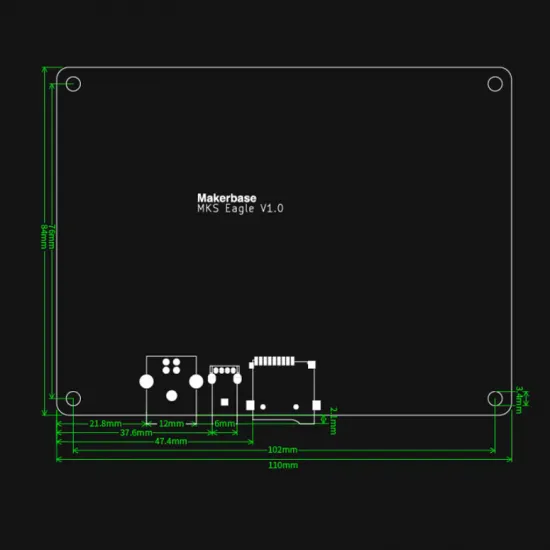
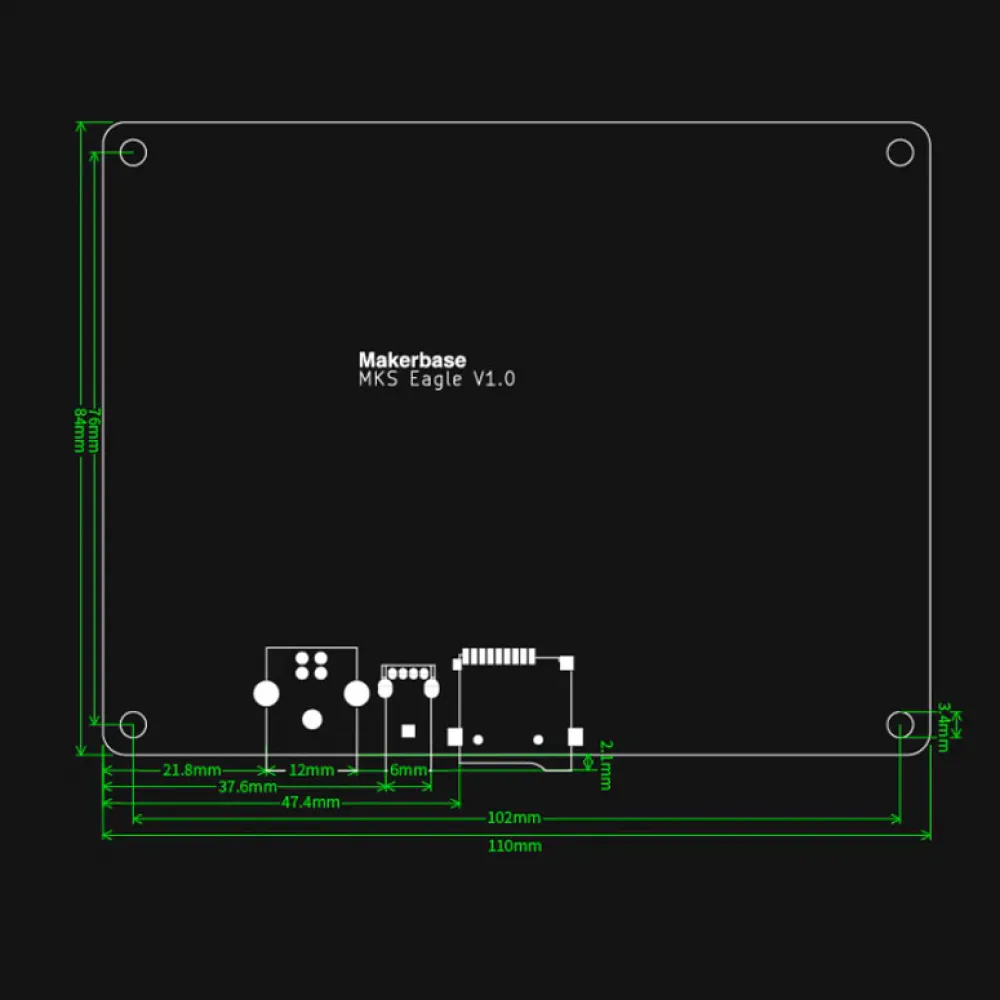
| Dimensions | 110 × 84 mm; 102 × 76 mm mounting centres |
| Documented firmware | Marlin 2 and Klipper |
Available connections
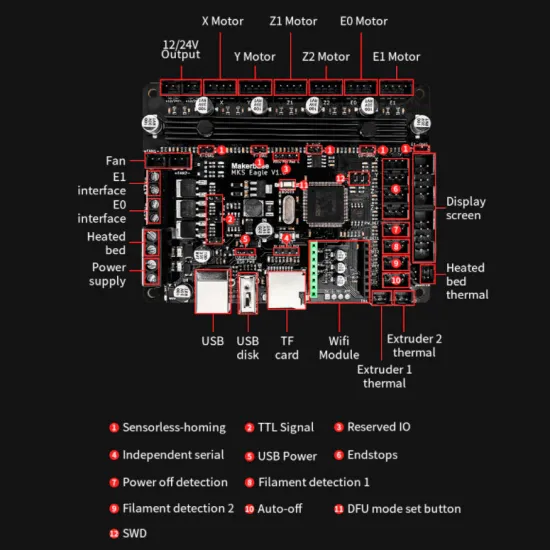
- Endstop inputs and DIAG routing for sensorless homing.
- Dedicated BLTouch or 3DTouch connector, subject to correct pinout and firmware.
- Two filament runout sensor inputs.
- Power-loss detection and automatic power-off output.
- Three reserved IO pins: PD14, PD1 and PD0.
- Independent USART3 serial port.
- SWD and BOOT0 interfaces for programming and recovery.
- EXP1/EXP2 display headers and a dedicated MKS Robin WiFi socket.
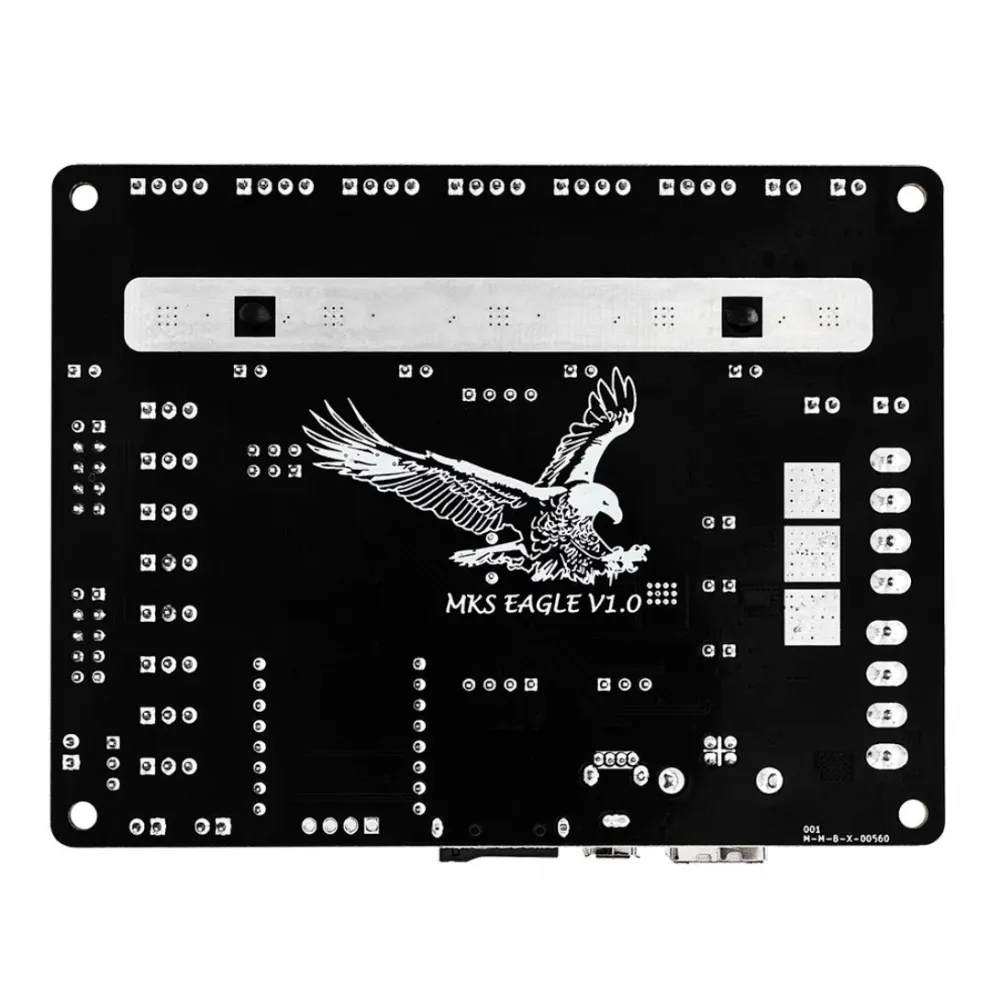
Integrated TMC2209 drivers and cooling
All five TMC2209 drivers can be configured by the firmware through UART. Current, microsteps, interpolation and operating modes can therefore be adjusted without potentiometers. Their DIAG outputs also support sensorless homing when the relevant jumpers are fitted and the firmware is correctly calibrated.
The drivers are soldered to the board and share a long heatsink. They cannot be replaced with other models, and driver failure requires board-level electronic repair. Makerbase does not provide a universal maximum-current rating for this complete assembly, so start with conservative current settings and validate them against the motor, load, temperature and airflow.
Compatibility
The MKS Eagle is intended for custom 3D printers and controller replacements where the mounting, wiring, connectors, display and firmware can be adapted. It is not a plug-and-play upgrade for an Ender, Prusa, Anycubic, Artillery, Voron or another machine merely because that printer uses NEMA 17 motors or a 24 V supply.
Makerbase documents the MKS MINI12864 V3 display for this board. EXP1/EXP2 can also support other displays listed by the manufacturer, but revision, electrical pinout and firmware configuration must be checked. Matching connectors alone do not prove compatibility.
The board includes a socket for the MKS Robin WiFi module, sold separately. Do not confuse it with the MKS TFT WiFi module or assume that it provides Klipper networking: Klipper normally communicates with its host computer through USB or USART3.
This product is for you if
- You need a compact controller with five integrated UART TMC2209 drivers.
- Your machine uses up to two extruders and two Z motors that may share one driver.
- You are prepared to build and configure Marlin or Klipper for the actual mechanics and wiring.
- You can adapt the enclosure, connectors, airflow and power distribution.
- You require microSD, USB host, compatible MKS displays or auxiliary inputs such as filament sensing and automatic power-off.
This product is not for you if
- You need replaceable drivers or want to use a driver model other than the integrated TMC2209.
- Your machine requires two independently controlled and levelled Z motors.
- You need a replacement that works without checking pinout, connectors, firmware and mechanical mounting.
- You require more than five independent motor channels.
- Your project specifically depends on RepRapFirmware or another integration not documented for this board.
Marlin configuration
Current Marlin sources include the BOARD_MKS_EAGLE definition. A basic selection is:
#define SERIAL_PORT -1
#define MOTHERBOARD BOARD_MKS_EAGLE

#define X_DRIVER_TYPE  TMC2209
#define Y_DRIVER_TYPE  TMC2209
#define Z_DRIVER_TYPE  TMC2209
#define E0_DRIVER_TYPE TMC2209
// #define E1_DRIVER_TYPE TMC2209  // enable only when E1 is used
Makerbase uses the mks_eagle_usb_flash_drive build environment when USB-drive support is enabled. Its MKS TS35 LVGL interface additionally uses MKS_TS35_V2_0, TFT_LVGL_UI and TOUCH_SCREEN. Do not enable these options for a different display.
The resulting file must be named mks_eagle.bin. Copy it to a compatible microSD card and restart the board to update. Motor steps, direction, limits, thermistors, thermal protection, PID, fans and probes must be configured for the actual machine before commanding any motion or heating.
Klipper configuration
Makerbase publishes a dedicated MKS Eagle configuration. For USB communication, build Klipper using:
- STM32F407 microcontroller.
- 48 KiB bootloader.
- USB on PA11/PA12 communication.
The normal make flash method does not directly update this board. After building, rename out/klipper.bin to mks_eagle.bin, copy it to microSD with the board powered down, insert the card and power up again.
The official configuration assigns the TMC2209 UART pins as follows:
| Channel | UART pin | Motor connector |
|---|---|---|
| X | PD5 | X |
| Y | PD7 | Y |
| Z | PD4 | Shared Z1 and Z2 |
| E0 | PD9 | E0 |
| E1 | PD8 | E1 |
Makerbase's generic file contains example current, rotation_distance, sensor, PID, limit and speed values. Do not copy them without adaptation: they describe a reference machine, not the MKS Eagle itself. Also obtain the board's actual USB identifier from /dev/serial/by-id/.
A USART3 build on PB11/PB10 at 250000 baud is also documented for systems that require a serial connection instead of USB.
Sensorless homing
The DIAG jumpers route each TMC2209 diagnostic signal to the relevant input. To use sensorless homing, install only the jumpers for the selected axes and configure sensitivity, current, speed and mechanics in the firmware.
Do not copy a sensitivity value from another printer. An incorrect value may cause false triggers or allow the axis to strike the end of travel. A physical probe or endstop is usually preferable on Z, particularly where a collision could damage the build plate or nozzle.
Installation and first start-up
- Work with both the power supply and USB disconnected.
- Confirm a 12 or 24 V DC supply, verify polarity and use suitable wire and terminals for the load.
- Fit the board on insulated standoffs and provide airflow across the heatsink.
- Check every motor, thermistor, heater, fan, endstop and probe against the official pinout.
- Never connect or disconnect motors, heaters or jumpers while the board is powered.
- Build firmware specifically for MKS Eagle; do not install a binary intended for Robin Nano V3 or another board.
- On the first start, verify communication and room-temperature sensor readings before anything else.
- Then test endstops and short motor movements at conservative current with heaters disconnected.
- Test each heater, its sensor and thermal protection separately.
- Monitor board, heatsink, connector and cable temperatures during the first prints.
Package contents
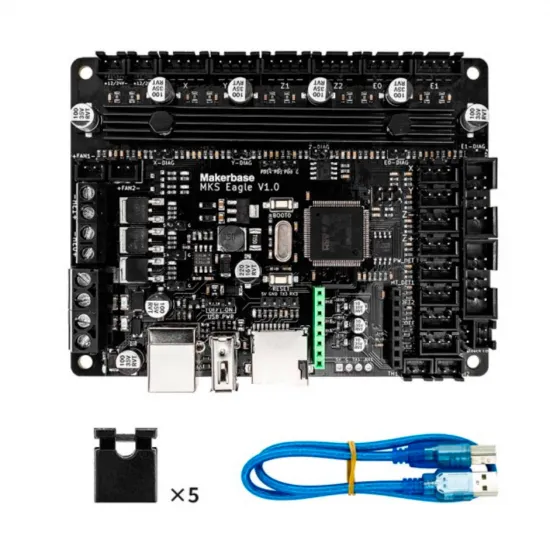
- 1 Makerbase MKS Eagle V1.0 board.
- 1 USB cable.
- 5 jumpers for the pictured DIAG connections.
Display, WiFi module, microSD card, power supply and other accessories are sold separately.
Technical documentation
See the official MKS Eagle hardware repository, including schematic, pinout and dimensions, and the Klipper configuration published by Makerbase.