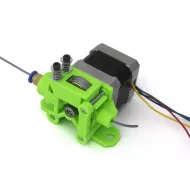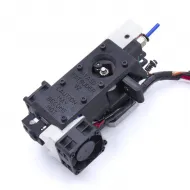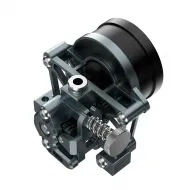
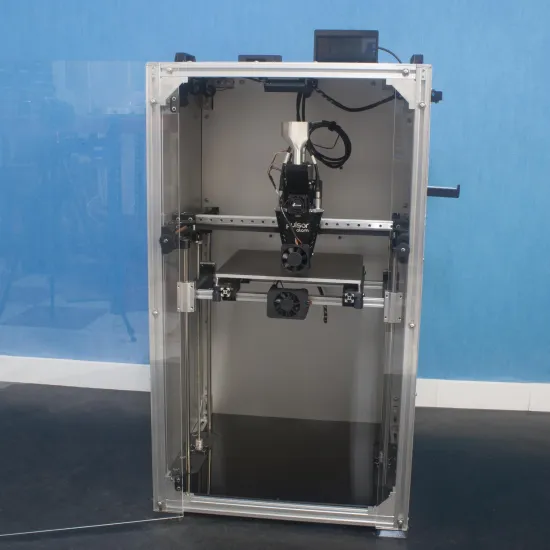


- Stock: 999
- Model: Pulsar Atom

Get a Quote with No Obligation
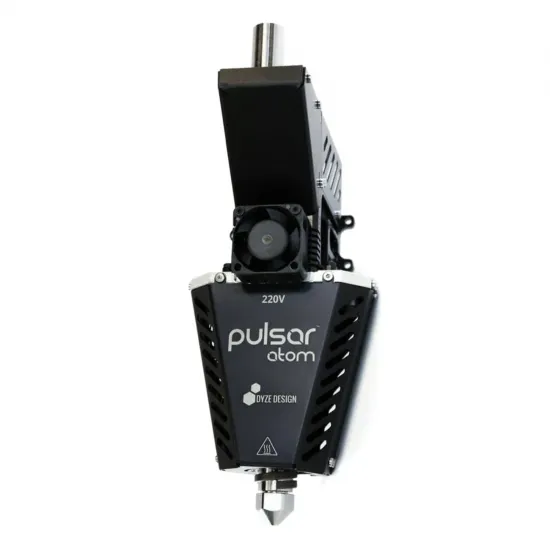
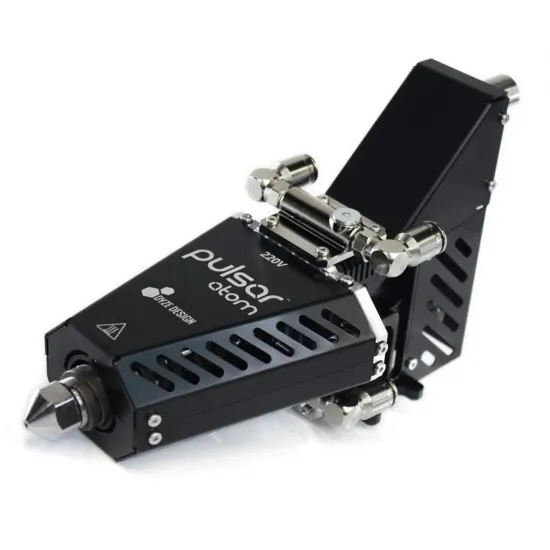
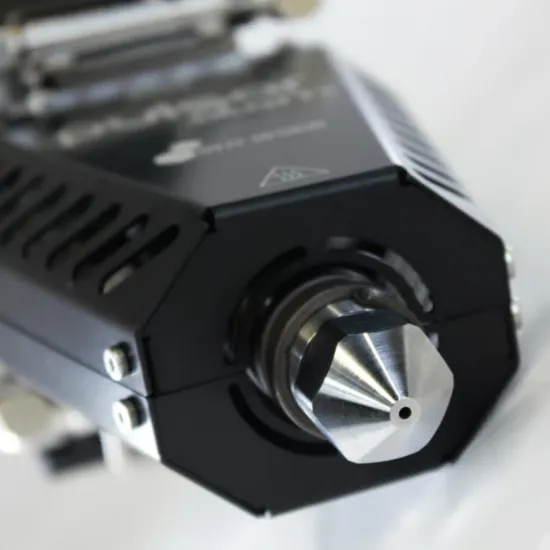
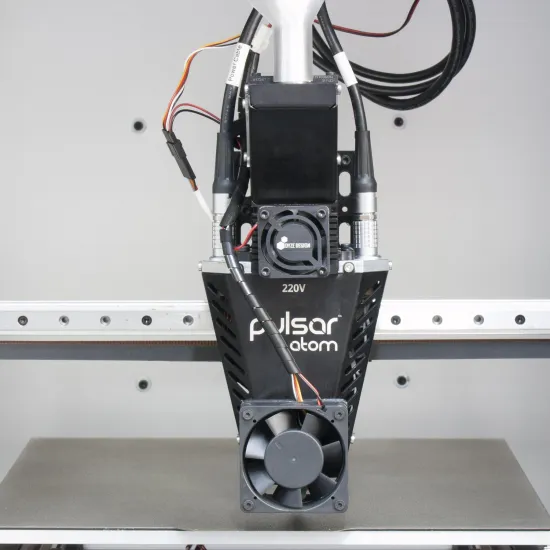
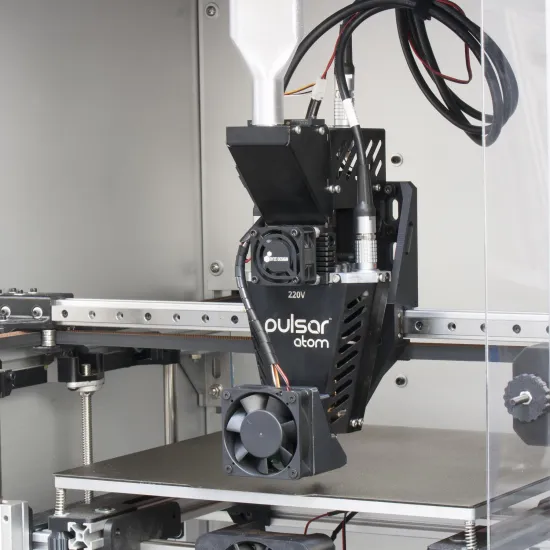
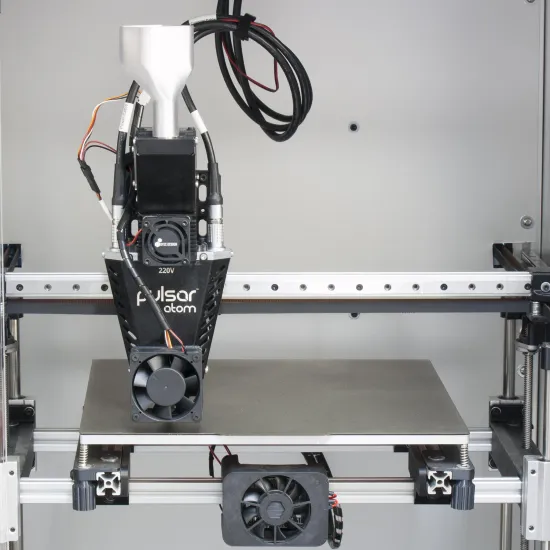
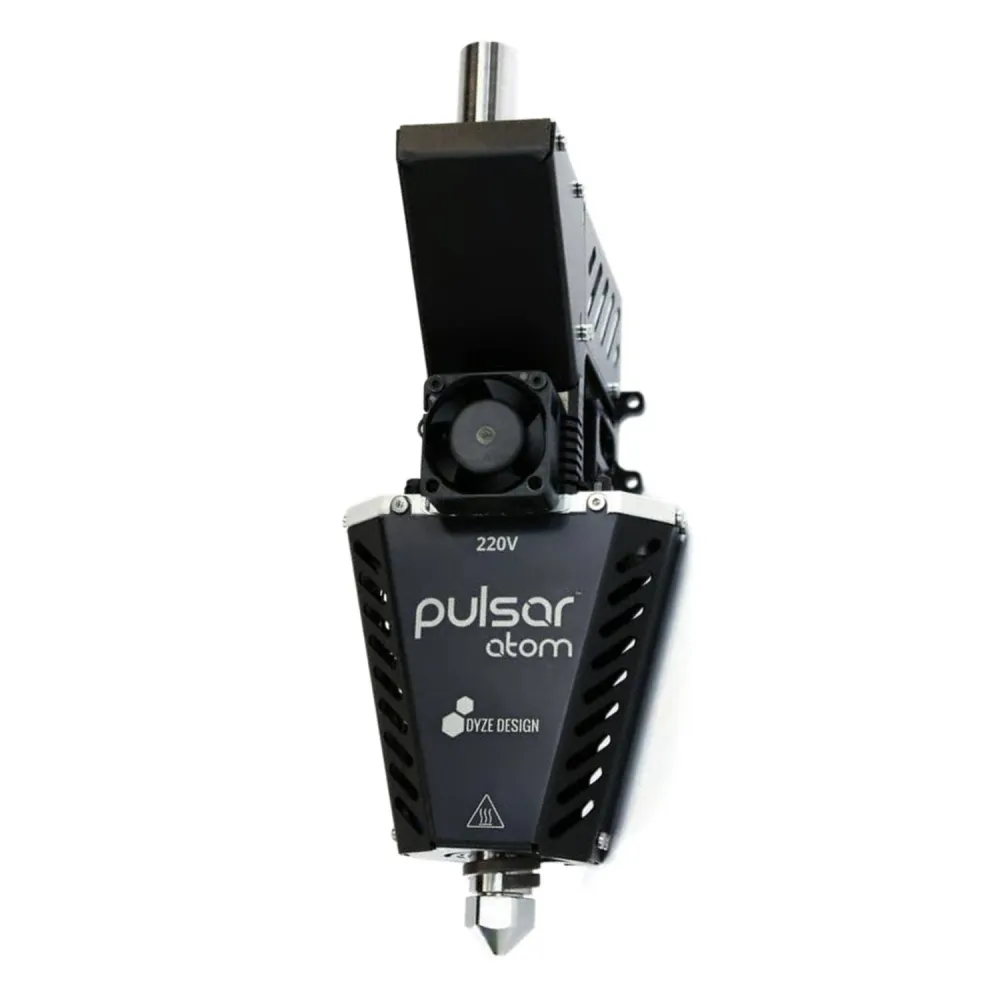
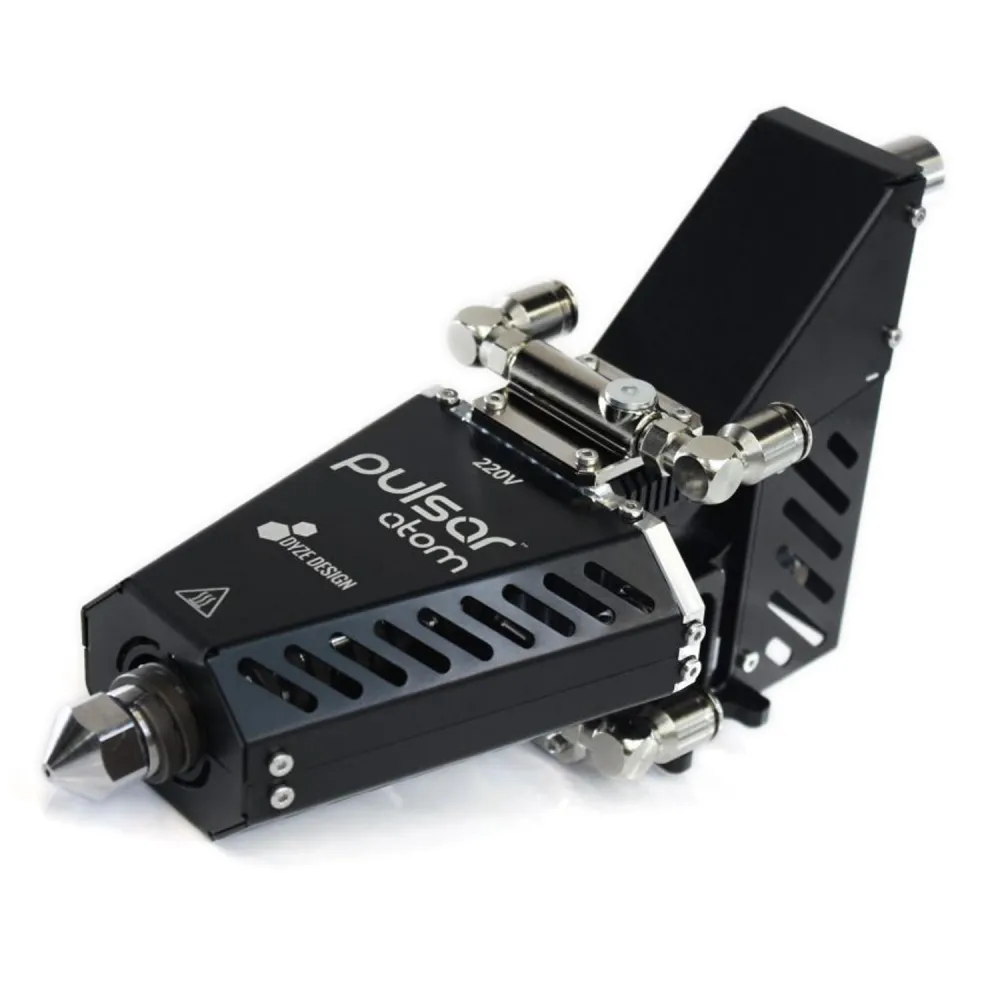
The Dyze Design Pulsar Atom is a precision pellet extruder for developing industrial 3D printers, large-format machines and robotic cells. It combines a compact screw system with two independently controlled heating zones, 0.4 to 2.5 mm nozzles and an operating temperature of up to 450 °C.
Its purpose goes beyond printing faster: direct pellet processing can reduce raw-material cost, support custom formulations and process selected filled compounds. This is an industrial integration component, not a conventional plug-and-play hotend; its mechanical, electrical, thermal and safety systems must be engineered for the actual machine.
Main specifications
| System | Direct screw-fed pellet extrusion |
|---|---|
| Overall envelope | 112 × 146 × 252 mm |
| Weight | 1500 g |
| Maximum operating temperature | 450 °C |
| Heating | Two independent AC zones: 250 W upper and 150 W lower; 400 W total |
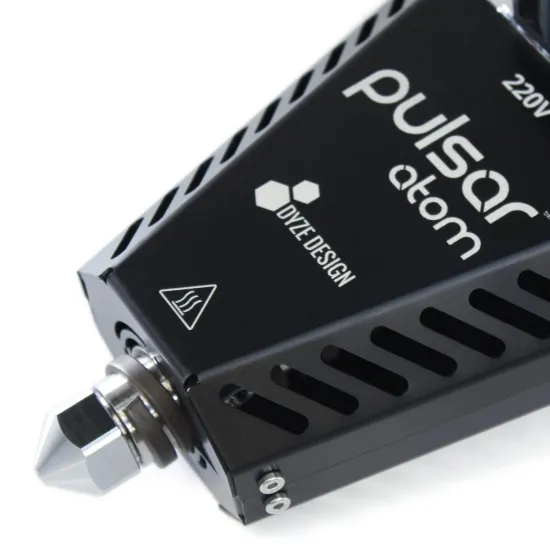
| Electrical version | 220 V AC on the pictured unit; always check the marking on the actual unit |
| Temperature sensors | 2 × PT100, one per heated zone |
| Motor | NEMA 17, 1.68 A RMS per phase; 24–48 V DC driver supply |
| Drive train | 6.23:1 reduction; 135 mm screw, up to 150 rpm |
| Standard screw | MC minimal-compression screw, 1.5:1, unless ordered otherwise |
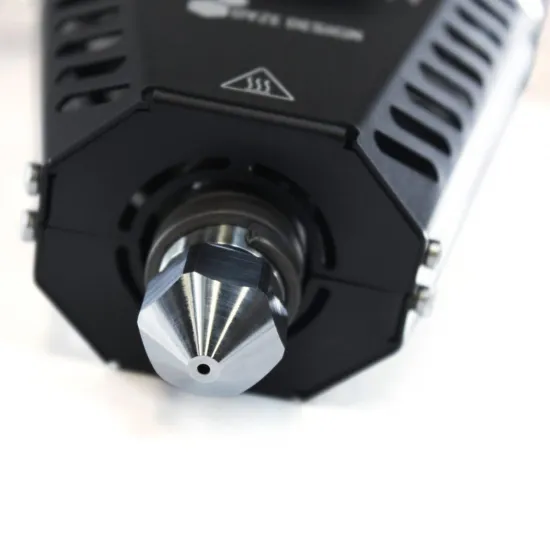
| Available nozzle sizes | 0.40, 0.60, 0.90, 1.20, 1.80 and 2.50 mm |
| Recommended pellet size | Up to 5 mm across the largest dimension |
| Documented maximum throughput | Up to 1.1 kg/h with LX175 PLA, 2.5 mm nozzle and 180/210 °C; not a universal value |
| Mounting | Four M4 clearance holes on a 60 × 30 mm pattern |
Precision and throughput in real use
Dyze Design documents a maximum of 1.1 kg/h with LX175 PLA, an MC screw, a 2.5 mm nozzle and upper/lower temperatures of 180/210 °C. Its production guide also records 234 mm³/s under those conditions and recommends normally operating at about 80% of a validated maximum.
Actual throughput changes with resin, pellet geometry and moisture, screw, nozzle, temperature and tool orientation. The same manufacturer records 155 mm³/s for Ingeo 3D850 in a different test. Maximum figures are therefore useful for sizing a project, but do not replace calibration for each material.
Pellet and material compatibility
The size requirement applies to the longest straight-line dimension of each pellet. Pellets below 5 mm are recommended; 5.0–5.2 mm pellets may produce unstable feeding, while pellets above 5.2 mm may fail to enter the screw. The largest grains in a blend must be checked, not only its average size.
Dyze Design has processed material families including PLA and rPLA, PETG, rPETG and rPET, TPU and PEBA, ASA, PCTG, PA6-GF and PC-GF. This demonstrates process capability but does not make every grade of those polymers compatible. Pellet shape, bulk density, viscosity, moisture, fillers, additives and size distribution can require a different screw or prevent stable feeding.
- Review the technical and safety data sheets for the exact resin.
- Dry the material according to its pellet manufacturer's instructions.
- Keep dust, contamination and uncontrolled size blends out of the feed.
- Start conservatively and recalibrate after changing material, batch, nozzle or temperature.
- Do not leave potentially corrosive or degrading material in the barrel during extended stops.
Screws and nozzles
The usual configuration uses the 1.5:1 MC minimal-compression screw. Dyze Design also offers 2.2:1 LC, 2.5:1 generic G, 3.5:1 HC and a 1.5:1 MP screw for micropellets below 3 mm. Selection depends on polymer, viscosity, fillers and pellet geometry rather than only the material family name.
Nozzles from 0.4 to 2.5 mm allow the process to favour detail or productivity. As official starting points, a 1.2 mm nozzle is paired with about 1.8 mm line width and 0.6 mm layer height; a 2.5 mm nozzle with 3.75 mm and 1.25 mm respectively. They are initial values: changing the width-to-height ratio changes pressure, finish and printing behaviour.
Electrical and thermal integration requirements
The two heating zones operate independently, each requiring its own PT100, measurement circuit and power stage. The AC heaters total 400 W and need two suitable SSRs. Current documentation specifies zero-crossing relays and slow switching, normally 2–3 Hz.
- Stepper driver rated for 1.68 A RMS per phase with a 24–48 V DC supply.
- Two conditioned PT100/RTD inputs.
- Two control outputs, two zero-crossing SSRs and overcurrent protection.
- 24 V DC for the product-cooling fan and pellet sensor.
- Protective earth, wiring, connectors and cabinet sized for the installation.
- A physical emergency stop that cuts heater power and the motor supply.
The 110 V and 220 V versions must not be confused. Check the permanent marking on the actual extruder before designing, wiring or replacing components. Connecting it to a printer controller does not remove the need for PT100 interfaces, SSRs, protections or a suitable motor driver.
Air or liquid cooling
The standard air-cooled Pulsar Atom is documented for ambient temperatures up to 60 °C. Operation in environments up to 150 °C requires the liquid-cooled configuration and high-temperature pellet sensor, tubing and harnesses. Adding a water loop alone does not automatically convert every standard unit.
Part cooling is a separate add-on. It is useful for polymers or geometries that must solidify before the next layer; without it, small parts may require lower speed. The manufacturer states that this add-on must not be used in the high-temperature ambient configuration.
Pellet feeding
The extruder can be supplied automatically, by gravity or from an on-tool hopper. Automatic feeding supports a remote hopper, long autonomy and lower moving mass, but adds controls and may require compressed air. Gravity is simple but needs a carefully routed tube. An on-tool hopper simplifies the system while adding gantry weight and limiting inclination.
The integrated capacitive sensor supports automatic feeding and can work as a pellet-runout detector in gravity-fed systems. Its sensitivity may need adjustment when the resin changes.
Mounting, motion and calibration
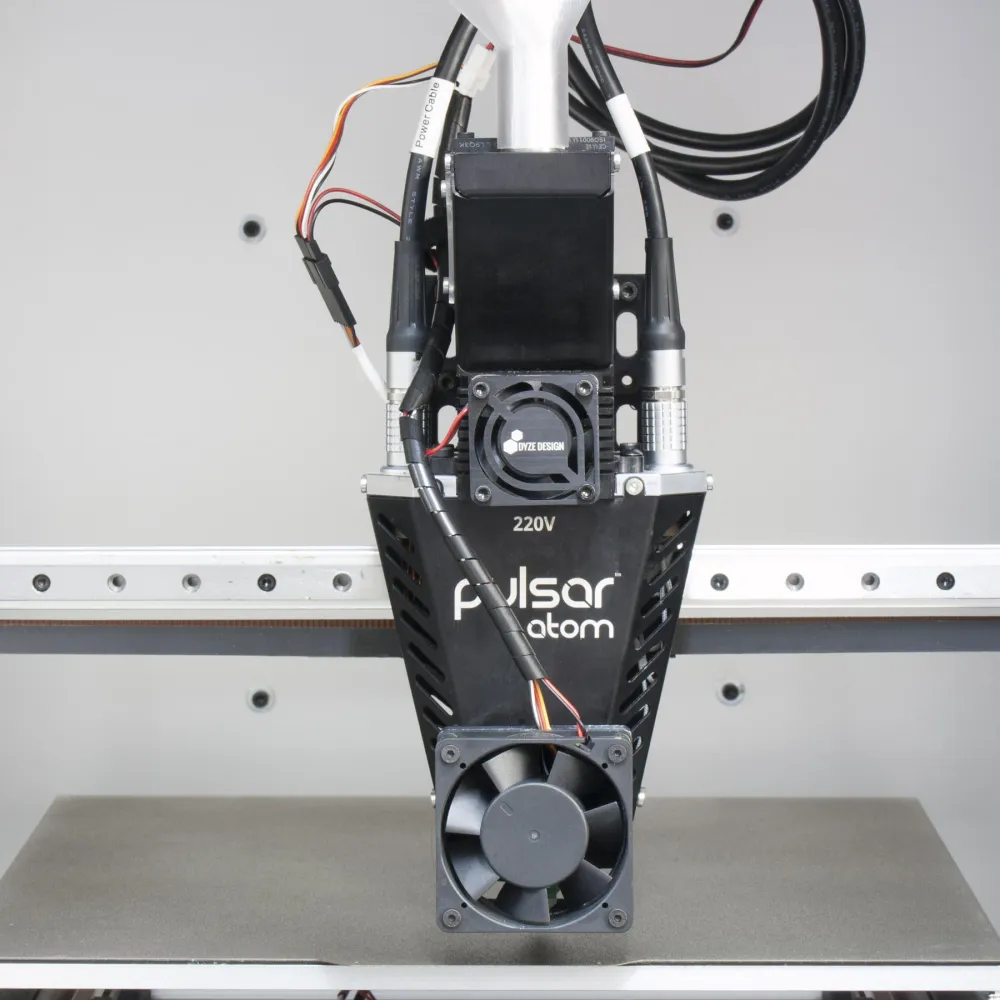
The unit mounts from the front through four M4 holes on a 60 × 30 mm pattern. Its 1.5 kg mass, 252 mm height and pellet feed must be included when sizing the carriage, guides, acceleration and usable build volume. The head becomes longer as it heats: the guide gives approximately 0.40 mm at 200 °C, 0.62 mm at 300 °C and 0.84 mm at 400 °C compared with a cold setting.
The slicer should use Z lift on travel moves of at least one layer height and a wipe distance equal to or greater than the line width. Thick beads and local over-extrusion can otherwise cause tool collisions. Gravity also changes output when the tool is inclined, so non-planar or robotic printing needs separate testing.
Firmware configuration
The manufacturer publishes starting configurations for Marlin, RepRapFirmware and Klipper. Every integration must define two heaters and two PT100 sensors, drive the SSRs correctly, configure the motor and tune each zone separately. Pins and sensor types depend on the controller and amplifier in use.
Marlin
The guide models the two zones as two extruders and uses 1000 steps/mm as a starting point. PT100 sensor numbers 68, 20, 21 or another value depend on the measurement circuit; copying one without identifying the amplifier can produce an incorrect temperature reading. Tune each heater separately with M303 and store the result with M500 when EEPROM support is enabled.
Klipper
The lower zone is defined in [extruder] and the upper zone in [heater_generic top_heater]. Dyze's initial values are rotation_distance: 24.92, gear_ratio: 6.23:1, 200 full steps per rotation, a virtual filament diameter of 2.85 mm and pressure_advance: 0.0. These begin calibration; they are not a finished machine profile.
PID_CALIBRATE HEATER=extruder TARGET=240
SAVE_CONFIG

# After the machine has cooled:
PID_CALIBRATE HEATER=top_heater TARGET=240
SAVE_CONFIG
The target must be suitable for the material and installation. Start and end macros must command, wait for and switch off both zones; conventional single-hotend G-code is insufficient.
RepRapFirmware
Official documentation provides a natural two-RTD, two-heater integration, assigning both heaters to one tool. Tune each zone separately with M303 and retain the resulting M307 parameters in config.g. Its examples are based on Duet 2 and RepRapFirmware 3.x; buses, pins and heater numbers differ on other boards and revisions.
Commissioning and maintenance
- With an empty barrel, confirm that product cooling is operating.
- Command slow extrusion and verify counter-clockwise screw rotation when viewed from the pellet inlet.
- Test each zone at 50–75 °C and confirm that the matching PT100 responds.
- Run the official heater dehumidifying procedure before first use.
- Tune each heater separately and calibrate flow with the actual material.
Avoid leaving hot polymer idle in the barrel, keep retraction below half a screw revolution, and purge between materials or before downtime. The gears are supplied with NLGI 2 silicone grease and need periodic inspection. For nozzle replacement, Dyze specifies clean conical sealing surfaces and 14 Nm installation torque while below 50 °C, never exceeding 15 Nm.
This is for you if…
- You are developing an industrial printer, a custom HPRO or a robotic pellet-extrusion cell.
- You need precision, technical materials and much higher output than a conventional filament hotend.
- You can engineer and validate mounting, pellet feeding, power electronics, firmware and safety.
This is not for you if…
- You need a hotend that plugs directly into a desktop printer without modification.
- You do not have independent control for two heaters and two PT100 sensors or a suitable emergency stop.
- You expect to process any pellet without characterising its size, moisture, screw and process parameters.
A complete HTA3D integration
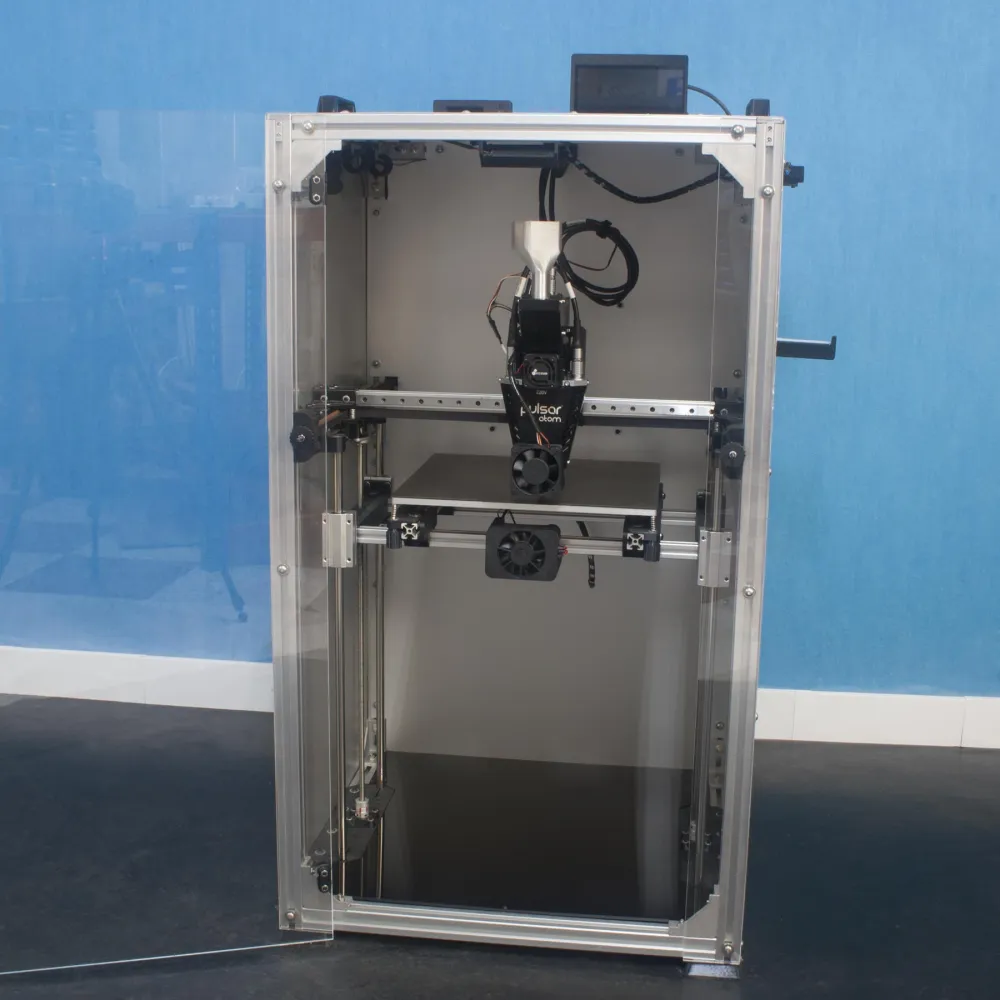
HTA3D has integrated the Pulsar Atom into HPRO pellet machines. If you need a complete system rather than an extruder component, see the HPRO-Custom for pellet extrusion, high-temperature processing or a made-to-measure build volume. Each project is sized around the resin, throughput, temperature, part size and production environment.
Documented base contents: one Pulsar Atom extruder and mounting hardware with four low-profile M4 × 10 screws. Motor driver, SSRs, PT100 amplifiers, harnesses, automatic feeding and cooling add-ons must be confirmed in the quotation.
Safety: integration and maintenance must be performed by qualified personnel. Isolate every power source before servicing, let the assembly cool and keep thermal protections enabled. Consult the official Pulsar Atom technical documentation for the wiring diagram, commissioning process, risk information and procedures applicable to the installed revision.