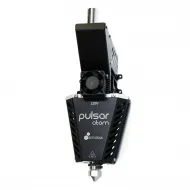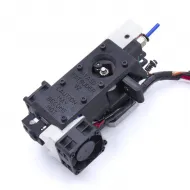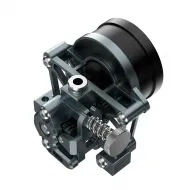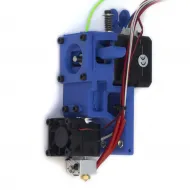


- Stock: 3
- Model: Sherpa-V1.5

Model:

Sherpa V1.5

CNC Metal Sherpa V1.5
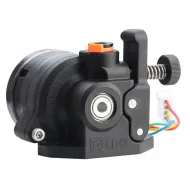
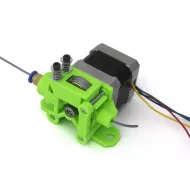
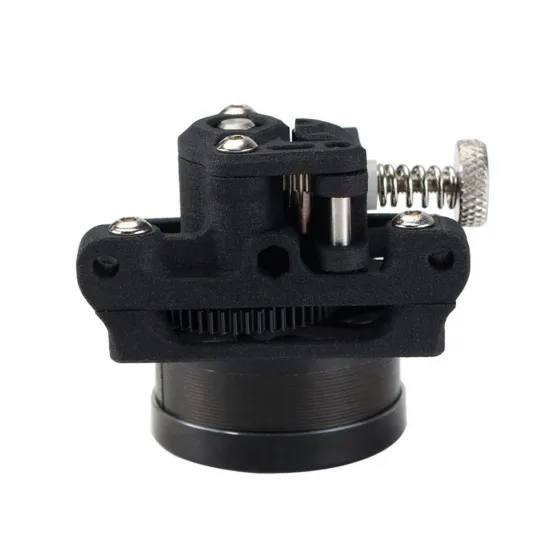
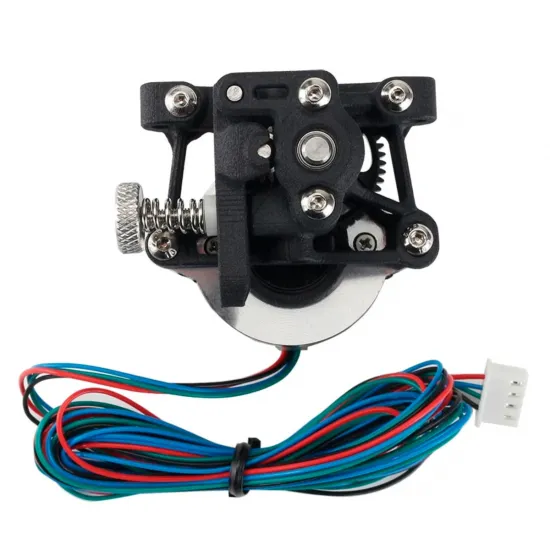
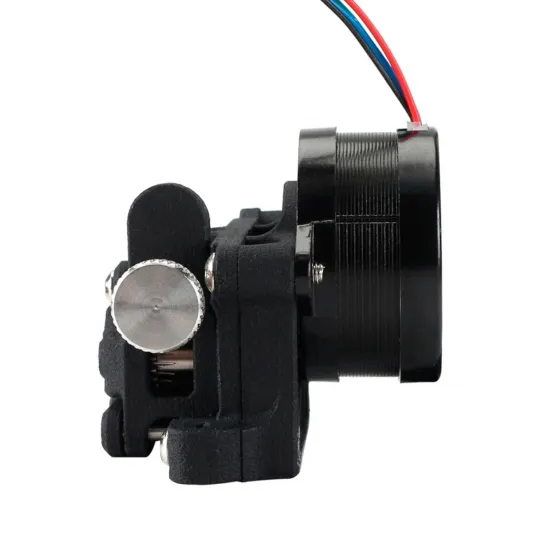
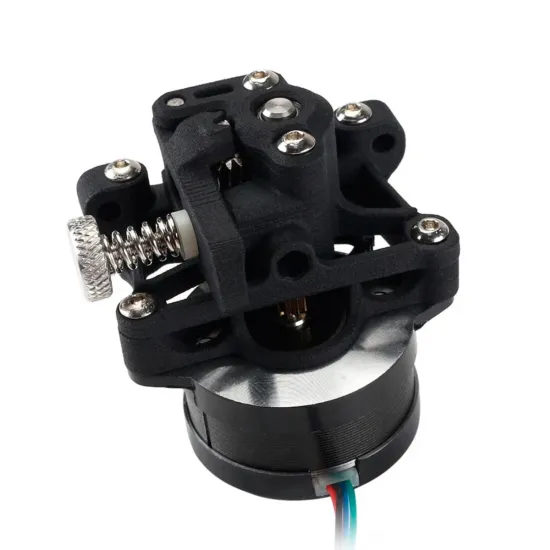
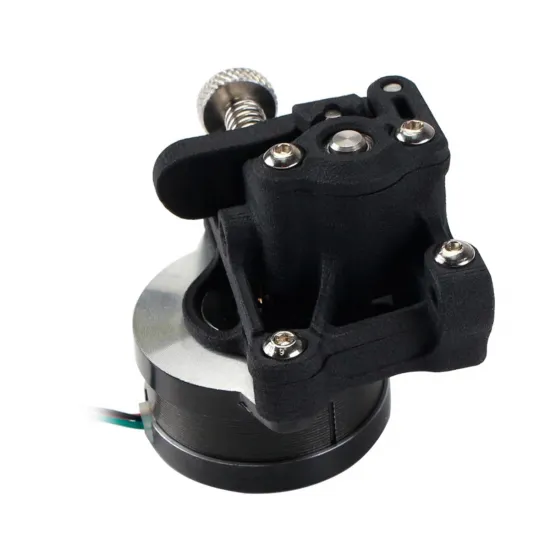
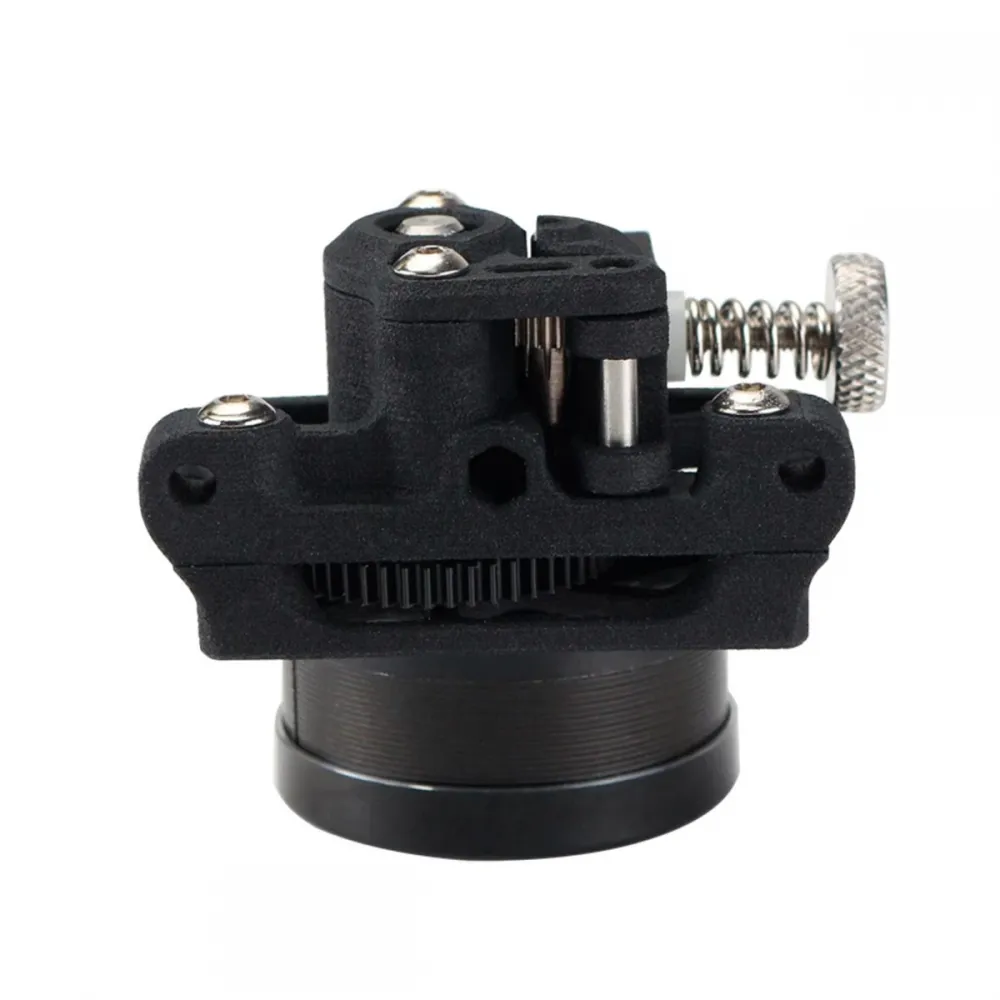
The FYSETC Sherpa Mini V1.5 is a compact 1.75mm filament extruder supplied with a NEMA 14 motor and dual-drive filament gears. Its small package is particularly useful for direct-drive toolheads where moving mass must be limited without giving up a geared transmission.
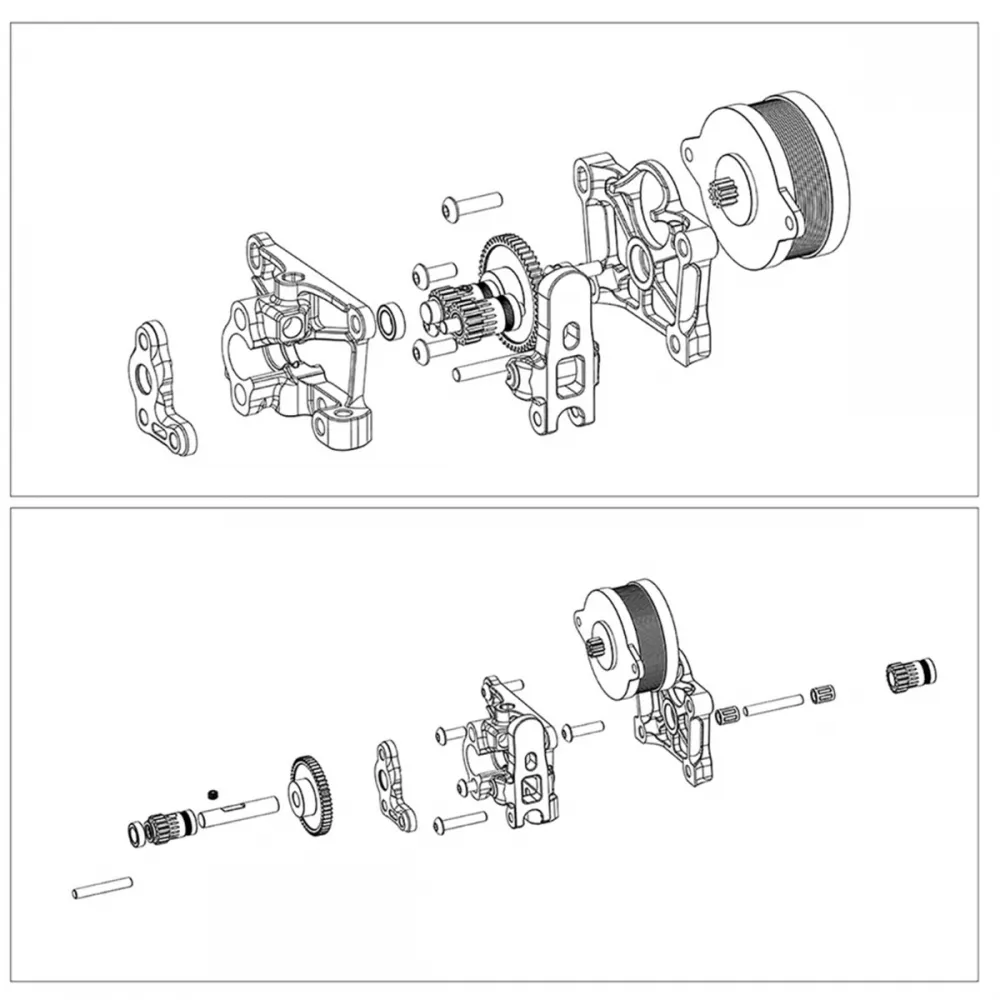
This revision combines an 8-tooth motor pinion with a 50-tooth CNC-machined POM gear, providing a nominal 6.25:1 ratio. The reduction multiplies available torque at the drive gears and enables precise filament-feed control.
What is different about revision V1.5
- 50:8 or 6.25:1 reduction: 25% more torque multiplication than FYSETC's 5:1 revision 1.1.
- 50-tooth gear: CNC-machined from POM and lightened to reduce inertia.
- Revised gear positioning: a separate guide helps provide repeatable assembly.
- Dual-drive gears: grip filament from both sides and distribute pressure more evenly.
- SLS polyamide housing: compact, durable body without conventional FDM layer lines.
Technical specifications
| Model | FYSETC Sherpa Mini Rev. 1.5 |
|---|---|
| Filament | 1.75mm |
| Drive system | Dual hobbed drive gears |
| Transmission | 8T pinion and 50T POM gear; 6.25:1 reduction |
| Included motor | FYSETC G36HSY4405-6D-1200A NEMA 14, 1.8° |
| Motor rated current | 1A per phase; the setting must follow the driver's current convention and be thermally validated |
| Motor cable | Approximately 1.2m, PTFE sleeve |
| Housing | Black SLS polyamide |
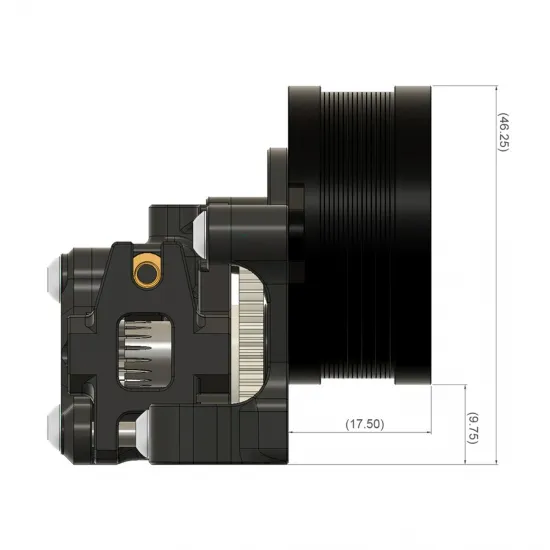
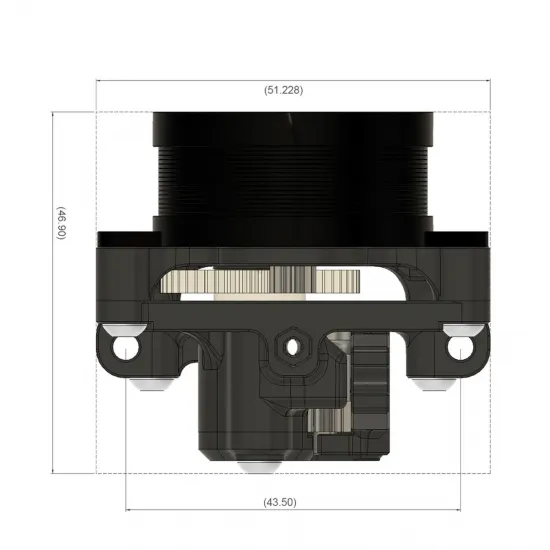
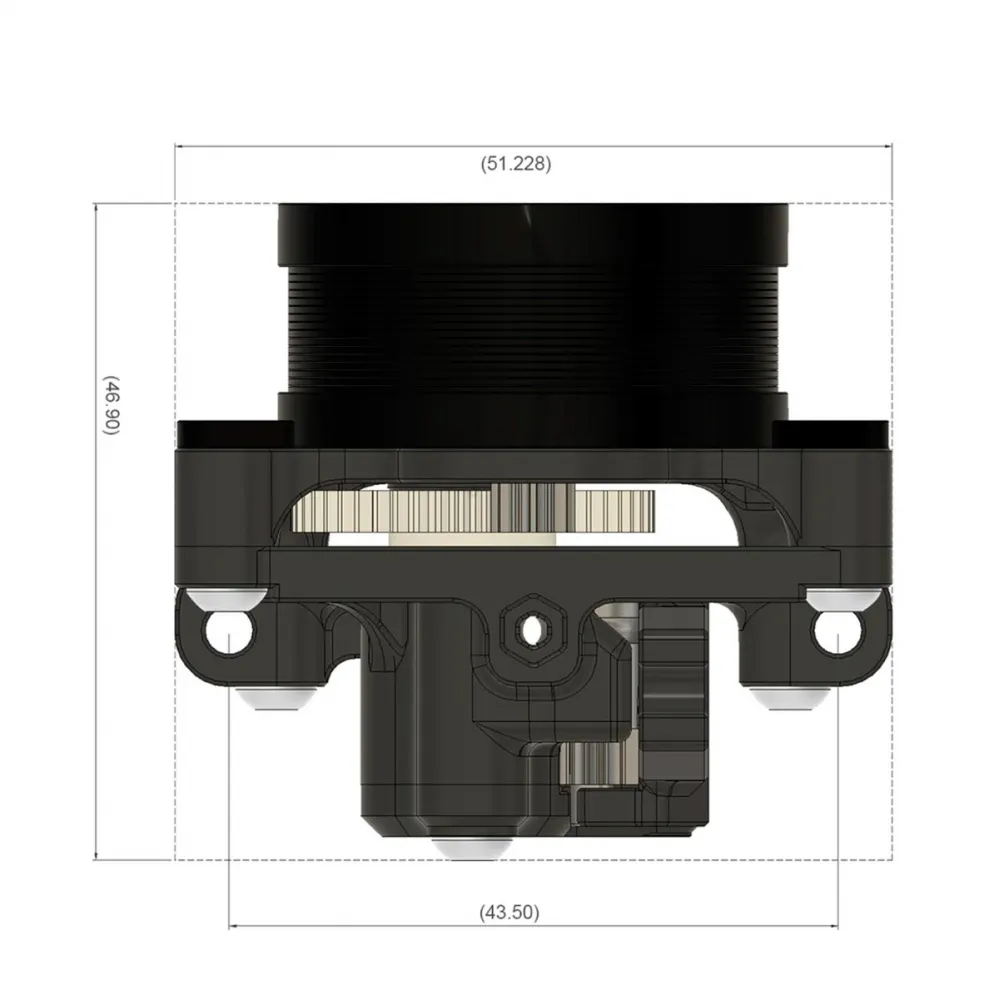
| Approximate outer dimensions | 51.2 × 46.9 × 46.3mm |
| Lower mounting-hole spacing | 43.5mm centre-to-centre in this revision's drawing |
| Approximate weight | 136g including motor |
Package contents and required parts
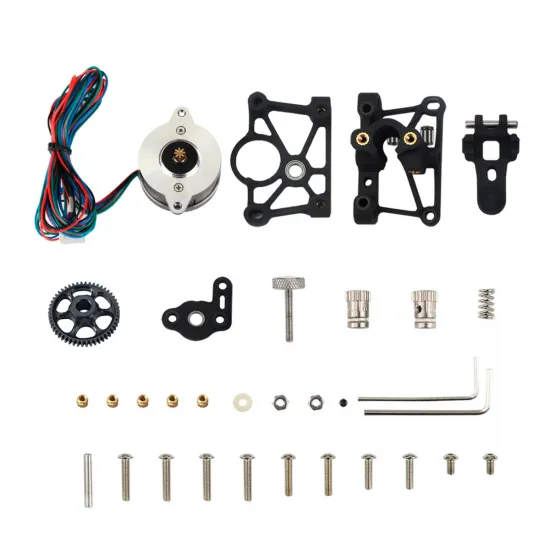
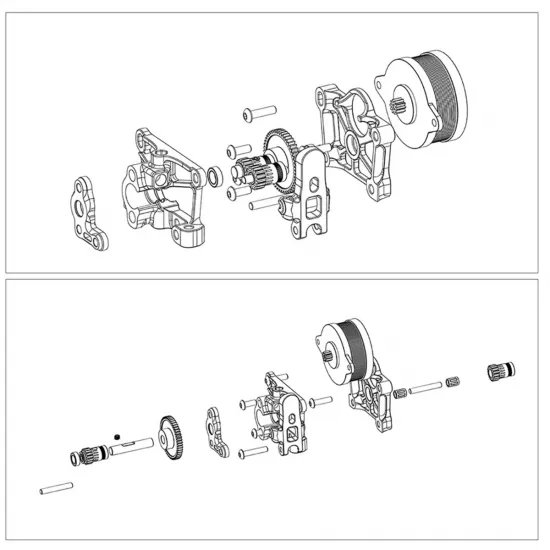
The FYSETC Sherpa Mini V1.5 extruder is supplied complete with its NEMA 14 motor, cable and the mechanics shown in the gallery. The hotend, toolhead-specific mount, PTFE tube and controller electronics are not included.
Where the mount and fitting allow it, filament can be guided using our 4 × 2mm PTFE tube for 1.75mm filament. Cut it squarely and bring it as close to the drive gears as possible without contacting the transmission.
Printer and toolhead compatibility
FYSETC documents adaptations for Creality Ender-2, Ender-3, Ender-3 Pro, Ender-3 V2, CR-10, CR-10S, CR-10 4S, CR-10 5S, CR-10 Mini and CR-20 families, as well as Voron and Annex Gasherbrum K3 projects. This confirms that suitable mounts exist, but it does not make the extruder a drop-in replacement: each machine needs a mount matching its carriage, hotend and revision.
Before installation, verify:
- mounting-hole pattern and spacing;
- alignment between extruder outlet and hotend inlet;
- motor, tensioner and cable clearance throughout travel;
- possible collisions with fans, probe, belts or frame;
- toolhead mass and any loss of usable travel;
- connector, coil order and stepper-driver capability.
The Sherpa Mini project supports direct-drive and Bowden arrangements with the appropriate mount. Direct drive provides a short path to the hotend; a remote Bowden installation requires a rigid frame mount and secure tube retention at both ends.
Rigid and flexible filament
The dual drive, reduction and short path promote consistent feeding of PLA, PETG, ABS, ASA and other 1.75mm filaments. It is also a suitable architecture for testing TPU and flexible materials because unsupported length is limited, but actual compatibility depends on hardness, speed, tension setting, guidance and hotend back pressure.
Do not overtighten the tensioner. Excess pressure may deform filament, increase friction and overload the small motor; insufficient pressure allows slipping.
Installation and wiring
- Attach the extruder to a rigid mount and keep the filament path straight.
- Fully insert any guide tube so that filament cannot buckle into a gap.
- With power disconnected, identify both motor-coil pairs and compare the connector with the board pinout. A matching plug does not guarantee matching pin order.
- Set a conservative driver current and monitor motor and driver temperature during sustained extrusion. FYSETC publishes 0.35A for its Ender-3 example; this is not universal for every controller.
- If direction is wrong, invert it in firmware or reverse one coil pair with power off. Never connect or disconnect the motor while its driver is powered.
Marlin, Klipper and RepRapFirmware setup
The mechanical ratio is known, but final feed calibration is specific to each unit. Effective microstepping, drive-gear diameter, tension and filament compression all affect the result.
Marlin
FYSETC publishes 870 steps/mm as a starting point for an Ender-3 using this revision. In a typical 1.8° motor and 16-microstep setup, it can be applied temporarily with:
M92 E870
M500
M500 stores the value only when EEPROM is enabled. To compile it into Marlin, change the E entry in DEFAULT_AXIS_STEPS_PER_UNIT. Then command a known length and correct it using:
new steps = current steps × requested distance ÷ actual distance
Klipper
The starting point equivalent to FYSETC's recommendation, assuming a 200-step motor and 16 microsteps, is:
[extruder]
microsteps: 16
full_steps_per_rotation: 200
gear_ratio: 50:8
rotation_distance: 22.99
rotation_distance: 22.99 is mathematically derived from FYSETC's published 870 steps/mm; it is a starting point, not a guaranteed calibration. Correct it using:
new rotation_distance = previous value × actual distance ÷ requested distance
Do not include the 6.25 factor again inside rotation_distance when gear_ratio: 50:8 is already defined.
RepRapFirmware
Set the extruder's effective microstepping with M350 where applicable, then use M92 E870 only as an initial value for an equivalent 16-microstep setup. Correct it by measurement and place the final value in config.g. Motor current must follow the command and current convention used by the installed board and driver.
Calibrate at low speed and with the hotend at temperature when filament passes through the nozzle. After feed distance is correct, tune flow, retraction and Pressure Advance or Linear Advance for the actual material and toolhead; do not copy these values from another machine.
Maintenance
- Periodically remove filament dust and debris from the drive gears.
- Check that the large gear turns freely without excessive play or tight spots.
- Review tension whenever changing to a filament with different hardness.
- Do not apply lubricant to teeth that contact filament.
- If needle bearings are removed, use only a small amount of compatible grease and avoid contaminating the housing or filament path.
This extruder is for you if
- You want a compact direct extruder with included motor and 6.25:1 gearing.
- You can install or print a toolhead-specific mount.
- You want dual drive and a short path for rigid or flexible materials.
- You can configure stepper current, direction and feed distance in firmware.
This extruder is not for you if
- You need a drop-in replacement without adapting the mount, wiring or firmware.
- Your board cannot be configured appropriately for the small NEMA 14 motor.
- You cannot check hotend alignment and possible toolhead collisions.
- You need the current Sherpa Mini Release 2 and require its parts to be interchangeable without checking dimensions.
Open design and documentation
This FYSETC revision derives from Annex Engineering's Sherpa Mini project. See the FYSETC manufacturing documentation and the open Sherpa Mini repository. The current Annex project is Release 2 and contains changes from FYSETC V1.5, so verify the revision before printing or ordering replacement parts.