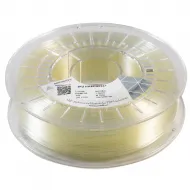
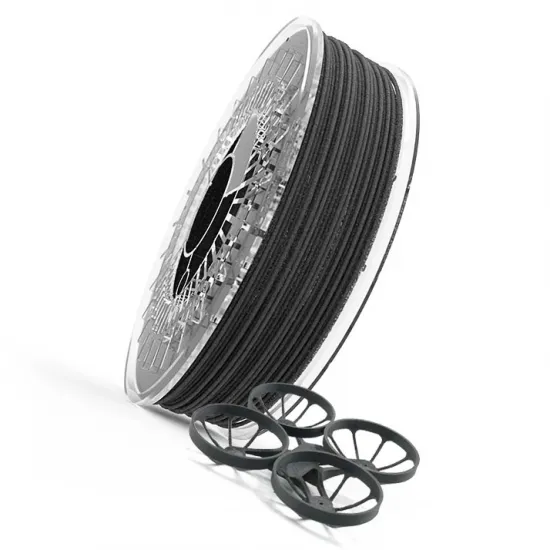
- Stock: 3
- Model: Recreus-PETG-G CF

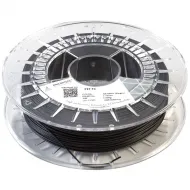
Recreus PET-G CF is a 1.75 mm technical filament based on PET-G and reinforced with 10% carbon fibre. It combines the dimensional ease of PET-G with high stiffness, reduced warping and a matte black finish suited to functional parts, tooling, brackets, housings and technical prototypes.
Developed by Spanish brand Recreus, it is supplied on a 700 g spool. This is not standard PET-G: its carbon filling is abrasive, so it requires a wear-resistant nozzle and a dedicated print setup.
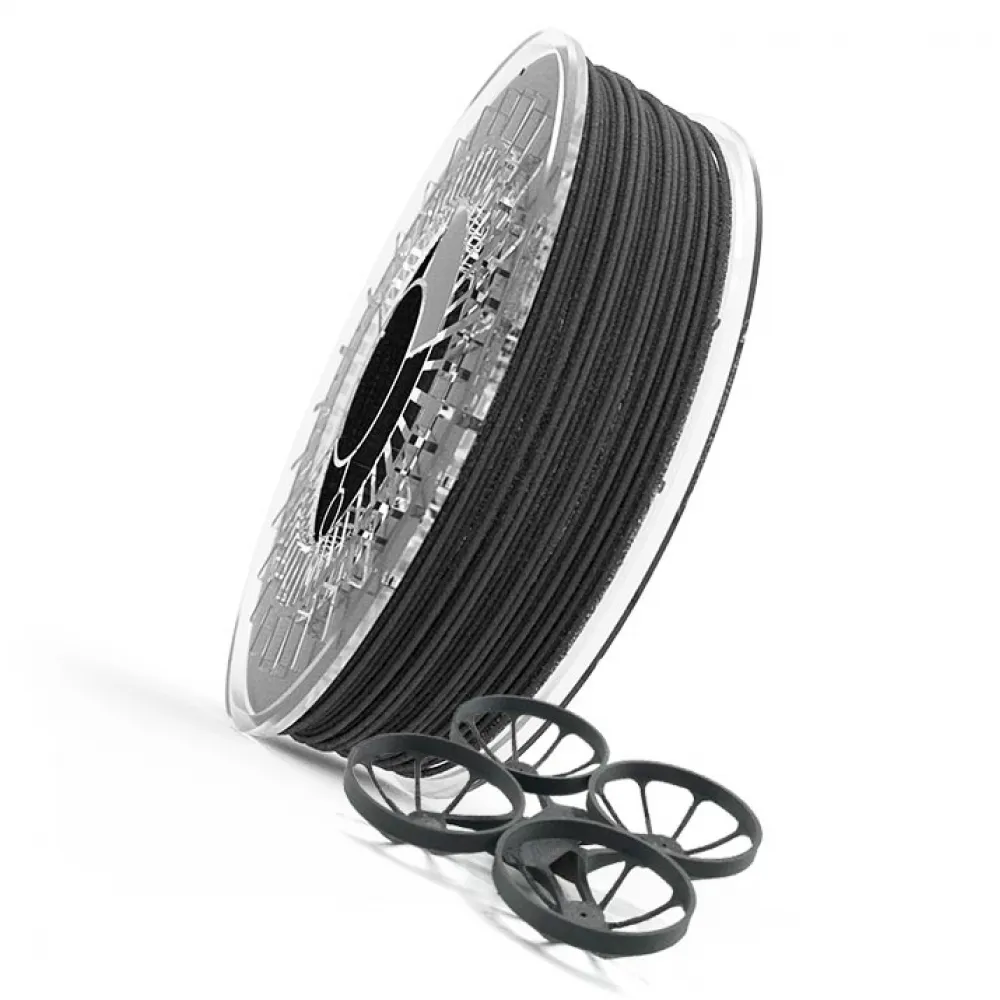
What carbon fibre adds
- High stiffness: it reduces deflection compared with ordinary PET-G and suits parts that must retain their geometry.
- Good dimensional stability: useful for brackets, gauges, fixtures and components with broad flat surfaces.
- Matte black finish: it helps conceal layer lines and gives parts a consistent technical appearance.
- Low elongation: it behaves more rigidly, but is also less ductile than an unfilled PET-G.
- Wear and chemical resistance: these are properties highlighted by the manufacturer, but they must be validated under the actual conditions of each application.
The reinforcement does not make an FFF part isotropic and it is not continuous fibre. Layer orientation, perimeter count, filament moisture and interlayer bonding remain critical.
Material technical data
| Property | Declared value | Test |
|---|---|---|
| Carbon fibre content | 10% | Manufacturer data |
| Density | 1.320 g/cm³ | ISO 1183 |
| Tensile modulus | 9000 MPa | ISO 527 |
| Tensile strength | 105 MPa | DIN 53504-S2 |
| Elongation at break | 4.0% | DIN 53504-S2 |
| Notched Charpy impact at 23 °C | 6.50 kJ/m² | ISO 179 |
| Heat deflection temperature | 72 °C at 0.45 MPa 67 °C at 1.82 MPa | ISO 75-2 |
| Vicat softening temperature | 80 °C | Vicat A, 50 N, 50 °C/h |
These figures come from test specimens and specific methods. They do not by themselves guarantee the performance of an FFF part: design, load direction, layer bonding, print settings and service conditions can substantially change the result. HDT and Vicat are not guaranteed continuous service temperatures.
Initial print settings
| Setting | Starting point | How to tune it |
|---|---|---|
| Nozzle | 245–260 °C | Tune for layer bonding, finish and flow; avoid long dwell times at high temperature. |
| Bed | 70–90 °C | Recreus's current guide uses 90 °C for the first layer and 85 °C afterwards; reduce if adhesion is excessive. |
| Speed | 40–50 mm/s as a conservative start | Increase only after measuring the hotend's sustainable volumetric flow. |
| Layer height | 0.20 mm with a 0.4 mm nozzle 0.30 mm with a 0.6 mm nozzle | More generous layers reduce the likelihood of clogging. |
| Part cooling | 0% generally; up to 40% for bridges and short layers | Avoid excessive airflow if it weakens layer bonding. |
| Retraction | 0.8–1.5 mm at 30 mm/s for direct drive | For Bowden systems, calibrate from scratch: required distance depends on the complete path. |
| Chamber | Draught-free; 45–50 °C preferred for demanding parts | Not essential for every geometry; respect the thermal limits of electronics and extruder parts. |
These are calibration starting points, not a universal profile. Hardened steel transfers heat differently from brass, so small temperature or speed adjustments may be required.
Recommended nozzle and wear
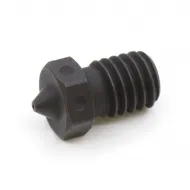
Use hardened steel, ruby or another nozzle expressly rated for abrasive materials. A brass nozzle can wear quickly, increasing its effective diameter and altering both flow and part dimensions.
We recommend 0.6 mm as the more tolerant option. The current manufacturer guide includes a 0.4 mm profile, but an older technical sheet recommended no less than 0.5 mm. A 0.4 mm nozzle should therefore be considered possible, not guaranteed. It requires dry filament, a clean nozzle, controlled flow and wear-resistant construction.
If your hotend uses standard V6 geometry, consider the 0.6 mm Trianglelab V6 hardened A2 steel nozzle. Check thread, overall length, sealing against the heatbreak and your block's tightening procedure first; sharing a 0.6 mm orifice does not make a nozzle mechanically compatible with every hotend.
Flow profiles published by Recreus
| Nozzle | Layer | Line width | Target flow | Temperature |
|---|---|---|---|---|
| 0.4 mm | 0.20 mm | 0.42 mm | 9.0 mm³/s | 250 °C |
| 0.6 mm | 0.30 mm | 0.62 mm | 20.3 mm³/s | 250 °C |
| 0.8 mm | 0.40 mm | 0.82 mm | 36.0 mm³/s | 252 °C |
| 1.0 mm | 0.50 mm | 1.02 mm | 56.3 mm³/s | 255 °C |
These are Recreus's published targets, not flow rates that every hotend can achieve. If you see under-extrusion, inconsistent gloss, weak bonding or extruder skipping, cap maximum volumetric flow in the slicer and test again.
Drying and storage
Moisture typically appears as popping, bubbles, rough surfaces, stringing and inconsistent extrusion. The current manufacturer guide includes both a short conditioning cycle of 55 °C for at least 1 hour and a deeper drying cycle of 65 °C for 4–6 hours.
Use a temperature-controlled dryer with airflow, follow the batch label and ensure the spool can withstand the selected temperature. If the spool's heat resistance is unknown, do not put the complete spool in an uncontrolled oven. After drying, store the filament sealed with desiccant and minimise exposure to humid air.
Bed adhesion
It can be printed on PEI or another surface suitable for PET-G. Clean the bed and tune the first layer without excessive squish. On smooth PEI or glass, a thin adhesive film may also act as a release layer, particularly under broad parts, and help prevent excessive bonding.
If corners lift, first check cleanliness, actual temperature, draughts and geometry; then consider a brim. If the part bonds too strongly, allow it to cool fully and reduce temperature or contact on the next print.
3D printer compatibility
It is compatible with 1.75 mm FFF printers whose hotend can safely maintain 245–260 °C and that have a nozzle and filament path suited to abrasive materials. Compatibility depends on the actual configuration:
- Creality K1C: designed for fibre-filled filaments and fitted with a hardened steel tip; create or tune a profile for this specific Recreus PET-G CF.
- Bambu Lab X1C: fitted with hardened nozzle and drive gears as standard. Use a generic or custom profile: this filament does not provide Bambu RFID identification or an automatic Bambu preset.
- Bambu Lab P1S and P1P: should not be assumed compatible with carbon-filled material in stock form. Bambu recommends upgrading the hotend and drive gears first.
- Prusa MK3, MK3.5, MK3.9, MK4, XL and CORE One: require an abrasion-resistant nozzle—such as hardened or ObXidian—and the correct nozzle diameter must be selected in the printer profile.
- Voron, RatRig, HPRO and other configurable machines: can process it only when the installed hotend, nozzle, extruder and bed meet the requirements. The project name alone does not guarantee compatibility.
- Ender-3, CR-10 and derivatives: many revisions exist. Verify the hotend's safe continuous temperature, the PTFE path near the hot zone and nozzle material.
Carbon filling can also wear drive gears, guides and tubes over long paths. Do not assume compatibility with AMS, MMU or other automatic material systems: check the exact system guidance and avoid tight filament bends.
Slicer tuning
- Dry the filament when its history is unknown or moisture symptoms appear.
- Fit an abrasion-resistant nozzle and enter its actual diameter in the slicer and, where applicable, in the printer.
- Tune temperature and flow before pursuing speed.
- Calibrate extrusion multiplier with a test part; do not automatically reuse the value from another PET-G.
- Cap maximum volumetric flow at a level the hotend can melt without under-extrusion.
- Calibrate pressure/flow dynamics for the chosen filament, nozzle and temperature.
- Reduce cooling if interlayer adhesion is weak; reserve more airflow for bridges and short details.
- Orient the part so the primary loads do not pull layers apart.
Antistatic does not mean ESD-safe
Recreus describes the material as antistatic, but the reviewed documentation does not publish surface or volume resistivity. Do not use it as a substitute for a conductive, dissipative or ESD-certified material without measuring and validating the finished part.
Safety and post-processing
The manufacturer's safety data sheet does not classify the mixture as hazardous under CLP, but molten plastic can cause burns and process fumes should not be inhaled. Print with suitable ventilation and avoid overheating or leaving hot material stationary for long periods.
Sanding, cutting, drilling or machining produces fine polymer and carbon dust that can irritate the eyes, skin and respiratory tract. Prefer wet sanding or local extraction, wear eye protection and suitable respiratory protection for dust—the SDS recommends FFP2 when dust is present—and clean without spreading particles with compressed air.
It is for you if
- You need a stiffer, more dimensionally stable PET-G for functional parts.
- You want a matte black technical finish.
- Your printer reaches the required temperature and has an abrasion-resistant nozzle.
- You can dry the material and calibrate a dedicated profile.
- You are producing fixtures, brackets, housings, robotics components or moderately loaded prototypes.
It is not for you if
- You only have a brass nozzle and do not want to replace it.
- You need high ductility, flexibility or impact toughness.
- You require an ESD-certified, conductive or resistivity-controlled part.
- The part needs food, medical, electrical or structural certification that you have not independently validated.
- You cannot control moisture, temperature, flow and cooling.
Contents
- 1 spool of black Recreus PET-G CF.
- Diameter: 1.75 mm.
- Net filament weight: 700 g.
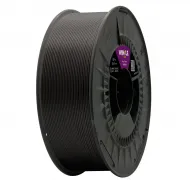
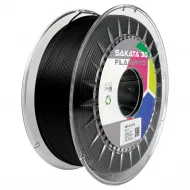
To compare other formulations in this catalogue family, see the WINKLE PETG CF and Sakata 3D PET-G CF15. Their profiles are not interchangeable: retain separate temperature, drying, flow and calibration settings for each material.