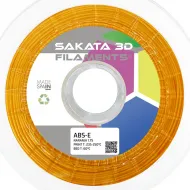


- Stock: 8
- Model: PETG-CF-15-SAKATA3D

Type:

PETG

PETG Transition

Recycled PETG

PETG CF-15
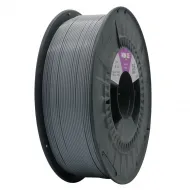
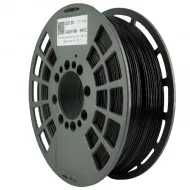
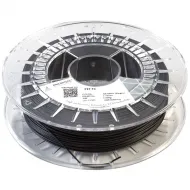
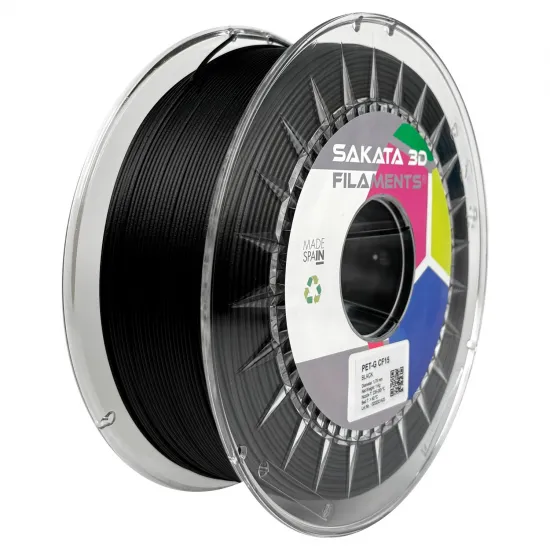
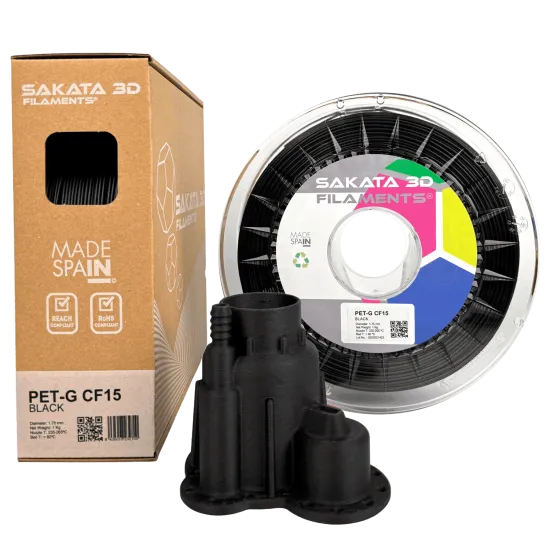
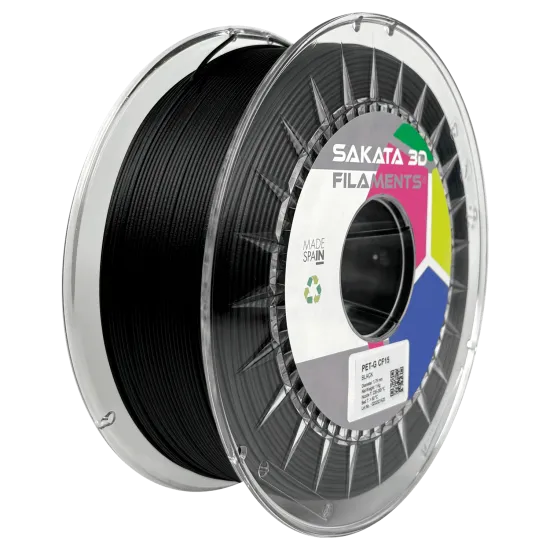
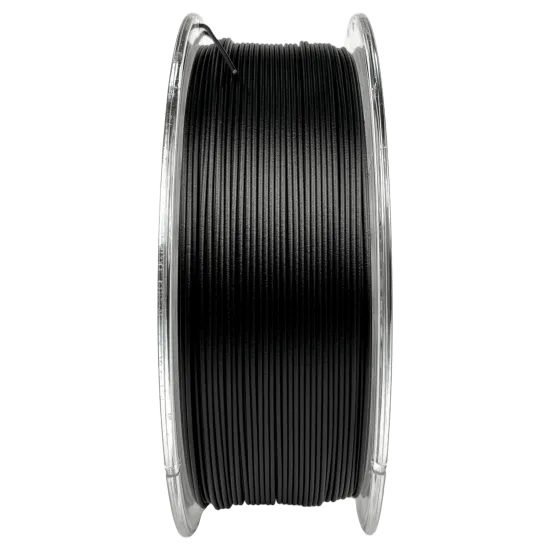
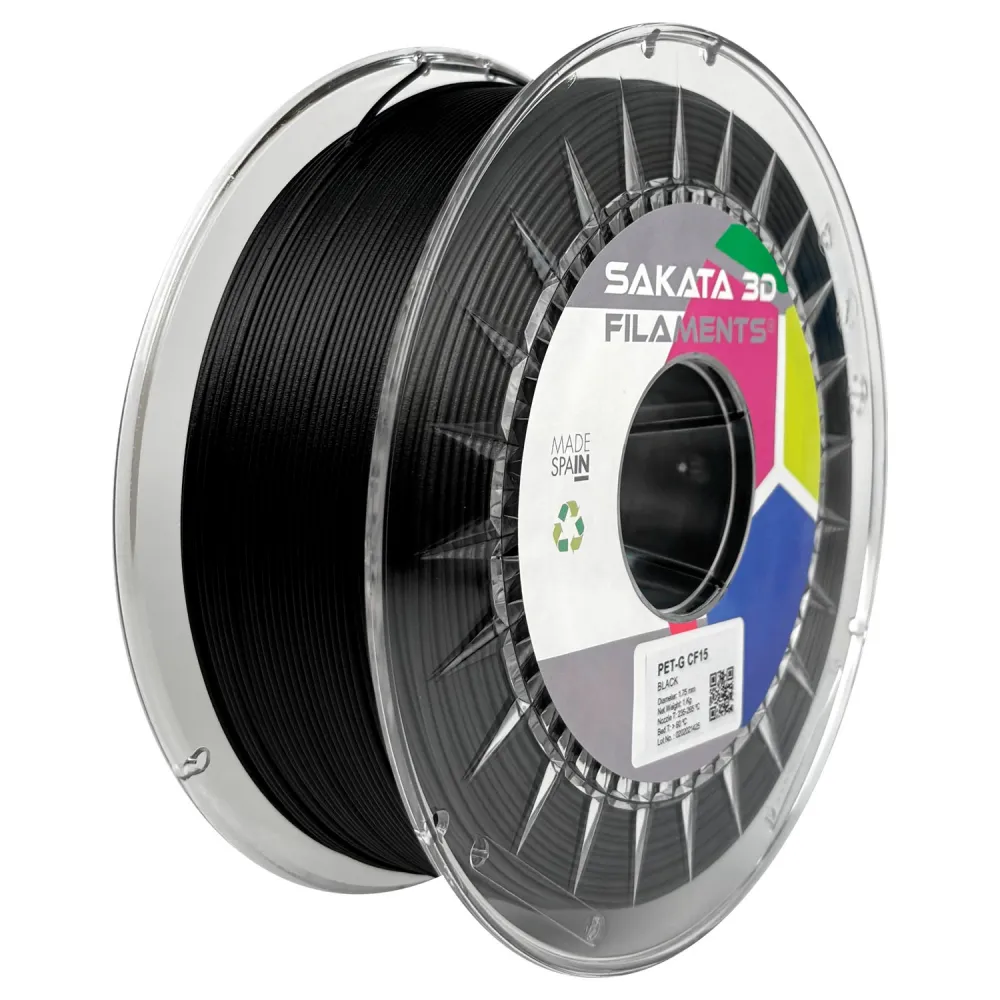
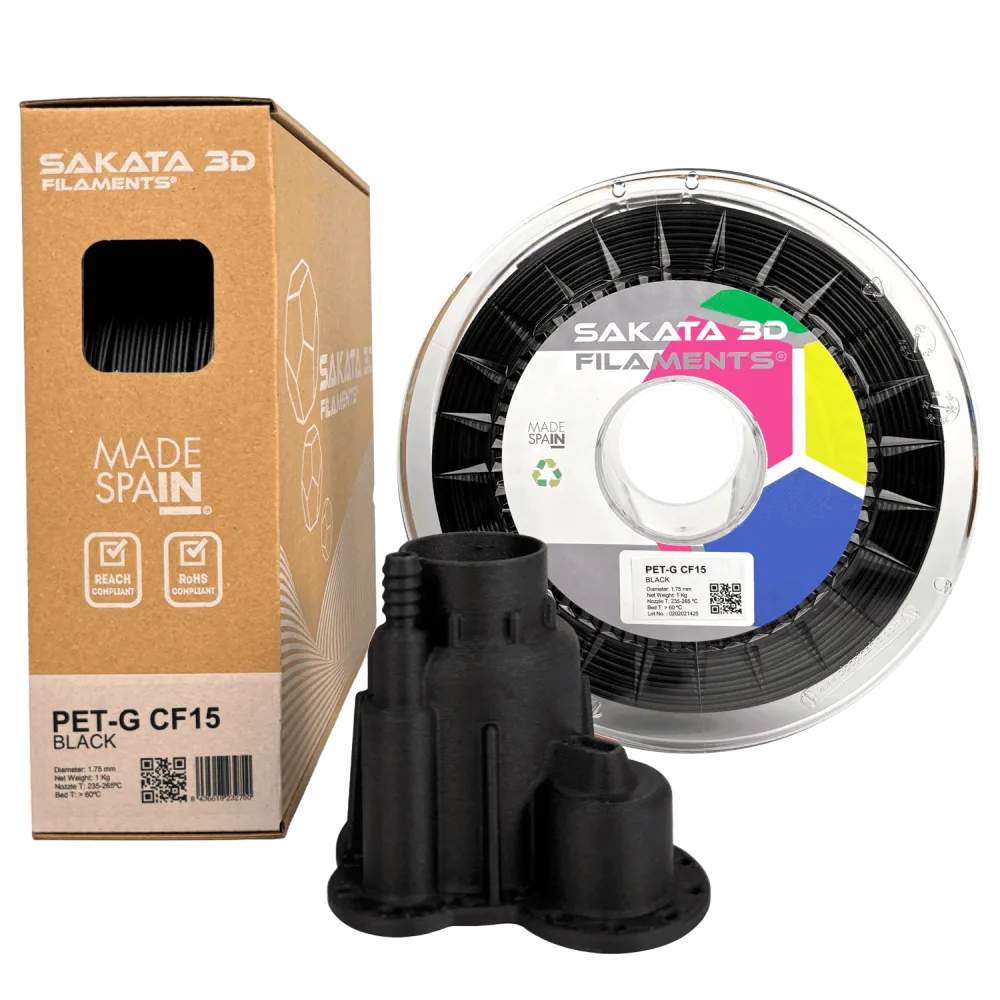
Sakata 3D PET-G CF15 is a black 1.75 mm engineering filament combining heat-stabilised PET-G with 15% special carbon fibres. It is intended for rigid, dimensionally stable parts with a matte appearance, including brackets, jigs, housings, functional prototypes and components subject to moderate, known loads.
The fibre increases stiffness and reduces the deformation associated with unfilled PET-G, but it also makes the material abrasive and less ductile. A wear-resistant nozzle, prior drying and a dedicated profile are required; it should not be treated as ordinary PET-G or assumed to work in every FDM printer.
Main features
- PET-G reinforced with 15% special carbon fibre.
- Black colour with a matte, technical-looking finish.
- Higher stiffness and dimensional stability than unfilled PET-G.
- Low shrinkage and good layer bonding as declared by Sakata.
- Suitable for open or enclosed printers.
- 1.75 ±0.03 mm diameter and 0.03 mm maximum roundness deviation.
- 1,000 g net spool.
- Made in Spain by Polimersia Global S.L.
Official print settings
| Setting | Sakata 3D starting value | How to use it |
|---|---|---|
| Nozzle temperature | 235–265 °C | Start near the middle and adjust for bonding, finish and flow without exceeding the hotend limit. |
| Nozzle | Hardened steel | Another material may be used only where its wear resistance is established. |
| Bed | Above 60 °C | Adapt to the surface, release agent, geometry and ambient temperature. |
| Surface | Glass or PEI | Use a release layer when excessive bonding may occur. |
| Part cooling | 40–60% | Reduce when layer bonding is weak; increase only when bridges and details need it. |
| Print speed | 40–100 mm/s | Begin near the lower limit and respect the hotend's measured volumetric flow. |
| Flow | 96–98% | Starting point; calibrate with a known-wall test piece. |
| Drying before printing | 4–6 h at 60 °C | Use a dryer with stable temperature and air circulation. |
| Printing from a drybox | 60 °C, optional | Useful for long prints or humid environments. |
Wear-resistant nozzle
Carbon fibre does not melt with the PET-G matrix and acts as an abrasive throughout the extrusion path. A brass nozzle can grow in diameter, lose accuracy and alter flow after a relatively small amount of material.
Sakata requires hardened steel but does not state a minimum diameter in the current TDS. A 0.6 mm outlet provides more relative clearance for particles than a 0.4 mm outlet. For compatible V6 hotends, our Trianglelab 0.6 mm hardened A2 steel V6 nozzle is a suitable candidate. Check thread, length, sealing surface and clearance before installation.
After changing nozzle size, select it in the slicer and recalibrate line width, layer height, flow, retraction, Pressure/Linear Advance and maximum volumetric flow. Hardened steel may also require a different temperature from brass because of its thermal conductivity; tune by result within 235–265 °C.
Physical, mechanical and thermal properties
| Property | Standard | Declared value |
|---|---|---|
| Density | ISO 1183 | 1.40 g/cm³ |
| Tensile modulus | ISO 527 | 6,500 MPa |
| Tensile strength | ISO 527 | 90 MPa |
| Elongation at break | ISO 527 | 3% |
| Flexural modulus | ISO 178 | 6,200 MPa |
| Flexural strength | ISO 178 | 115 MPa |
| Charpy impact, unnotched | ISO 179 | 55 kJ/m² |
| Charpy impact, notched | ISO 179 | 5 kJ/m² |
| HDT at 0.45 MPa | ISO 75 | 70 °C |
| HDT at 1.8 MPa | ISO 75 | 60 °C |
These are TDS reference values under the stated standards. Sakata does not describe specimen production, orientation or conditioning in this sheet, so they are not guaranteed printed-part values. FFF results depend on layers, walls, infill, orientation, moisture, temperature, voids and geometry.
The high modulus and 3% elongation describe a stiff, relatively inflexible material. A density of 1.40 g/cm³ also means it is not automatically lighter per unit volume; weight savings are only possible where stiffness allows the part to be redesigned with less material. HDT figures are not continuous service-temperature ratings.
3D printer compatibility
| Machine or family | Compatibility | Conditions |
|---|---|---|
| HTA3D HPRO-330 / HPRO-400 | Configurable | Wear-resistant nozzle, hotend and sensor suitable for 265 °C, appropriate surface and calibrated profile. |
| Bambu Lab X1 Carbon | Suitable hardware | Hardened nozzle and gears are fitted; create or adapt a profile for this Sakata material and check the chosen feed path. |
| Creality K1C | Suitable hardware | Creality specifies a hardened tip and PET-CF support; use the material's 40–100 mm/s range, not the printer's advertised maximum speed. |
| Prusa MK4/MK4S, XL and MK3.x | Conditional | Replace a standard brass nozzle with a hardened one and verify temperature, surface and profile. |
| Voron V0, Trident and 2.4 | Configuration-dependent | Check the actual hotend, nozzle, extruder, filament guide, bed, enclosure and profile. |
| Basic printer with brass nozzle | Not recommended as supplied | At minimum, it needs a wear-resistant nozzle and genuine thermal capacity for the stated range. |
A printer supporting “PETG” is not necessarily prepared for PETG-CF. In addition to the nozzle, fibre can wear extruder gears, filament entries and tubing, particularly along long paths and tight bends.
Drying and storage
Dry the spool for 4–6 hours at 60 °C before printing. For long jobs or humid environments, Sakata allows it to remain in a 60 °C drybox while printing. After use, store it in a sealed bag or container with desiccant.
Popping, bubbles, rough surfaces, stringing, irregular flow or weak layer bonding may indicate moisture. Do not try to hide it only by increasing temperature, flow or retraction: dry the material again and repeat the test.
Adhesion and part removal
Sakata recommends glass or PEI with the bed above 60 °C. PET-G may bond too strongly to some smooth surfaces; where the plate manufacturer recommends it, use a thin release layer and allow the part to cool before removal.
The material can be printed in an open or enclosed machine. An enclosure can stabilise larger parts, but does not replace drying or allow motor, extruder or electronics temperature limits to be exceeded.
Recommended applications
- Jigs, fixtures, gauges and assembly supports.
- Technical housings and covers requiring dimensional stability.
- Arms, brackets and parts where stiffness is prioritised.
- Functional prototypes and validation parts.
- End-use components subject to known loads and prior testing.
It must not replace a metal, machined or certified component without validation. For impact, repeated flexing, pressure, safety or sustained temperature, test the actual orientation and geometry with an appropriate margin.
PET-G CF15 compared with other options
If fibre is unnecessary, standard Sakata PET-G is less abrasive, more flexible and works with ordinary nozzles. If you need a carbon composite for more demanding conditions and accept a more critical drying and tuning process, see Sakata PA-CF15; it is not a universal upgrade, but a different polymer with different requirements and behaviour.
Is it right for you?
It is right for you if you need more stiffness and stability than standard PET-G, have a hardened nozzle and can dry the material and calibrate its profile. It is particularly useful for tooling and engineering parts where a matte black finish is also desirable.
It is not right for you if you need a flexible part, want to print directly through a brass nozzle, require food-contact or medical approval, or expect guaranteed mechanical values without testing the final part. It is also unsuitable where the hotend cannot reliably reach 235–265 °C.
Safety
Sakata recommends good general workplace ventilation. The material is not certified for food contact or medical applications. When sanding, cutting or machining parts, control the generated dust, avoid inhalation and use extraction and protection appropriate to the process.
Contents: one 1 kg net spool of black Sakata 3D PET-G CF15, 1.75 mm diameter.