

- Stock: 41
- Model: PETG-CF GST3D

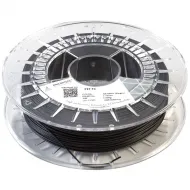
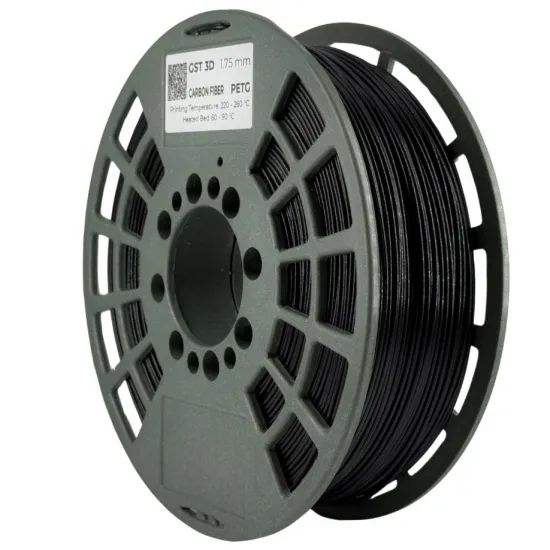
GST3D PETG-CF is a 1.75 mm filament combining a PETG matrix with carbon microfibres. It is intended for functional parts where stiffness, dimensional stability and a technical-looking matt black finish are particularly useful, including brackets, jigs, housings, robotics components and moderately loaded prototypes.
The reinforcement changes both the printed part and the printing process compared with regular PETG. This is an abrasive material: it requires a wear-resistant nozzle and a profile tuned to the actual hotend. Fibre reinforcement alone does not make every design structural; layer orientation, walls, infill and geometry remain critical.
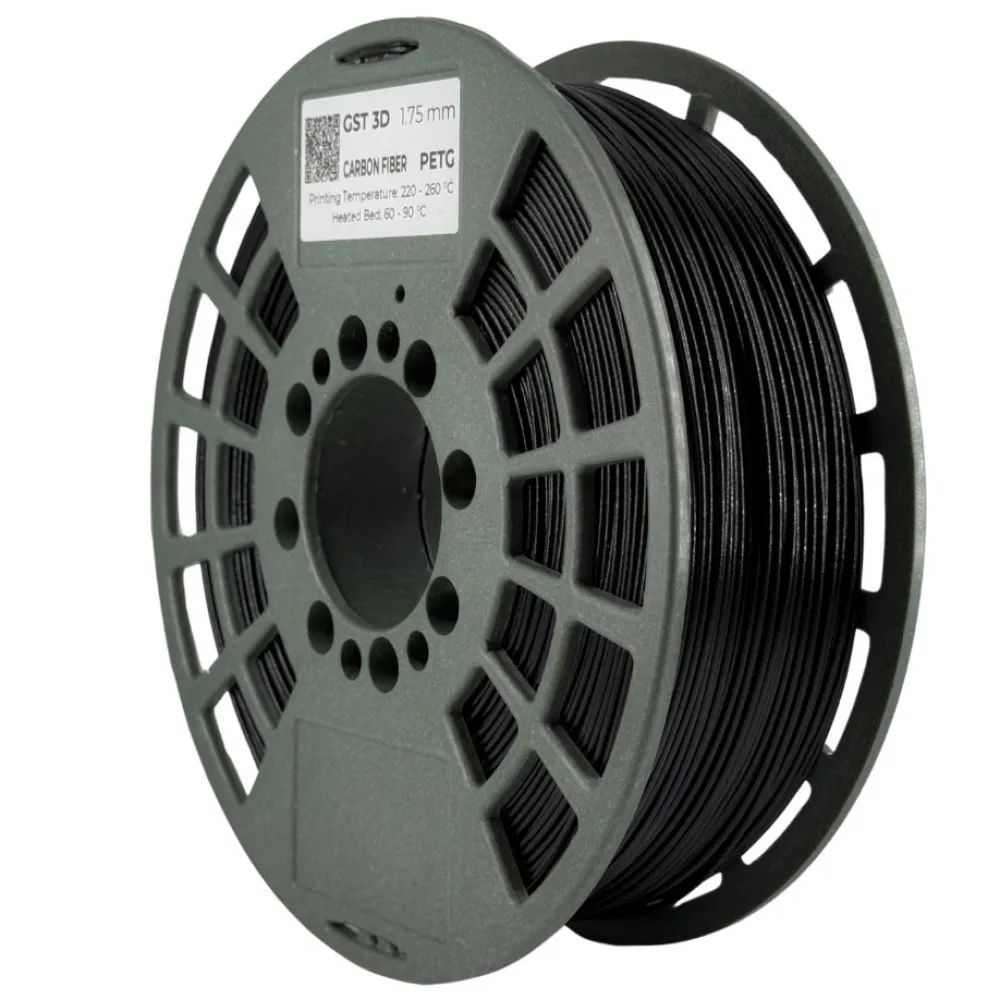
Main specifications
- Material: PETG reinforced with carbon microfibres.
- Brand: GST3D.
- Diameter: 1.75 mm.
- Contents: 1 kg spool, vacuum packed.
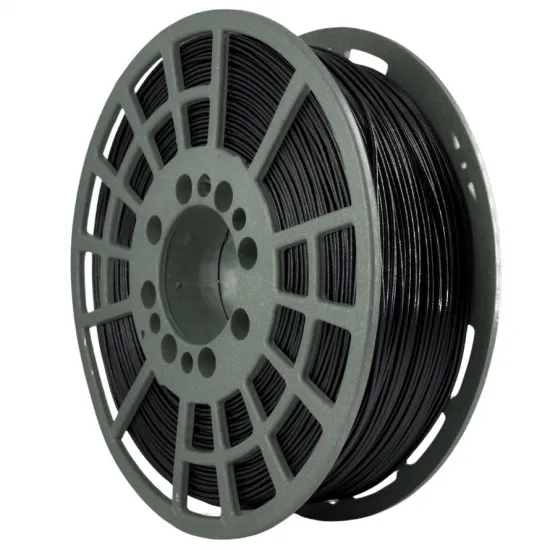
- Colour: carbon black with a matt technical texture.
- Nozzle temperature printed on the spool: 220–260 °C.
- Bed temperature printed on the spool: 60–90 °C.
Use these ranges as starting points. Final temperature and speed depend on nozzle, hotend, volumetric flow, build surface, geometry and environment. GST3D does not publish a maximum speed or flow curve for this formulation that would support a universal 300 mm/s claim.
Recommended nozzle and hotend
Use hardened steel, carbide, ruby or another nozzle explicitly intended for abrasive filament. A brass nozzle can wear, increasing its effective diameter and changing flow, tolerances and surface quality.
- 0.4 mm: retains finer detail but requires a clear filament path and careful calibration. If your hotend uses the V6 format, a 0.4 mm hardened A2 steel V6 nozzle is available.
- 0.6 mm: is generally more tolerant with fibre-filled compounds because it gives particles more clearance and supports taller layers. For V6 hotends, see the 0.6 mm hardened A2 steel V6 nozzle.
Always check thread, length, diameter and installation procedure: abrasion resistance does not make a nozzle compatible with every hotend. If the hotend has PTFE in its hot zone, follow its manufacturer's temperature limit; a 260 °C setting on the display does not prove that sustained operation is safe.
Safe starting setup
- Select a PETG-CF profile or duplicate a PETG profile so it can be tuned without altering the original.
- Start within the spool's 220–260 °C nozzle and 60–90 °C bed ranges. Use a temperature tower and first-layer test to find the appropriate setting.
- Begin at a conservative speed and increase it only if the hotend maintains flow without under-extrusion and the part retains good interlayer bonding. Tune flow and pressure advance or linear advance where supported.
- Adapt cooling to the model. Too much airflow can weaken layer bonding, while bridges and overhangs may need more cooling.
- Recalibrate flow and temperature after replacing a brass nozzle: different nozzle materials do not transfer heat in the same way.
Printer compatibility
It can be used on 1.75 mm printers such as HTA3D HPRO, Voron, Creality K1C or Bambu Lab X1 Carbon when the particular build has a suitable hotend, wear-resistant nozzle, capable extruder and calibrated profile. Voron and HPRO machines can use different components, so the machine name alone does not confirm the installed nozzle. On Bambu Lab systems, check the drive gears and filament-feed path as well.
Do not recommend it for an Ender-3, Prusa MK3/MK4, Bambu P1P/P1S or another printer solely because it can reach the required temperature. A brass or non-abrasive-rated stock nozzle needs an appropriate upgrade. Bambu Lab classifies carbon- and glass-fibre-reinforced polymers as not recommended for the A1 mini. Compatibility with AMS, AMS Lite, CFS, MMU and other automatic feeders must also be verified; use an external spool path where required.
Storage and use
Keep the spool sealed with desiccant. If you notice popping, bubbles, excessive stringing or an unusually rough surface, check for absorbed moisture before changing many settings. Use only a drying cycle suitable for PETG and for the spool itself; no specific time and temperature are stated here because GST3D does not publish them for this formulation.
Choose it if you want a stiffer black PETG with good dimensional stability and a matt finish for functional parts, and your printer is prepared for abrasive materials. It is not for you if you intend to use a brass nozzle, need transparency or flexibility, require a guaranteed printing speed or need certified mechanical properties for a critical application.