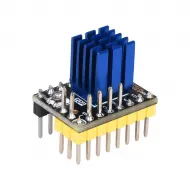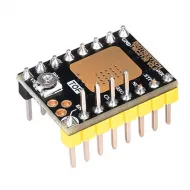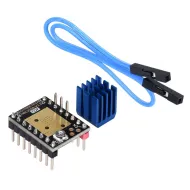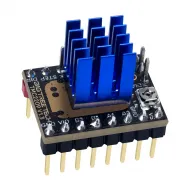


- Stock: 54
- Model: TMC2209-Fysetc

Model:

TMC2208

TMC2130

TMC2209
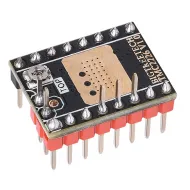
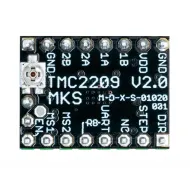
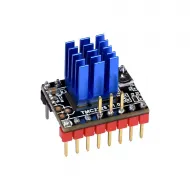
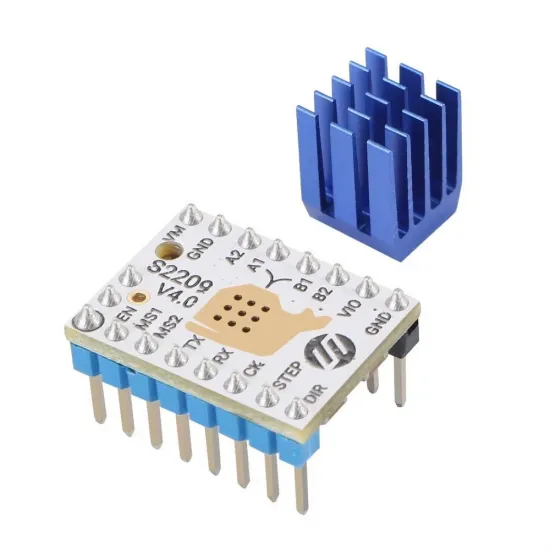
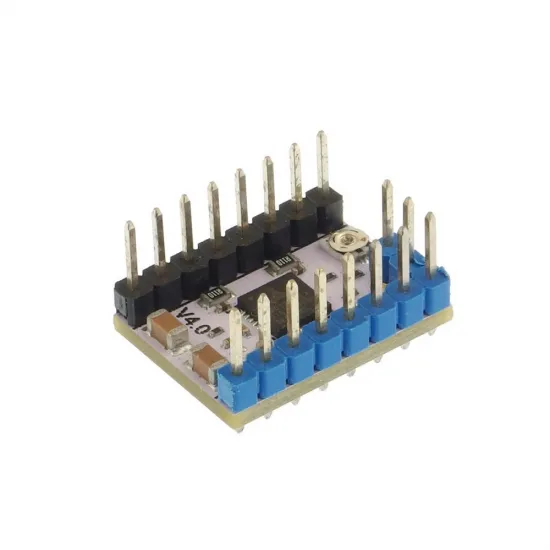
The FYSETC S2209 V4.0 is a StepStick driver based on the TMC2209, designed to control two-phase bipolar stepper motors with quiet operation and advanced UART configuration. It can operate as a standalone STEP/DIR driver or provide firmware-controlled current, StealthChop2, SpreadCycle, CoolStep and StallGuard4 when the controller board and wiring support UART communication.
This listing refers specifically to revision V4.0. Although it uses the familiar StepStick form factor, electrical compatibility must always be checked: fitting into a socket does not guarantee correct orientation, pinout, jumpers or DIAG/UART wiring.
Quiet operation and configurable control
- StealthChop2: particularly quiet operation at suitable speeds.
- SpreadCycle: a mode intended for dynamic response and accurate current control.
- MicroPlyer: internal microstep interpolation up to 1/256.
- StallGuard4: load and stall detection, which can be used for sensorless homing when the complete installation is compatible and properly tuned.
- CoolStep: dynamic current adaptation in supported configurations.
- UART: firmware configuration and driver diagnostics.
It is suitable for 3D printers, light CNC machines, robots and mechanisms using compatible stepper motors. For motor selection and current adjustment, see for example our 1.7 A NEMA 17 stepper motor; driver current must be calculated for the actual motor and mechanics instead of copied from another machine.
Technical specifications
| Feature | Value |
|---|---|
| Manufacturer and revision | FYSETC S2209 V4.0 |
| Driver IC | Trinamic / Analog Devices TMC2209 |
| Supported motors | Two-phase bipolar stepper motors |
| Motor supply VM | 5.5–28 V DC; suitable for common 12 and 24 V systems |
| Logic supply VIO | 3–5 V |
| IC limit | Up to 2 A RMS / 2.8 A peak; not a guaranteed continuous module rating |
| Prudent practical reference | Approximately up to 1.2 A RMS with suitable heatsink, airflow and thermal monitoring; installation dependent |
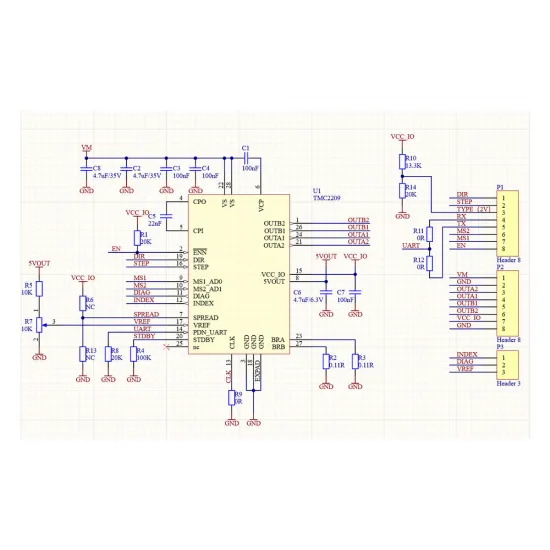
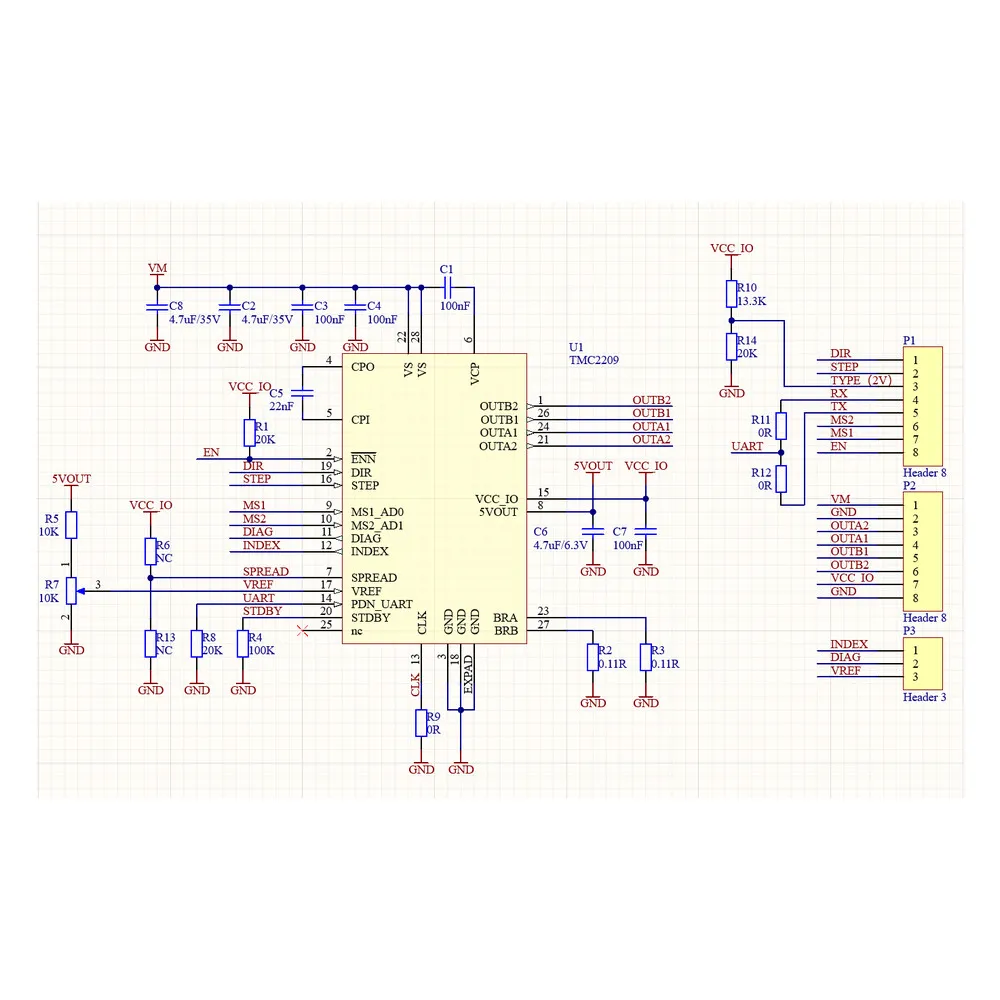
| V4.0 sense resistors | 0.11 Ω according to the official schematic |
| MS1/MS2 microsteps | 1/8, 1/2, 1/4 or 1/16; internal interpolation up to 1/256 |
| Interfaces | STEP/DIR and UART |
| UART addresses | Up to four through MS1/MS2, depending on board wiring |
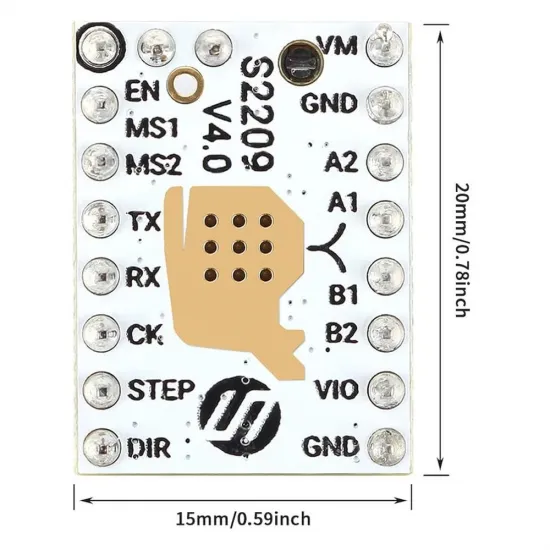
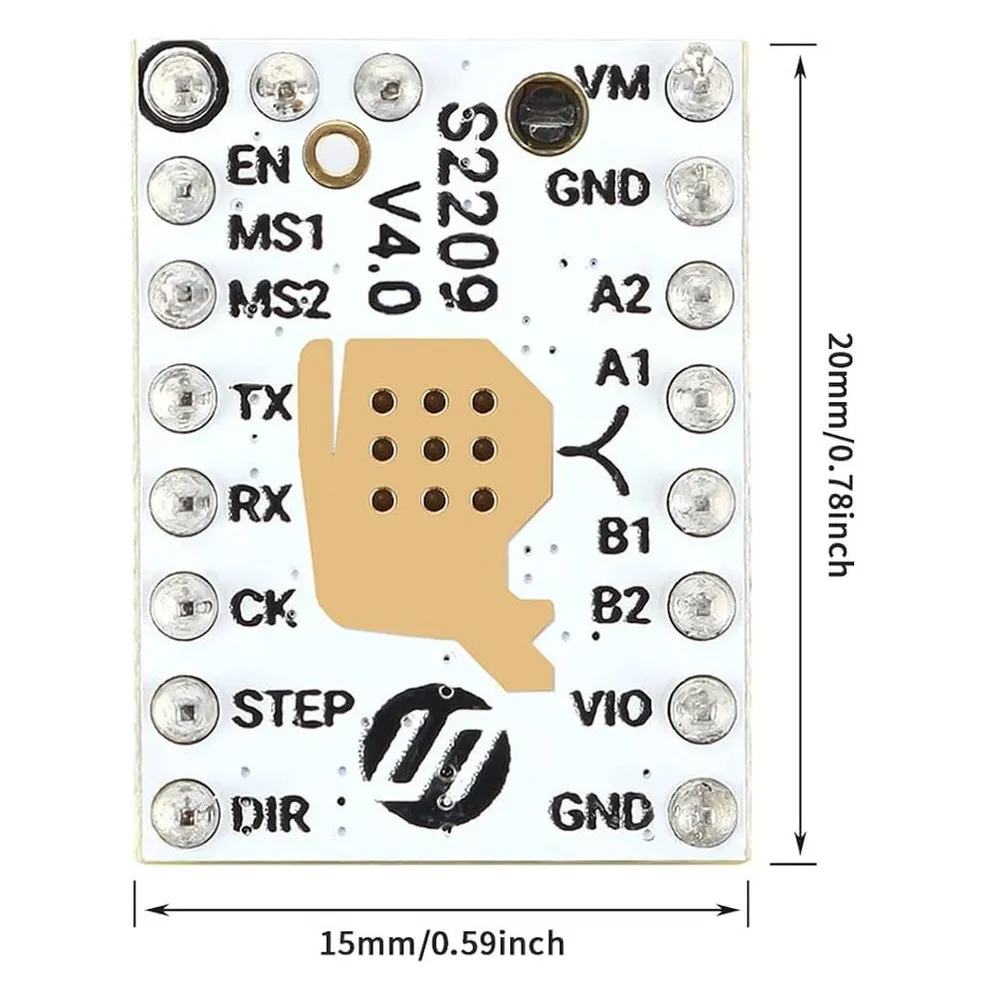
| Nominal dimensions | Approximately 20 × 15 mm, StepStick format |
Compatibility checks
The module can be used with controller boards featuring replaceable StepStick sockets, a motor supply within the supported range and a TMC2209-compatible electrical pinout. FYSETC F6/S6 or Spider boards, various BIGTREETECH SKR boards and some MKS controllers may support this driver, but orientation, jumpers, UART pins and DIAG routing vary between models and revisions.
For example, the BIGTREETECH SKR 3 has configurable external-driver sockets, but its own manual must be followed to select UART mode, place jumpers and verify orientation. A diagram for one SKR, MKS or FYSETC controller must not be transferred directly to another board.
This is not a direct replacement for boards with soldered drivers, and printer-name compatibility cannot be guaranteed. Many Creality, Prusa, Bambu Lab and other commercial machines use integrated drivers or proprietary controller boards.
Standalone STEP/DIR or UART configuration
Standalone STEP/DIR
The controller board drives EN, STEP and DIR without accessing the TMC2209 registers. Microsteps depend on MS1/MS2 and current is adjusted physically through VREF. This is suitable for boards without UART, but does not provide firmware current control, full diagnostics or firmware-managed sensorless homing.
UART mode
UART allows RMS current, microsteps, interpolation, StealthChop or SpreadCycle and driver status to be configured from firmware. On V4.0, TX is connected to PDN_UART through a 1 kΩ resistor and RX connects directly to PDN_UART. The controller board may still require jumpers, a specific UART address or additional wiring.
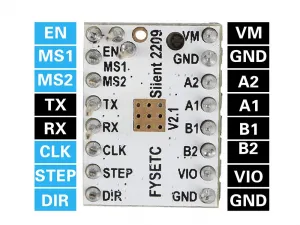
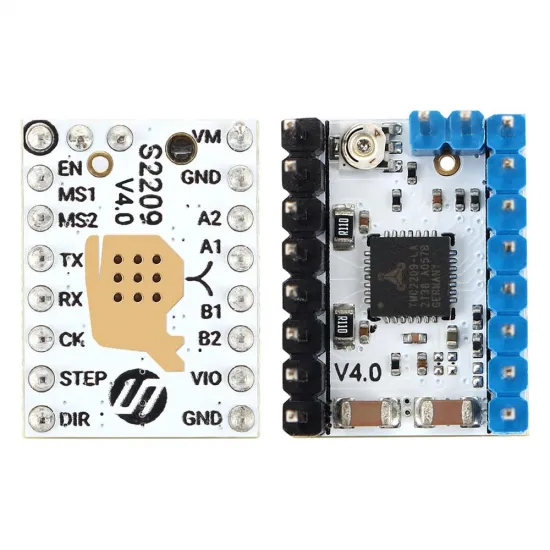
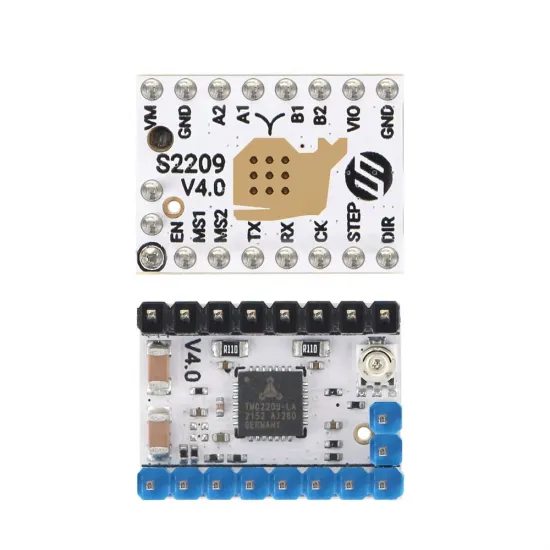
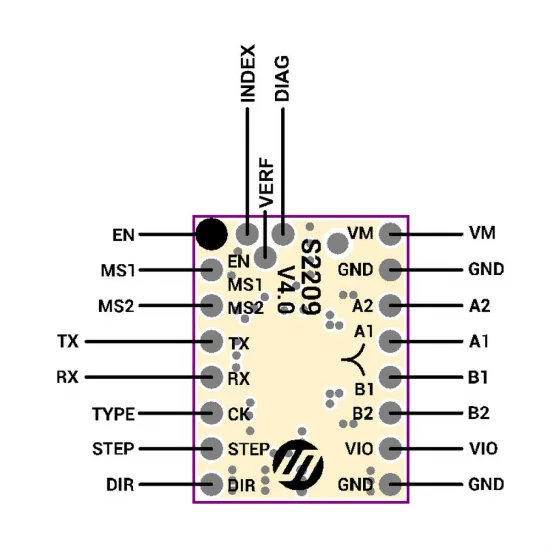
Revision V4.0 pinout
| Group | Pins | Function |
|---|---|---|
| Control | EN, STEP, DIR | Enable, step and direction |
| Configuration | MS1, MS2 | Standalone microsteps or UART address |
| Communication | TX, RX | Single-wire UART through PDN_UART |
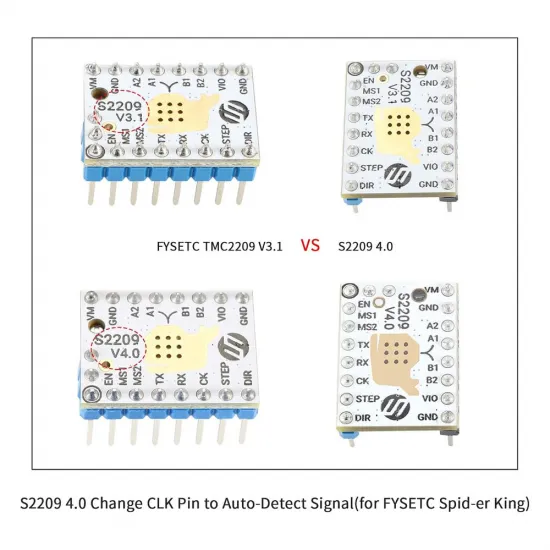
| V4.0 identification | TYPE | Module-type identification; the physical board may retain CK silkscreen at this position |
| Motor | A1, A2, B1, B2 | Outputs for both motor coils |
| Power | VM, VIO, GND | Motor supply, logic supply and ground |
| Diagnostics | DIAG, INDEX, VREF | Diagnostics/StallGuard, index and current reference |
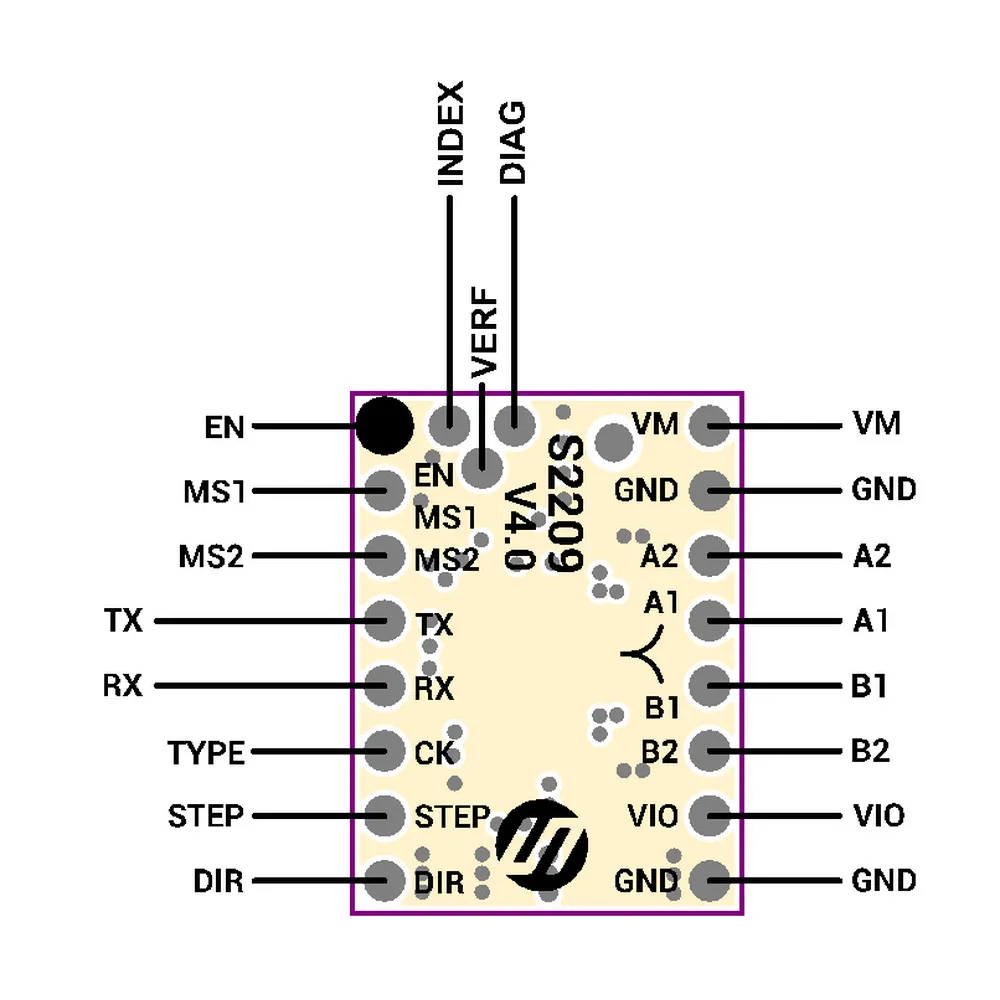
Important: FYSETC documentation names the pin replacing the former CLK pin on V4.0 as TYPE, although the visible silkscreen on some V4.0 units reads CK. Wiring must follow the revision-specific schematic and the controller-board manual.
Safe installation
- Fully disconnect the machine, including USB power.
- Consult the controller pinout and locate VM, GND, VIO, EN, STEP and DIR.
- Verify orientation before inserting the module. A StepStick may fit while rotated 180° and be damaged at power-up.
- Set mode and UART jumpers exactly as specified by the board manual.
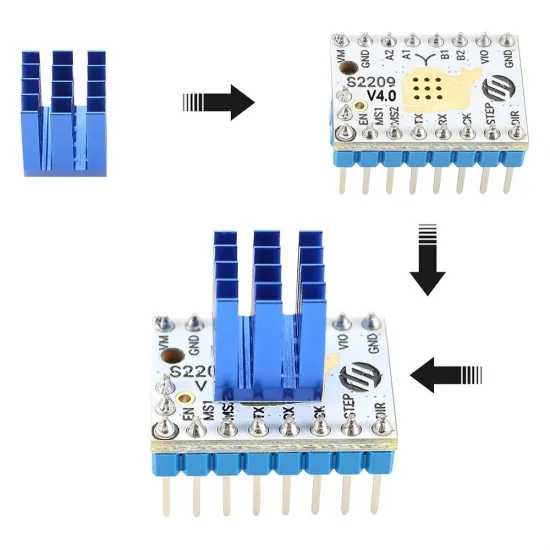
- Install the heatsink over the thermal area without touching pins or adjacent components.
- Begin with a moderate current and check temperature, torque, noise and missed steps.
Current adjustment and cooling
The 2 A RMS and 2.8 A peak figures are IC limits under suitable conditions, not guaranteed continuous ratings for every small StepStick module. As a prudent practical reference, FYSETC places SilentStepStick operation around 1.2 A RMS when suitable heatsinking, airflow and thermal monitoring are provided.
The correct current depends on the motor, supply voltage, acceleration, mechanical load, ambient temperature and airflow. Too little current may cause missed steps; excessive current increases both motor and driver temperature. In UART mode, begin conservatively and review diagnostics. In standalone mode, VREF must be measured with suitable instruments using the revision V4.0 procedure; do not apply a formula intended for another board.
Marlin configuration
For UART operation, declare the axis driver as TMC2209. For example:
#define X_DRIVER_TYPE TMC2209When used only as a standalone STEP/DIR driver, TMC2209_STANDALONE may be appropriate. Serial pins, jumpers and available features depend on the board and Marlin version.
M906can read or adjust current when supported by the configuration.M122displays driver status and helps verify communication.- Uniform “all LOW” or “all HIGH” responses commonly indicate a power, UART wiring, address or pin problem.
StealthChop, hybrid threshold and sensorless homing are separate features. Selecting TMC2209 in Marlin does not configure them automatically.
Klipper configuration
A minimal section follows this structure, replacing the placeholders with the actual controller and motor data:
[tmc2209 stepper_x]
uart_pin: <controller_UART_pin>
run_current: <suitable_RMS_current>
interpolate: True
stealthchop_threshold: 0
run_current is expressed in RMS amperes. Klipper's default sense_resistor value is 0.110 Ω, matching the official V4.0 schematic, so it normally does not need to be declared. stealthchop_threshold: 0 keeps SpreadCycle enabled; StealthChop should only be activated after considering noise, torque and positional accuracy.
DUMP_TMC STEPPER=stepper_x can be used to inspect registers. A UART read error may be caused by missing motor power, an incorrect pin or address, misplaced jumpers, or the need to fully power-cycle the machine before testing again.
RepRapFirmware use
RepRapFirmware can control the module as an external STEP/DIR/EN driver when the board provides suitable outputs. In this case:
M569defines axis direction and may require explicit STEP/DIR timing for an external driver.M350must match the physically selected microsteps when the firmware has no UART control of the TMC2209.M906can only change current when the hardware and that RepRapFirmware version provide a compatible control interface; it cannot control the potentiometer of a standalone module by itself.
UART, diagnostics, StealthChop and StallGuard availability depends on the Duet or compatible board, its expansion hardware and firmware version. There is no universal configuration for every RepRapFirmware controller.
Sensorless homing is installation dependent
StallGuard4 can detect axis load and create a virtual endstop, but it requires UART, compatible DIAG routing and calibration. The threshold varies with current, homing speed, temperature, moving mass and machine friction. It must not be treated as plug-and-play, particularly on Z axes or mechanisms where a false trigger or collision could cause damage.
The FYSETC S2209 V4.0 is a versatile way to upgrade a controller with replaceable driver sockets and gain quiet motion, diagnostics and advanced configuration. Reliable operation depends on treating it as a configurable electronic component: check revision, orientation, cooling, current and the exact controller-board documentation before applying power.