

- Stock: 37
- Model: TMC2209-MKS

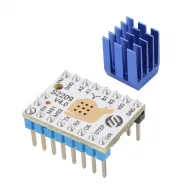
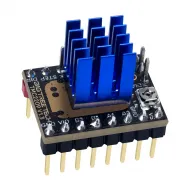
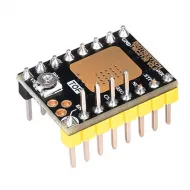
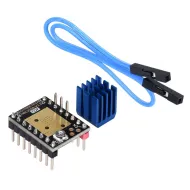
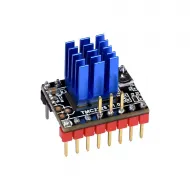
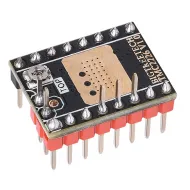
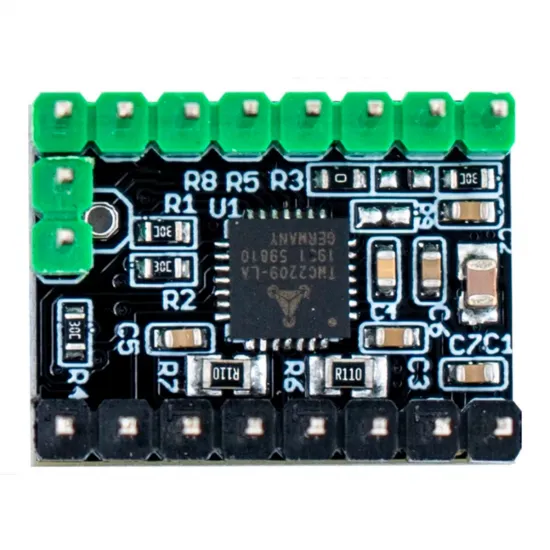
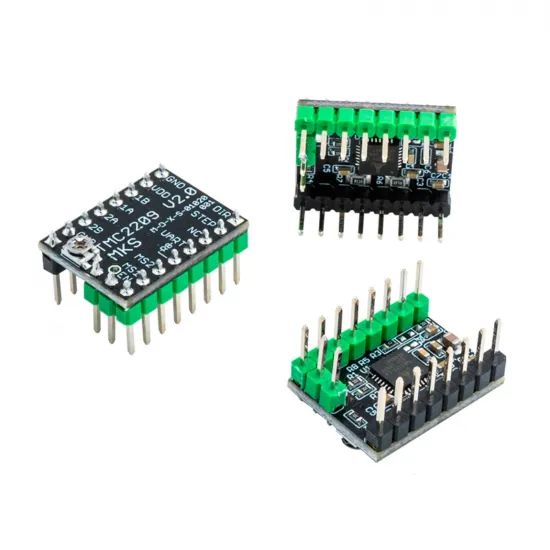
The MKS TMC2209 V2.0 is a StepStick driver for two-phase bipolar stepper motors, designed to reduce motion noise and allow advanced firmware configuration. It can operate through conventional STEP/DIR signals or use single-wire UART to configure current, microsteps, operating modes and diagnostics.
This listing refers to the physical V2.0 revision. Compared with V1.0, Makerbase moved the DIAG output to simplify sensorless homing on compatible controllers. This feature is not automatic: it requires UART, correctly routed DIAG, suitable logic voltage, firmware configuration and tuning on the actual machine.
Main functions
- StealthChop2: particularly quiet operation at suitable speeds and loads.
- SpreadCycle: current control aimed at more dynamic motion and a wider torque margin.
- MicroPlyer: internal interpolation up to 256 microsteps for smoother motion without requiring that input resolution from the controller.
- StallGuard4: load or stall detection that may be used for sensorless homing when the installation is compatible and properly tuned.
- CoolStep: load-dependent current adjustment available through compatible UART configuration.
- UART: firmware control of RMS current, microsteps, modes and diagnostics.
- STEP/DIR: conventional operation even on controllers that do not manage the driver through UART.
Verified specifications
| Feature | Value |
|---|---|
| Manufacturer and revision | MKS / Makerbase TMC2209 V2.0 |
| Integrated circuit | Trinamic / Analog Devices TMC2209 |
| Compatible motor | Two-phase bipolar stepper motor |
| Motor supply | 5.5-28 V DC using the internal regulator; suitable for common 12 and 24 V systems |
| VIO logic voltage | 3.3 or 5 V; Makerbase requires 3.3 V for sensorless operation on this revision |
| Interfaces | EN, STEP, DIR and single-wire UART |
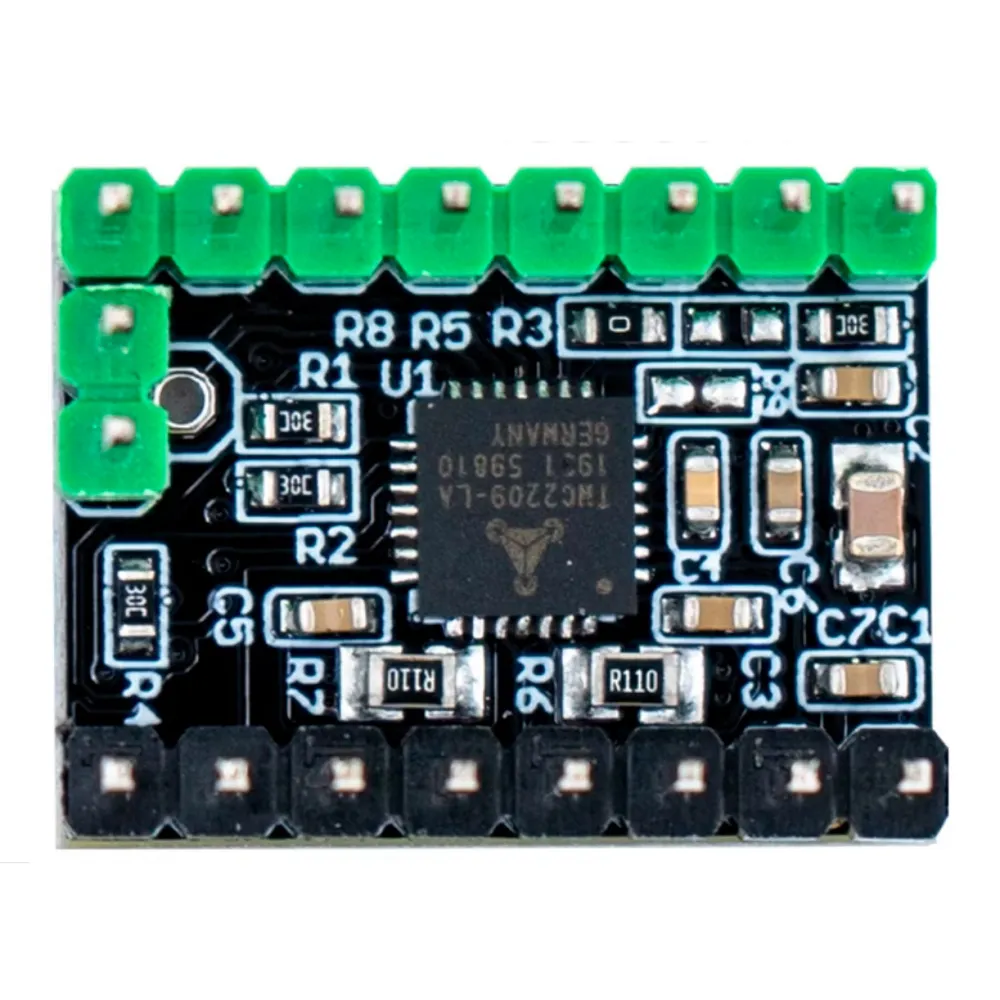
| Sense resistors | 0.11 ohm, marked R110 |
| Standalone microsteps | 1/2, 1/4, 1/8 or 1/16 through MS1/MS2 |
| UART resolution | Configurable up to 1/256 |
| Interpolation | MicroPlyer up to 256 microsteps |
| Chopper modes | StealthChop2 and SpreadCycle |
| Detection | StallGuard4 with DIAG output; use depends on controller, logic, firmware and tuning |
| PCB dimensions | 15.24 x 20.32 mm, excluding pins and accessories |
| Contents | 1 MKS TMC2209 V2.0 driver |
Current and VREF adjustment
In standalone operation, the potentiometer controls VREF. The official MKS V2.0 schematic relates its 0.11 ohm sense resistors to these approximate values:
| Measured VREF | RMS current stated by MKS |
|---|---|
| 0.50 V | 0.35 A RMS |
| 1.25 V | 0.88 A RMS |
| 2.50 V | 1.77 A RMS theoretical; do not use as a default continuous setting |
A 1.25 V reading does not mean 1.25 A: the module's own schematic equates it to approximately 0.88 A RMS. With UART, RMS current is normally configured in firmware; use the potentiometer only in accordance with the controller and driver documentation.
Insufficient current may cause missed steps, while excessive current heats the motor, driver and controller. A heatsink, when used, does not replace suitable airflow through the electronics compartment.
Microsteps in standalone STEP/DIR mode
| MS2 | MS1 | Input microsteps | Interpolation |
|---|---|---|---|
| GND | GND | 1/8 | Up to 1/256 |
| GND | VIO | 1/2 | Up to 1/256 |
| VIO | GND | 1/4 | Up to 1/256 |
| VIO | VIO | 1/16 | Up to 1/256 |
Other resolutions may be selected through UART. When multiple TMC2209 drivers share one serial line, MS1 and MS2 may also select a UART address from 0 to 3; the jumper arrangement depends on the controller.
Pinout, orientation and compatibility
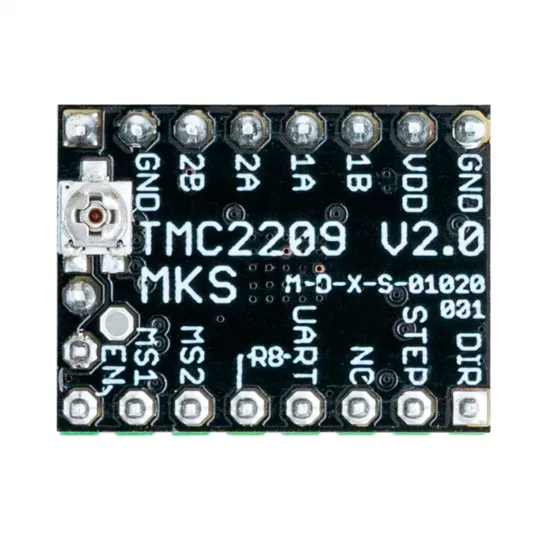
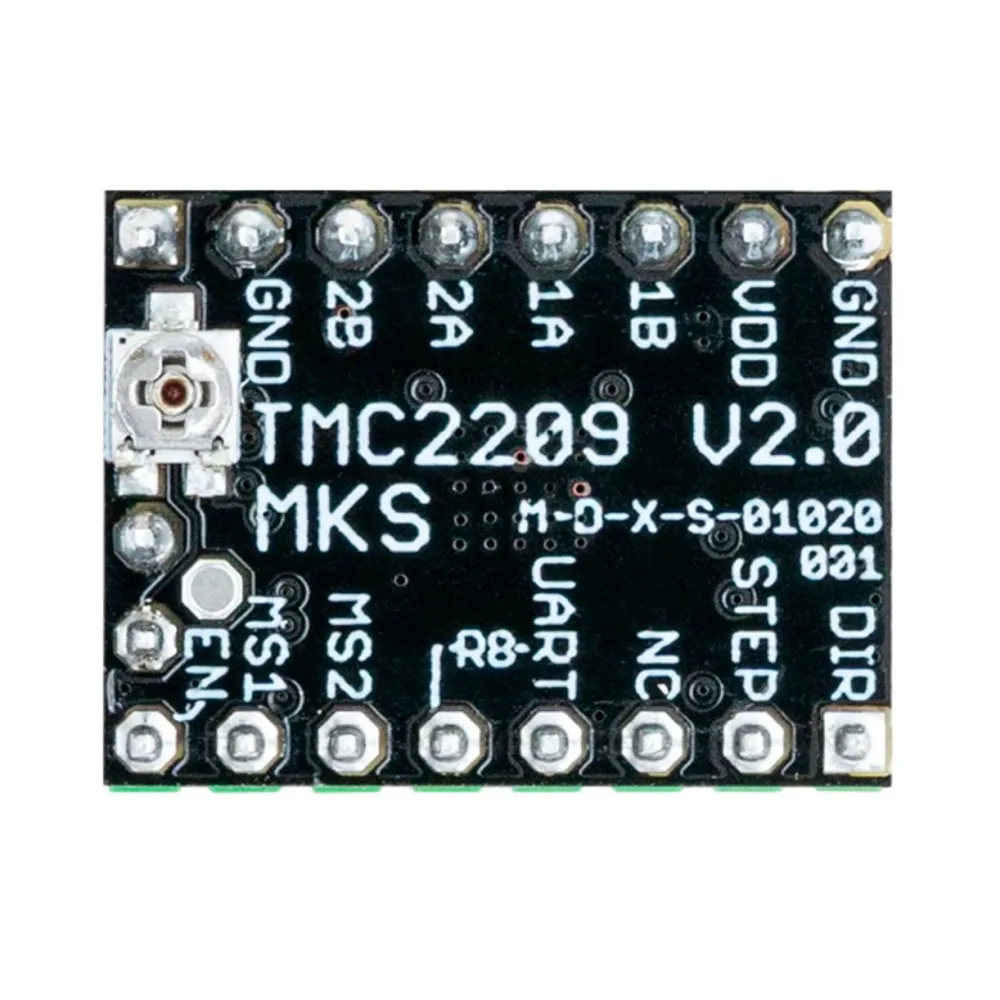
The module uses the common StepStick format, but physical fit does not prove electrical compatibility. Before applying power, VM, GND, VIO, EN and DIR must match between driver and controller. Also check motor voltage, logic voltage, UART pin, DIAG position and available space.
| Group | Pins | Function |
|---|---|---|
| Control | EN, STEP, DIR | Enable, step pulse and direction |
| Configuration | MS1, MS2, CLK | Microsteps or UART address and optional clock |
| Communication | UART / PDN_UART | Single-wire configuration and diagnostics |
| Motor | 1A, 1B, 2A, 2B | Outputs for the two motor coils |
| Power | VM, VIO and GND | Motor supply, logic supply and ground |
| Diagnostics | DIAG and INDEX | Stall/error detection and configurable index |
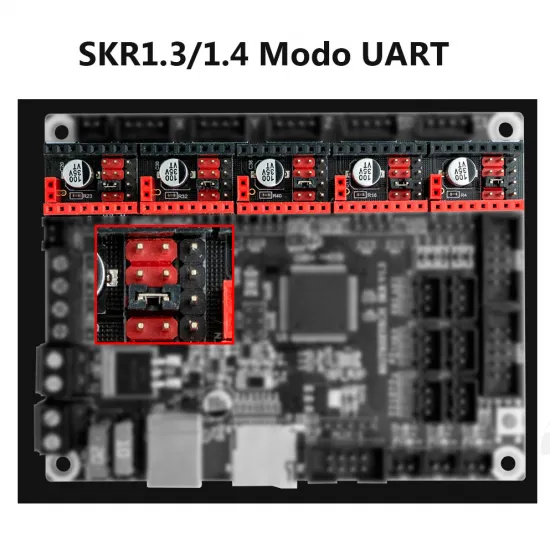
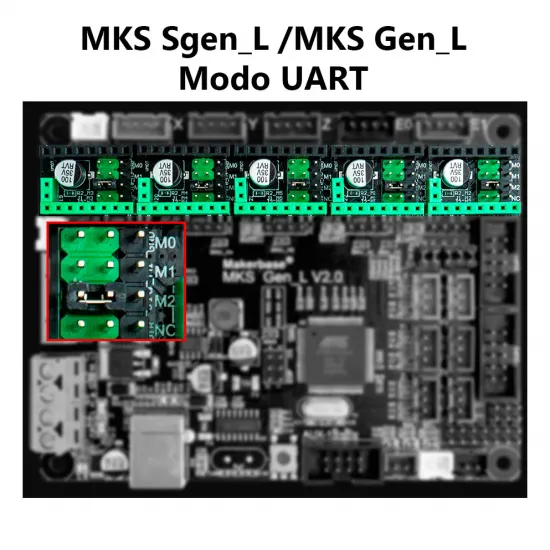
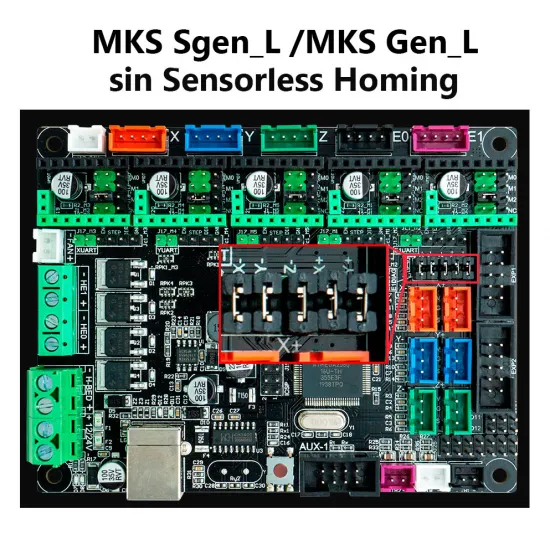
Makerbase specifically lists MKS SGEN_L, MKS Gen_L V2.1 and MKS Robin E3D as controllers prepared to use DIAG with this revision. Their exact manual and jumper layout must still be followed, and Makerbase requires 3.3 V driver logic for sensorless operation.
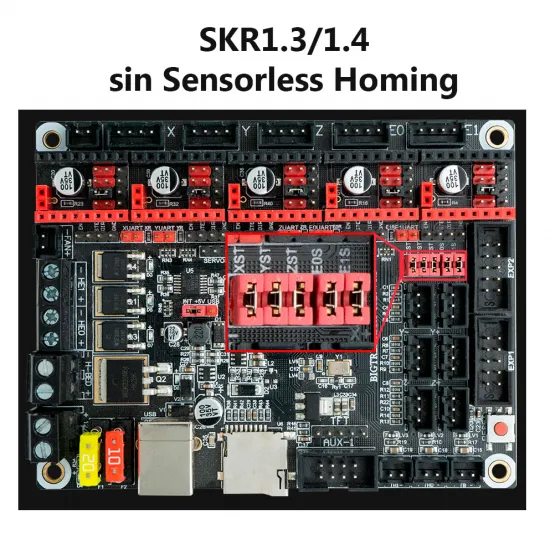
Other MKS, BIGTREETECH, FYSETC or StepStick-compatible controllers may support it in STEP/DIR or UART mode, but this must not be assumed from the controller or printer name alone. It is not a direct replacement for electronics with soldered drivers or a proprietary pinout.
It can control NEMA 17 motors such as our 1.7 A NEMA 17 stepper motor when current and mechanics are configured correctly. The motor's nominal current must not simply be copied as the driver setting. If another current implementation of the same chip is preferred, consider the BIGTREETECH TMC2209 V1.3, while checking pinout, UART, DIAG and controller again.
Safe installation
- Switch off the power supply and disconnect the USB cable.
- Consult the pinout and jumper diagram for the exact controller revision.
- Verify orientation using VM/GND and EN/DIR before inserting the module.
- Configure the socket for standalone STEP/DIR or UART as specified by the controller manual.
- Connect both motor coils according to the actual pinout; never try combinations while powered.
- Set a conservative initial current and provide airflow through the electronics compartment.
- Begin with short, slow movements and check UART, temperature, noise, torque and missed steps.
- Enable sensorless only after normal motion has been verified and the machine can be stopped safely.
Marlin configuration
For UART control, declare the relevant axis driver as TMC2209. For example:
#define X_DRIVER_TYPE TMC2209When used only through STEP/DIR without communication, TMC2209_STANDALONE may be appropriate. RMS current, microsteps, interpolation and serial pins must come from the actual controller and motor; there is no universal copy-and-paste configuration.
M122: checks communication and reports driver status.M906: reads or changes current when UART is working.M913: adjusts the hybrid threshold ifHYBRID_THRESHOLDis enabled.M914: adjusts sensitivity ifSENSORLESS_HOMINGis enabled.
On a TMC2209, sensitivity 255 is the most sensitive and 0 the least sensitive. Excessive sensitivity may cause false triggers, while a low value may fail to detect the stop. Marlin recommends removing the second homing bump for an axis using sensorless homing.
Klipper configuration
A base section follows this structure, replacing placeholders with the actual controller pins and motor current:
[tmc2209 stepper_x]
uart_pin: <controller_UART_pin>
run_current: <suitable_RMS_current>
sense_resistor: 0.110
interpolate: True
stealthchop_threshold: 0
run_current is expressed in RMS amperes. stealthchop_threshold: 0 keeps SpreadCycle active; a high threshold may be used for StealthChop after considering noise, torque and positional accuracy. Klipper generally recommends leaving hold_current undefined unless there is a justified need.
If multiple TMC2209 drivers share a UART line, uart_address accepts values from 0 to 3 when the controller allows address selection through MS1/MS2. DUMP_TMC STEPPER=stepper_x can be used to inspect communication and registers.
Sensorless homing in Klipper
[tmc2209 stepper_x]
diag_pin: ^<controller_DIAG_pin>
driver_SGTHRS: <tuned_value_0_to_255>

[stepper_x]
endstop_pin: tmc2209_stepper_x:virtual_endstop
homing_retract_dist: 0
Tune one axis at a time and start with the carriage near the centre. On a TMC2209, 255 is maximum sensitivity and 0 is minimum. The result changes with speed, current, mass, friction and temperature, so another printer's value should not be copied. Move the carriage away from the stop before repeating a homing operation.
Real sensorless homing limitations
StallGuard4 can replace a mechanical switch on some X or Y axes, but detection depends on the carriage reaching a firm and repeatable limit. It may be unreliable at very low or very high speeds and may change if current, belt tension, temperature or friction changes.
We do not recommend presenting it as a universal Z-axis solution: a leadscrew may generate considerable force and repeatability may be insufficient for first-layer positioning. A physical endstop may be safer in critical, delicate or collision-sensitive mechanisms.
Is it for you?
It is for you if your controller has compatible StepStick sockets, you have checked orientation and pinout, and you want quiet motion with optional UART adjustment and diagnostics.
It is not for you if your controller has soldered drivers, you cannot confirm VM/GND/VIO, you require high current without cooling, or you expect plug-and-play sensorless homing without configuring controller and firmware.
Contents
- 1 x MKS TMC2209 V2.0 driver.
The MKS TMC2209 V2.0 combines quiet motion, UART control and StallGuard4 in a compact module. For reliable operation, always check controller revision, orientation, jumpers, motor current, cooling and firmware configuration before applying power.