

- Stock: 190
- Model: TMC2209-Bigtreetech

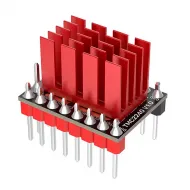
Model:

TMC2130 SPI

TMC2130 STEP/DIR

TMC2208 UART

TMC2209 - UART

TMC2225 UART

TMC2226 UART - STEP/DIR

TMC2240 SPI

TMC5160 pro SPI
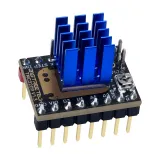
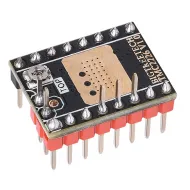
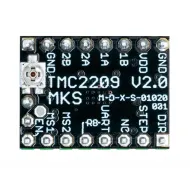
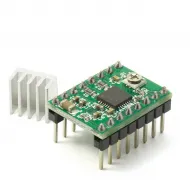
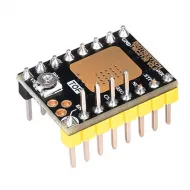
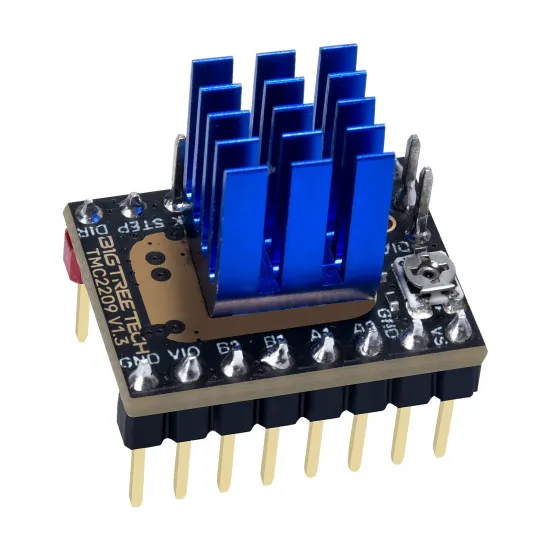
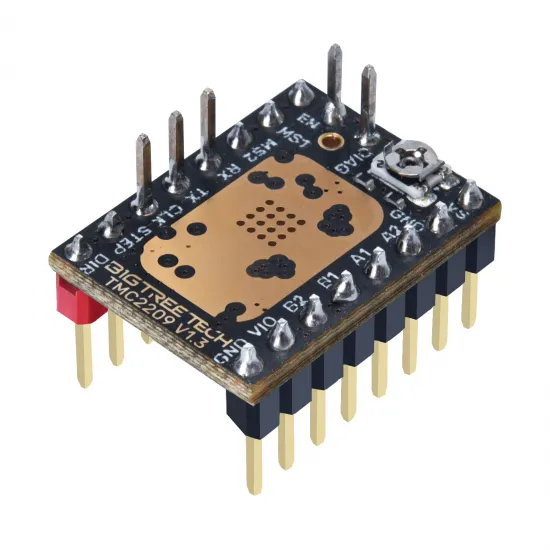
The BIGTREETECH TMC2209 V1.3 is a StepStick driver for two-phase bipolar stepper motors, designed for quiet motion, accurate control and advanced configuration in 3D printers, light CNC machines, robots and automation projects. It can operate through standard STEP/DIR signals or communicate over UART to configure current, microsteps and operating mode from firmware.
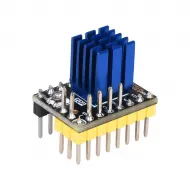
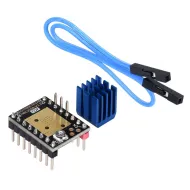
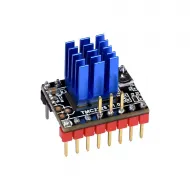
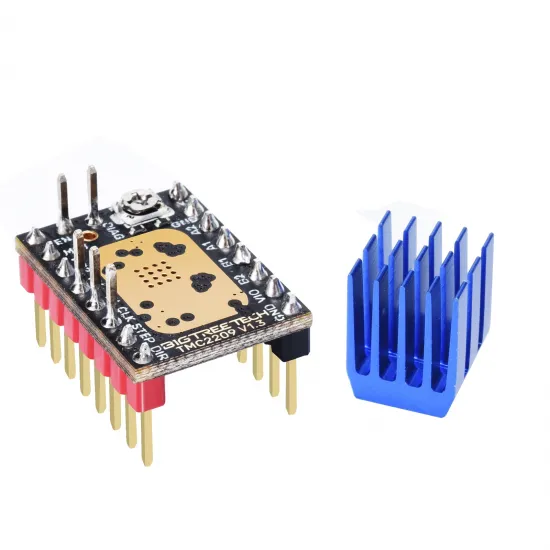
This listing is specifically for revision V1.3 and includes one driver and one blue heatsink. It supports StealthChop2, SpreadCycle, MicroPlyer, CoolStep and StallGuard4. These features are not all enabled automatically: availability depends on the controller, its jumpers, UART/DIAG wiring and suitable firmware configuration.
Main features
- StealthChop2: particularly quiet operation at suitable speeds and loads.
- SpreadCycle: intended for dynamic response and accurate current control when torque and stability are priorities.
- MicroPlyer: internal interpolation up to 256 microsteps for smoother motion without requiring that step frequency from the MCU.
- StallGuard4: load and stall detection, suitable for sensorless homing when the complete installation is compatible and calibrated on the actual machine.
- CoolStep: dynamic current adaptation available in supported UART configurations.
- UART: firmware control of RMS current, microsteps, modes and driver diagnostics.
Technical specifications
| Feature | Value |
|---|---|
| Manufacturer and revision | BIGTREETECH TMC2209 V1.3 |
| Driver IC | Trinamic / Analog Devices TMC2209 |
| Motors | Two-phase bipolar stepper motors |
| Motor supply | 12–28 V DC according to the V1.3 module manual; suitable for common 12 and 24 V systems |
| Module current | Up to 2 A peak according to the V1.3 manual; actual capacity depends on cooling and temperature |
| Cooling | BIGTREETECH requires active cooling above 1.2 A |
| Sense resistors | 0.11 Ω |
| Interfaces | STEP, DIR, EN and single-wire UART |
| Microsteps | Standalone selection up to 1/16; configuration and interpolation up to 1/256 |
| Modes | StealthChop2 and SpreadCycle |
| Detection | StallGuard4 with DIAG output; subject to controller, wiring, firmware and calibration |
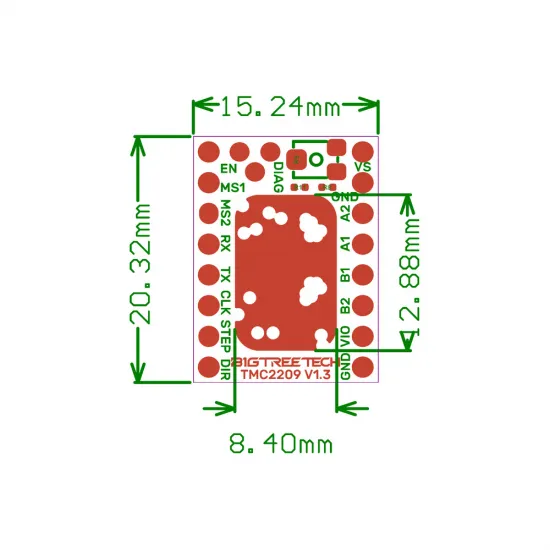
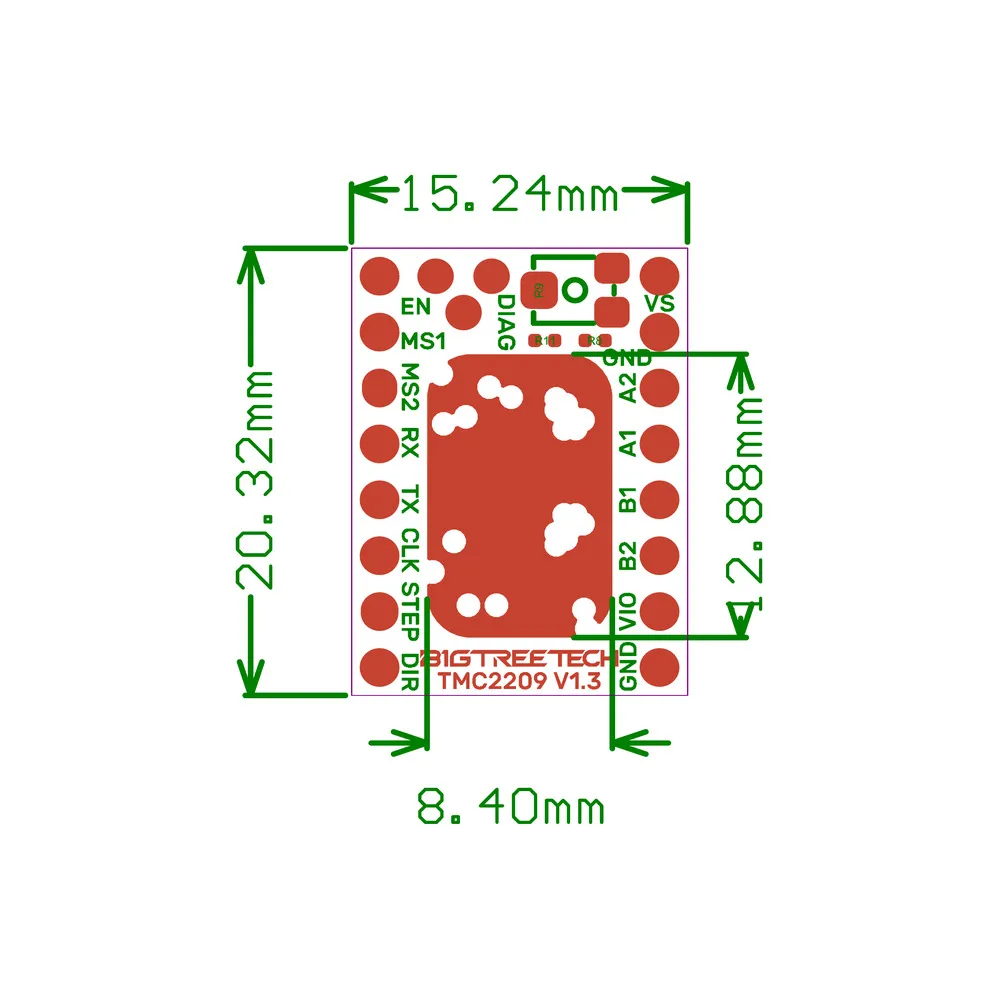
| PCB dimensions | 20.32 × 15.24 mm |
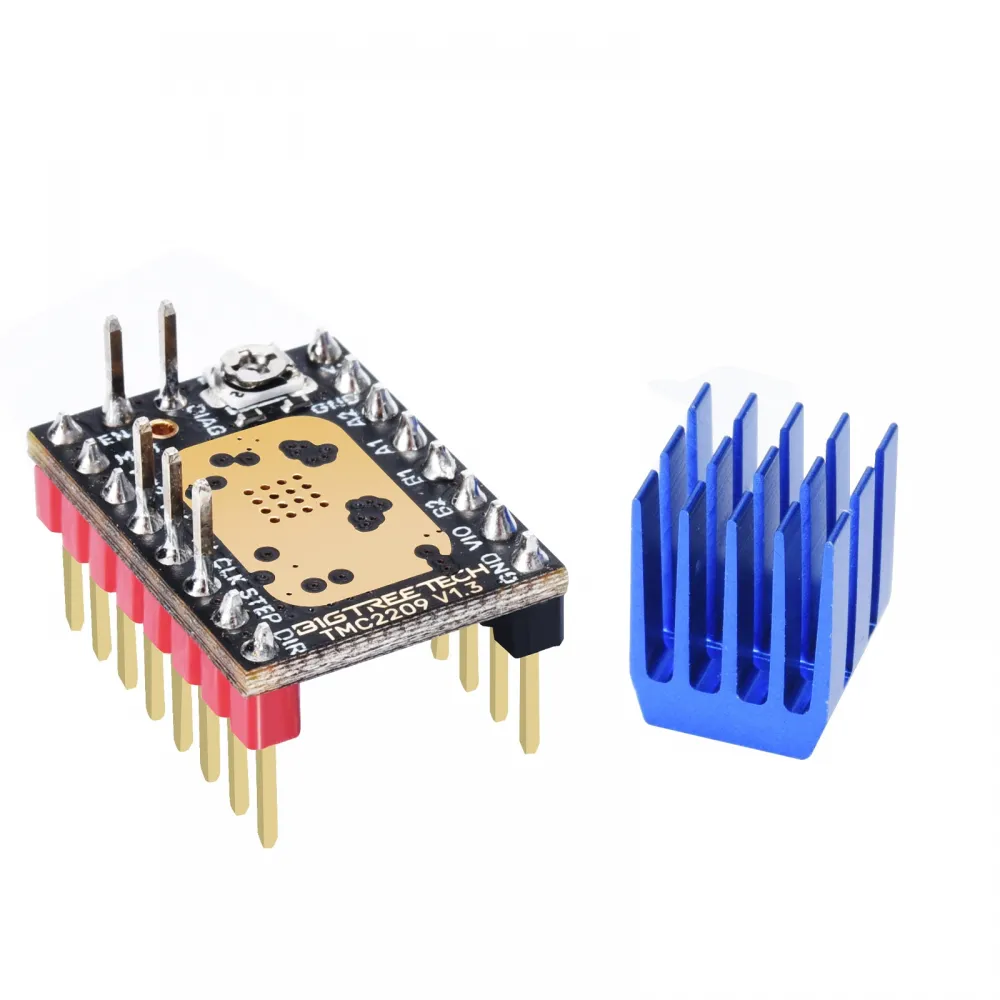
| Contents | 1 BIGTREETECH TMC2209 V1.3 driver and 1 blue heatsink |
Compatibility depends on the actual controller
The module can be conditionally used in controllers with replaceable StepStick sockets that support the TMC2209 pinout, orientation and voltages. UART also requires the correct jumpers, serial pin and configured address. Sensorless homing additionally requires DIAG to be routed to the appropriate endstop input.
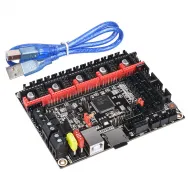
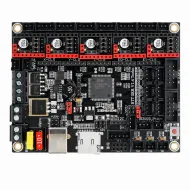
The BIGTREETECH SKR 3 is an officially documented example for this V1.3, but its own jumper diagram and orientation must be followed. Other SKR, MKS, FYSETC and similar socketed controllers may use a different configuration; physical fit does not prove electrical compatibility.
This is not a direct replacement for controllers with soldered drivers, proprietary connectors or a different assignment. Compatibility cannot be guaranteed from the printer name alone: a Creality Ender, Prusa, Voron or another machine may use different controller boards and revisions.
For NEMA 17 motors, such as our 1.7 A NEMA 17 stepper motor, driver current must be calculated for the actual motor and mechanics. Do not copy a setting from another printer because transmission, acceleration, moving mass, airflow and motor rating may differ.
Standalone STEP/DIR or UART control
Standalone STEP/DIR mode
The controller drives EN, STEP and DIR without accessing the TMC2209 registers. Microsteps are selected through MS1/MS2 and current depends on physical VREF adjustment. This is useful for controllers without UART, but it does not provide firmware current control, full diagnostics or firmware-managed sensorless homing.
UART mode
V1.3 is factory-prepared for UART through the RX pin identified in the manual. UART provides firmware control of RMS current, microsteps, interpolation, StealthChop2, SpreadCycle and driver diagnostics. Some boards require another assignment: BIGTREETECH provides R10 pads for routing UART to two pin positions, but this modification should only be made when required by the exact controller manual.
Standalone microstep selection
| MS1 | MS2 | Input microsteps | Interpolation |
|---|---|---|---|
| GND | GND | 1/8 | Up to 1/256 |
| VIO | GND | 1/2 | Up to 1/256 |
| GND | VIO | 1/4 | Up to 1/256 |
| VIO | VIO | 1/16 | Up to 1/256 |
Other values can be selected through UART, and MS1/MS2 may provide addressing when several TMC2209 drivers share one serial line. The jumper pattern beneath the socket is controller-specific.
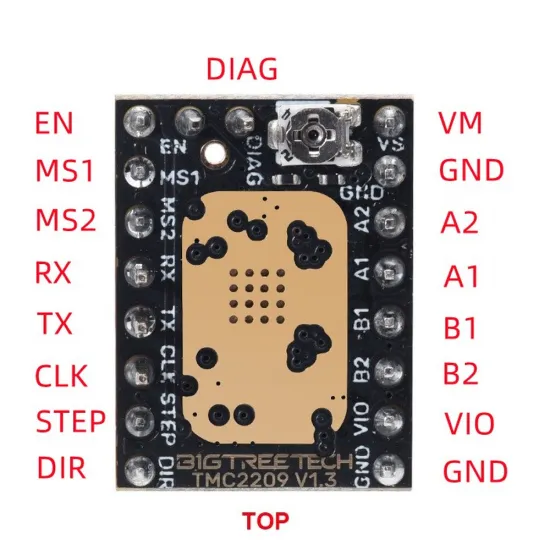
V1.3 pinout and orientation
| Group | Pins | Function |
|---|---|---|
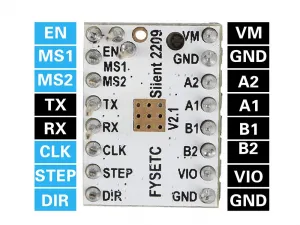
| Control | EN, STEP, DIR | Enable, step pulse and direction |
| Configuration | MS1, MS2, CLK | Microsteps/UART address and optional external clock |
| Communication | RX, TX | Single-wire UART; assignment depends on R10 and controller design |
| Motor | A1, A2, B1, B2 | Outputs for both motor coils |
| Power | VM/VS, VIO and GND | Motor supply, logic supply and ground |
| Diagnostics | DIAG | StallGuard output for diagnostics or a virtual endstop where supported |
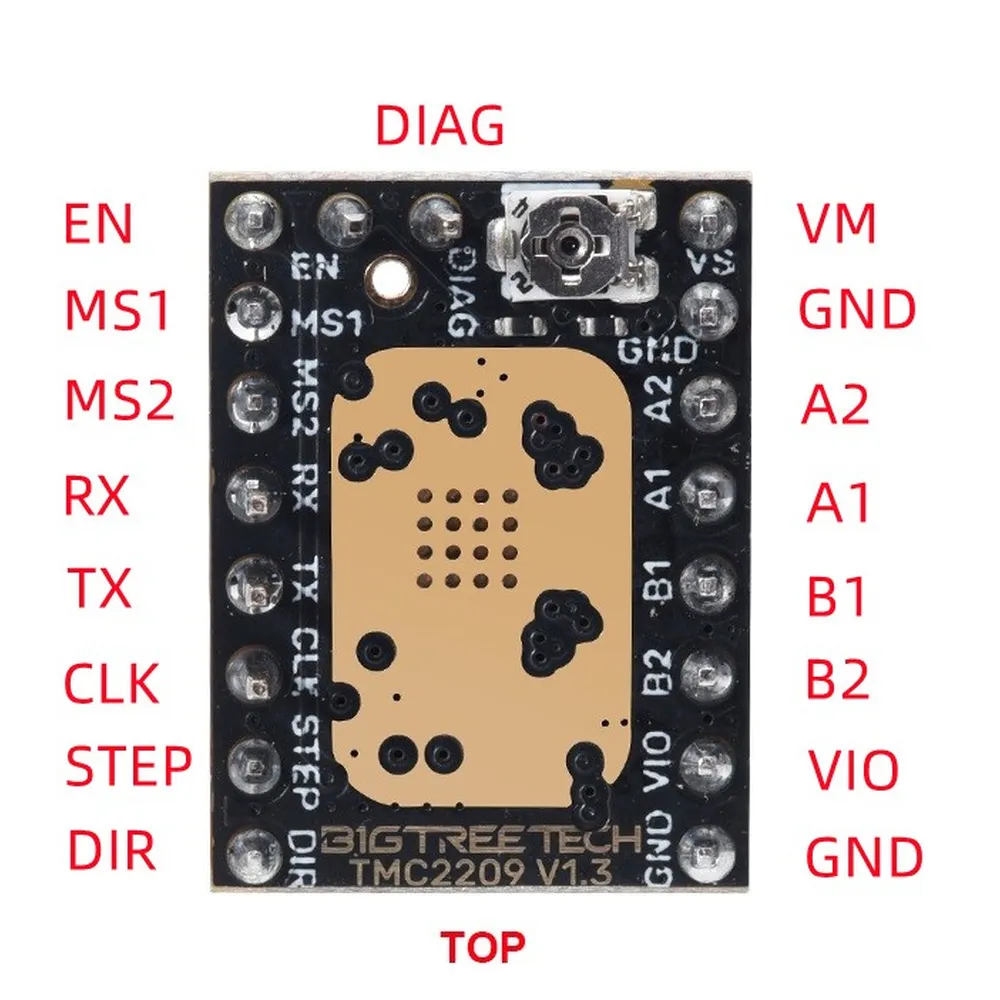
Safe installation
- Disconnect the main power supply and USB cable.
- Consult the pinout and jumper diagram for the exact controller revision.
- Verify orientation using VM/GND and EN/DIR before inserting the module.
- Configure the socket for UART or standalone operation as specified by that controller manual.
- Install the heatsink over the indicated thermal area without touching the potentiometer or causing a short circuit.
- Connect both motor coils according to the controller pinout.
- Configure a conservative initial current and begin with short, slow movements.
- Check communication, temperature, noise, torque and missed steps before increasing speed or acceleration.
Never connect or disconnect the motor, insert or remove the driver, or change jumpers while the electronics are powered.
Current adjustment and cooling
Too little current may cause missed steps; excessive current heats both the motor and driver and may trigger thermal shutdown. In UART mode, RMS current should normally be configured in firmware and checked under real load. In standalone mode, follow the VREF procedure for this revision; do not use a formula intended for another carrier board.
The supplied heatsink improves heat transfer but does not replace airflow. BIGTREETECH requires active cooling above 1.2 A, and it may be needed earlier inside a closed enclosure, at high ambient temperature or beside other hot drivers.
Marlin configuration
For UART operation, declare the relevant axis driver as TMC2209. For example:
#define X_DRIVER_TYPE TMC2209When used only as a standalone STEP/DIR driver, TMC2209_STANDALONE may be appropriate. In Configuration_adv.h, review RMS current, microsteps, interpolation and the 0.11 Ω sense resistance for every axis. Serial pins must come from the actual controller pin file and manual.
M122: checks communication and reports driver status.M906: reads or changes current in mA when UART is working.M913: adjusts the hybrid threshold whenHYBRID_THRESHOLDis enabled.M914: adjusts sensitivity whenSENSORLESS_HOMINGis enabled.
StealthChop, SpreadCycle, hybrid threshold and sensorless homing are separate features. Selecting TMC2209 does not calibrate them automatically. Sensorless homing requires DIAG to be connected to the correct endstop, suitable endstop logic and sensitivity and speed tuning on the actual machine.
Klipper configuration
A base section follows this structure, replacing the placeholders with the actual controller pins and motor current:
[tmc2209 stepper_x]
uart_pin: <controller_UART_pin>
run_current: <suitable_RMS_current>
sense_resistor: 0.110
interpolate: True
stealthchop_threshold: 0
run_current is expressed in RMS amperes and has no universal value. stealthchop_threshold: 0 keeps SpreadCycle enabled; a very high threshold may be used for permanent StealthChop after considering noise, torque and positional accuracy. Klipper generally recommends leaving hold_current undefined unless there is a justified need.
uart_address accepts values from 0 to 3 when several TMC2209 drivers share one UART line and the controller permits address selection. DUMP_TMC STEPPER=stepper_x helps check communication and registers.
Sensorless homing in Klipper
[tmc2209 stepper_x]
diag_pin: ^<controller_DIAG_pin>
driver_SGTHRS: <tuned_value_0_to_255>

[stepper_x]
endstop_pin: tmc2209_stepper_x:virtual_endstop
homing_retract_dist: 0
On a TMC2209, 255 is the most sensitive setting and 0 the least sensitive. The correct value depends on current, homing speed, moving mass, temperature and friction. Tune it carefully and allow the carriage to move away from the stop before repeating a homing operation. Do not copy another printer's sensitivity value.
RepRapFirmware use
Advanced compatibility depends on the controller and its specific RepRapFirmware port. The module can operate as an external STEP/DIR/EN driver where compatible signals are available:
M569configures direction and, where applicable, external-driver timing.M350must match physically selected microsteps when UART control is unavailable.M906only changes current when that controller and firmware version can communicate with the driver; it cannot adjust a standalone module's potentiometer by itself.M915is used for stall detection in supported implementations, but requires a supported driver, correct DIAG/endstop routing and a calibrated homing sequence.
Some RepRapFirmware controllers include integrated TMC2209 drivers, but this does not prove that every external socket supports UART. The controller and firmware-version documentation must take priority.
Sensorless homing is useful but conditional
StallGuard4 can turn load detection into a virtual endstop and reduce the number of mechanical switches. However, it is not plug-and-play: it requires UART, correct DIAG routing, a suitable homing speed and sensitivity calibration. Friction, belt tension, temperature, current and moving mass can all change the trigger point.
Use particular care on Z and on mechanisms where a late or false trigger may cause damage. A separate physical endstop may remain preferable for critical installations.
Contents
- 1 × BIGTREETECH TMC2209 V1.3 driver.
- 1 × blue heatsink.
The BIGTREETECH TMC2209 V1.3 provides quiet motion, UART configuration and StallGuard4 in a compact StepStick format. Reliable operation depends on checking controller revision, orientation, jumpers, motor current, cooling and firmware configuration before applying power.