

- Stock: 53
- Model: Servo-360º
Type:

180°

360°
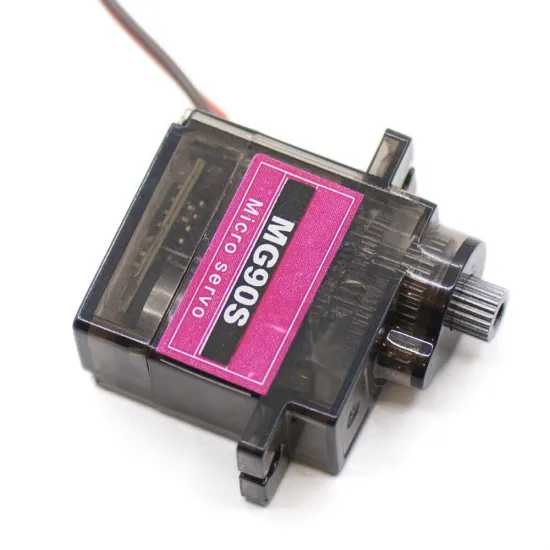
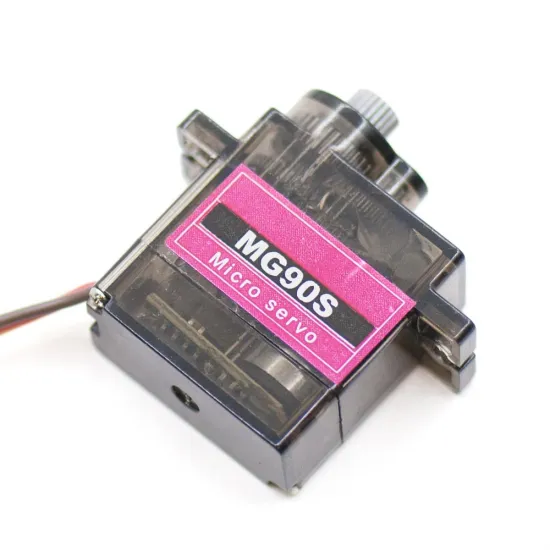
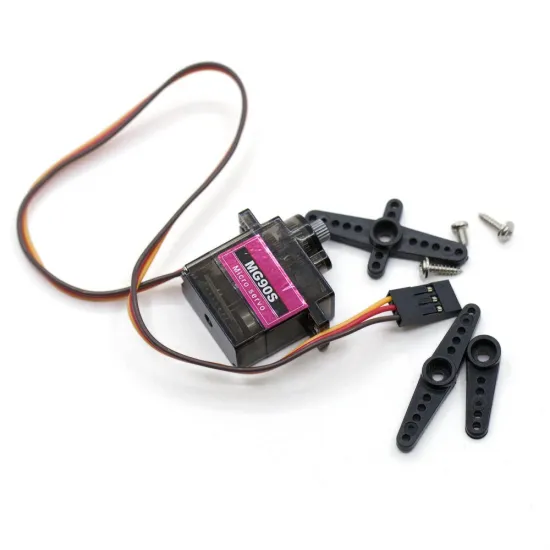
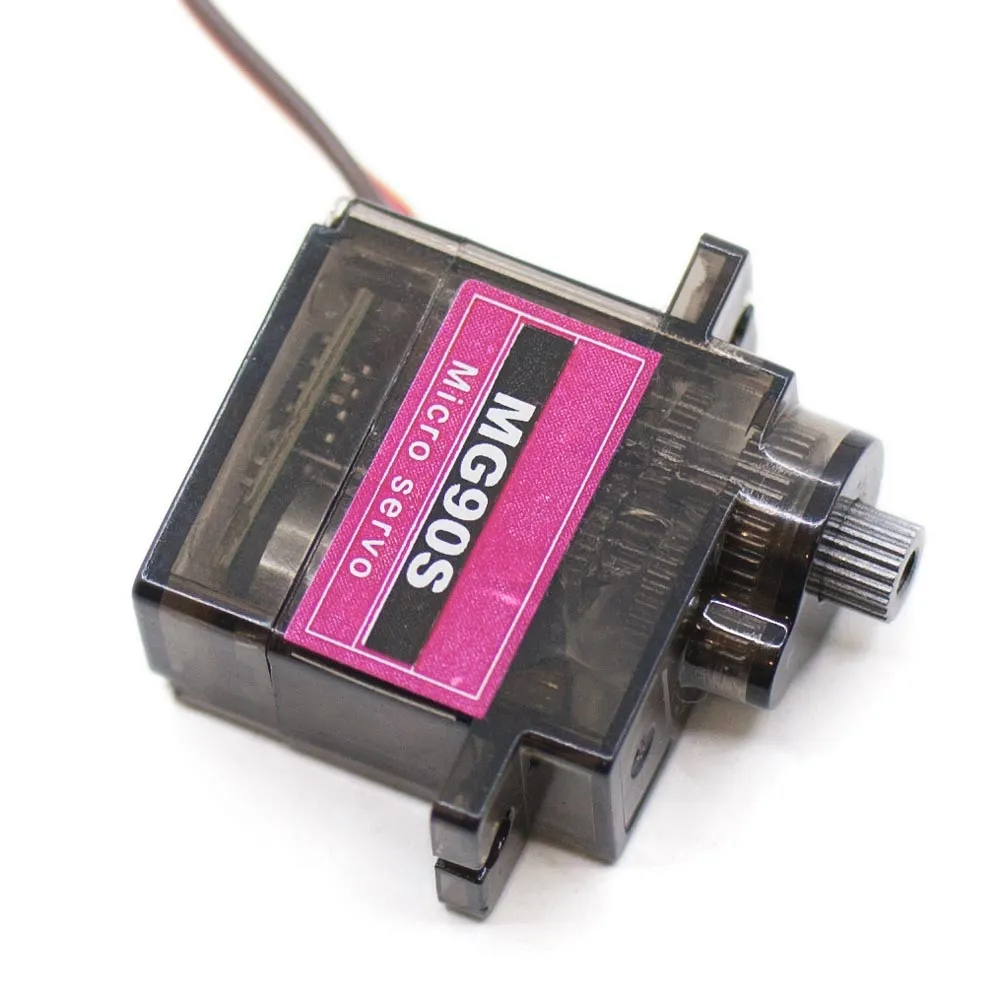
Continuous-rotation MG90S-type micro servo with metal gears and a compact body. This 360° version is intended to drive wheels, rollers and small mechanisms that need sustained rotation in either direction.
It is not a 0-to-360° positioning servo. The signal controls direction and speed around a neutral point; it cannot command a specific angle or one exact revolution on its own. An encoder or another external sensor is required to count turns or determine position.
Main features
- Continuous rotation: supports both directions and approximate speed control through a hobby-servo signal.
- Metal gears: provide greater wear resistance than an entirely plastic gear train.
- Micro format: suitable for educational robotics, small vehicles, feeders, rollers and compact automation.
- Three-wire control: power, ground and signal.
- Included accessories: three plastic horns and mounting hardware.
| Feature | Declared value |
|---|---|
| Type | Continuous-rotation micro servo |
| Gears | Metal |
| Reference supply | 4.8V; a regulated 5V supply may be used for commissioning |
| Declared stall torque | 2.0kgf·cm at 4.8V; this is not a continuous working-torque rating |
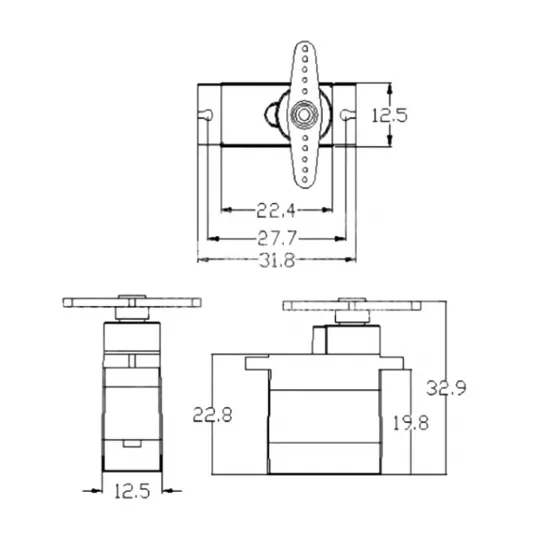
| Declared dimensions | 22.8 × 12.2 × 28.5mm |
| Weight | 13.4g |
| Lead | Approximately 22cm |
| Declared dead band | 5µs |
| Declared temperature range | 0-55°C |
How a continuous servo is controlled
As a starting point, a signal close to 1500µs normally represents neutral. Decreasing or increasing pulse width commands opposite directions, while moving farther from neutral increases speed. The exact value varies between units, so calibrate it in small steps with the mechanism lifted or unloaded.
If the servo creeps when the centre value is sent, adjust neutral by a few microseconds at a time until it stops. Actual direction may be opposite to the expected direction and speed is not closed-loop data: it changes with voltage, load and friction.
Safe power and wiring
- Use a regulated 5V supply able to handle servo start-up and stall peaks.
- Do not connect it directly to 12V or 24V and do not power it from a signal pin.
- When using an external supply, join its ground to the controller ground.
- The usual convention is brown or black for GND, red for positive and orange, yellow or white for signal. Always check connector order before applying power.
- Avoid holding the shaft stalled: current rises quickly and may damage the servo or power supply.
Arduino example
The official Arduino Servo library can control continuous servos in microseconds. This example first applies an approximate neutral value:
#include <Servo.h>

Servo motor;

void setup() {
  motor.attach(9);
  motor.writeMicroseconds(1500); // approximate initial neutral
}

void loop() {
  // Adjust around 1500µs in small steps.
}
Values near 1500µs help locate slow movement and the stop point. Do not start with wide endpoints: calibrate neutral first, then direction and finally the required speed.
Using it with 3D-printer firmware
- Marlin: enable at least one servo with
NUM_SERVOSand assign a compatible pin.M280 P0 S90is an approximate initial neutral; lower and higher values command opposite directions. Calibrate it on the machine. - Klipper: define a
[servo name]section. Neutral can be located withSET_SERVO SERVO=name WIDTH=0.0015, adjusting pulse width in small steps.WIDTH=0disables PWM output but is not a universal mechanical safety stop. - RepRapFirmware 3: first create a servo output with
M950 S0 C"pin_name", then control it withM280 P0 S1500. The pin name is board-specific.
For every firmware, confirm that the selected pin supports the required output and is not assigned to another function. Design servo power separately from logic power whenever the board output cannot supply current peaks.
Choose it if…
- You need compact continuous rotation in both directions.
- You want approximate speed and direction control from Arduino, a robotics controller or firmware with a servo output.
- Your application can calibrate neutral and does not need position data without extra sensors.
Do not choose it if…
- You need to command a specific angle: choose the 180° positional MG90S micro servo instead.
- You need to count revolutions, hold an angular position or measure speed accurately without an encoder.
- The mechanism requires high continuous torque, outdoor use, water resistance or a safety function.
Package contents: 1 continuous-rotation micro servo, 3 plastic horns and mounting hardware.