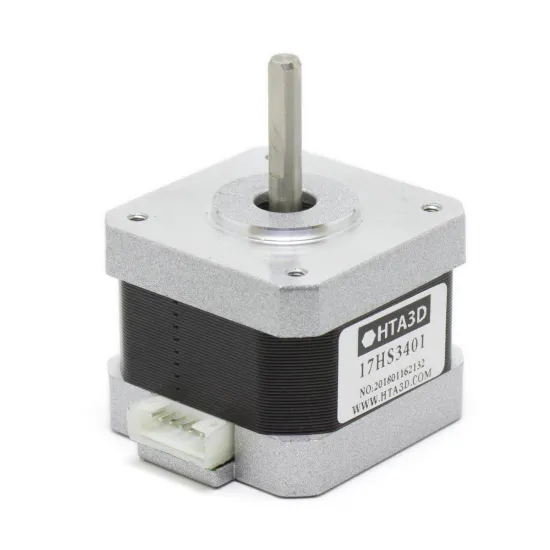
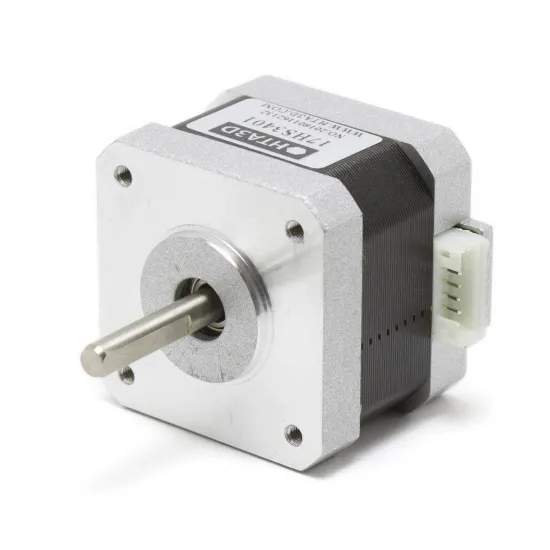
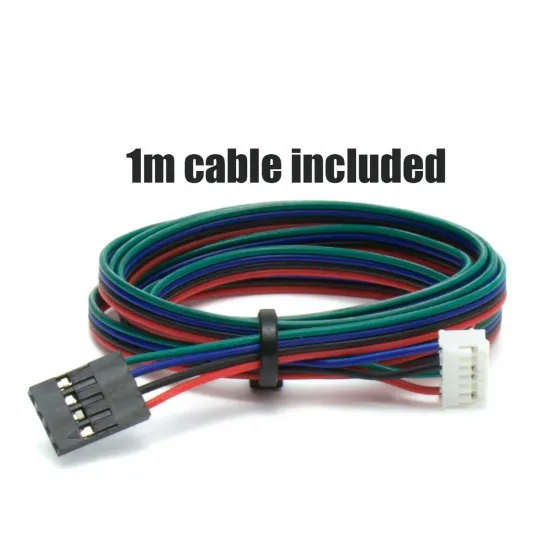


- Stock: Out of Stock
- Model: 17HS3401
Model:

17HS2408

17HS3401

17HS4401

17HS4401s-09

17HS8401

17hs8401S-09

17HS6401

17HS6401s-09
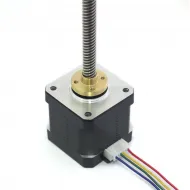
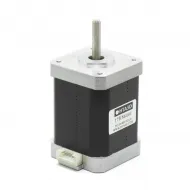
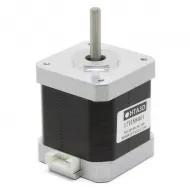
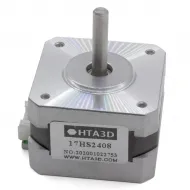
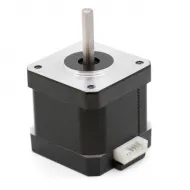
The 17HS3401 is a compact NEMA 17 stepper motor with a 34 mm body, 5 mm D-shaped shaft and 1.8° step angle. Its rated minimum holding torque is 28 N·cm. It can suit light or space-constrained mechanisms, including small belt axes, plotters, laser engravers and some moving extruders, provided the available running torque is sufficient for the actual load.
A cable of approximately 1 metre with a Dupont-style termination is included. The NEMA 17 face suits compatible mounts and transmissions, but the motor is not a universal replacement: check body length, shaft, load, current, connector and coil order first.
Electrical and mechanical data
| Feature | Rated value |
|---|---|
| Type | Two-phase, four-wire bipolar stepper |
| Step angle | 1.8°; 200 full steps per revolution |
| Rated current | 1.3 A per phase |
| Phase resistance / inductance | 2.4 Ω / 2.8 mH |
| Holding torque | 28 N·cm minimum (0.28 N·m), energized and stationary |
| Detent torque | 1.6 N·cm maximum, unpowered |
| Rotor inertia / motor mass | 34 g·cm² / approximately 220 g, without cable |
Holding torque is not the torque available at operating speed. Acceleration, transmission, supply voltage, current regulation and driver cooling also affect performance.
Dimensions and mounting
- NEMA 17 face up to 42.3 × 42.3 mm; 34 mm motor body length.
- Four M3 threaded mounting holes on a 31 ± 0.1 mm square pattern according to the series drawing.
- Ø22 mm centring boss, approximately 2 mm high.
- Front Ø5 mm shaft with D flat and nominal 24 ± 0.5 mm projection.
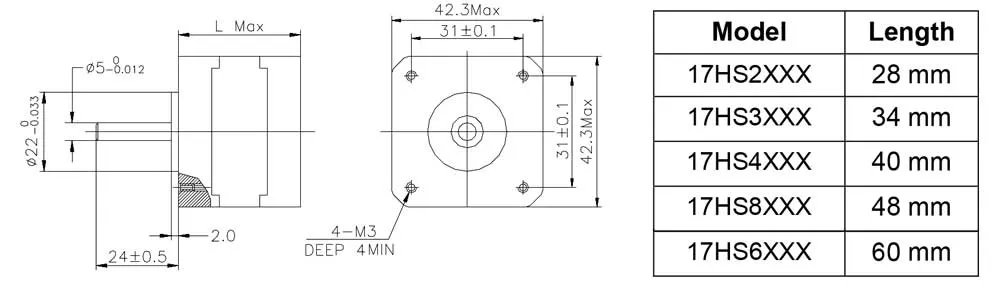
The drawing shows family dimensions. Check the delivered motor if your application has critical tolerances. Use M3 screws of suitable length so they do not enter the motor body.
Compatible components and alternatives
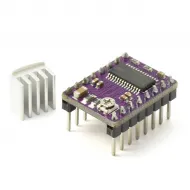
The motor can fit the NEMA 17 L bracket if there is room for its body and cable. Its shaft diameter suits a 20-tooth GT2 pulley with a 5 mm bore, subject to hub position and fastening a grub screw against the flat. It needs a current-regulated bipolar driver, such as a TMC2209 installed and cooled according to its controller board.
If more holding torque is needed and space allows it, compare the 40 mm, 40 N·cm NEMA 17 or the 48 mm, 52 N·cm 17HS8401. They are alternatives rather than automatic substitutes: mass, body length and electrical ratings differ.
For a specific printer — including an Ender, Prusa or Voron — NEMA 17 alone does not establish drop-in compatibility. Compare the existing motor code and dimensions, connector, coil pairs, driver, current and required running torque.
Wiring and initial setup
- With all power disconnected, identify both coil pairs using a multimeter. Do not assume a universal colour code or Dupont connector pinout.
- Wire each complete pair to one driver phase as shown in the driver's diagram. If the motor only vibrates, stop and recheck the pairs.
- Set current for the motor and the actual driver documentation, then monitor skipped steps and temperature. The 1.3 A per-phase rating is neither a universal VREF nor a firmware RMS setting that can be copied unchanged.
- Test direction, travel and acceleration at low speed before applying the working load.
Do not connect the motor directly to a 12 or 24 V supply, or plug/unplug it while the driver is powered. The driver controls winding current; incorrect wiring can damage the motor or electronics.
Steps per revolution and firmware
At 1.8° per step, the motor has 200 full steps per revolution. Travel per revolution depends on the pulley, leadscrew or gear reduction. For example, a direct 20-tooth GT2 pulley moves nominally 40 mm per revolution. With 16 microsteps and no reduction, the initial calculation is 80 steps/mm; adapt it to the transmission and calibrate the actual machine.
- Marlin: set the relevant axis microstepping and steps per millimetre.
M92adjusts steps per unit;M500saves after validation when EEPROM is enabled. - Klipper: for that example use
full_steps_per_rotation: 200,microsteps: 16androtation_distance: 40for the correct axis; change them for a different transmission. - RepRapFirmware:
M350sets microstepping andM92steps per unit.M906controls current only if firmware manages the driver; set an external driver's current on the driver itself.
Choose this motor if
You need a relatively light 34 mm NEMA 17 with a 5 mm D shaft and can verify that its 28 N·cm static holding torque and running behaviour suit your mechanism.
Choose another motor if
You need an identical replacement without checking dimensions and wiring, require more torque at speed, or intend to run the motor without a current-regulated driver.