

- Stock: 97
- Model: IR-Module
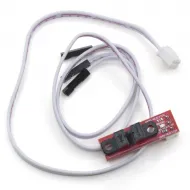
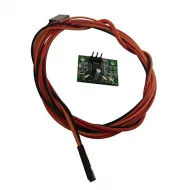
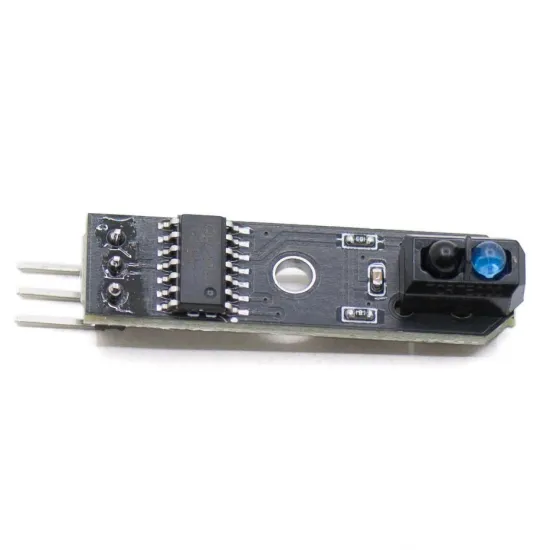
This TCRT5000 infrared reflective sensor module detects nearby surfaces, objects and contrast changes through a digital output. It is suitable for line-following projects, reflective-mark detection, optical counters, small automation systems and electronic prototypes.
The TCRT5000 combines an infrared emitter and a phototransistor facing in the same direction. Emitted light reflects from the surface in front of the sensor and returns to the receiver. When the reflected signal crosses the circuit threshold, the OUT signal changes state and the indicator LED switches on.
Applications
- Line-following robots.
- Detection of light and dark surfaces.
- Reading reflective marks.
- Edge and nearby-object detection.
- Rotation counting using a contrasting mark.
- Simple optical encoders for mechanisms and CNC machines.
- Arduino and microcontroller prototypes.
The module does not measure a specific distance or provide an analogue reflectivity value. Its output only switches between two digital states.
Working distance
The TCRT5000 manufacturer specifies a nominal peak response at approximately 2.5 mm. The component retains a relative optical response from approximately 0.2 to 15 mm under its test conditions, but the actual switching distance depends on:
- Surface colour and reflectivity.
- Matt, glossy or transparent finish.
- Object angle and alignment.
- Ambient lighting.
- Dirt on the emitter or receiver.
- Module tolerances and supply voltage.
For repeatable detection, begin at approximately 2–3 mm and adjust the physical position while testing the actual target surface.
Features
- Sensor: TCRT5000 reflective sensor.
- Emitter: approximately 950 nm infrared.
- Detector: phototransistor.
- Recommended supply: 5 V.
- Output: digital.
- Indicator: status LED.
- Sensitivity: fixed, without an adjustment potentiometer.
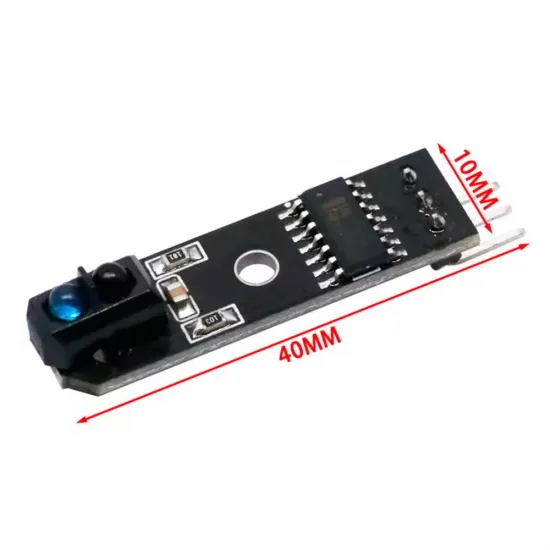
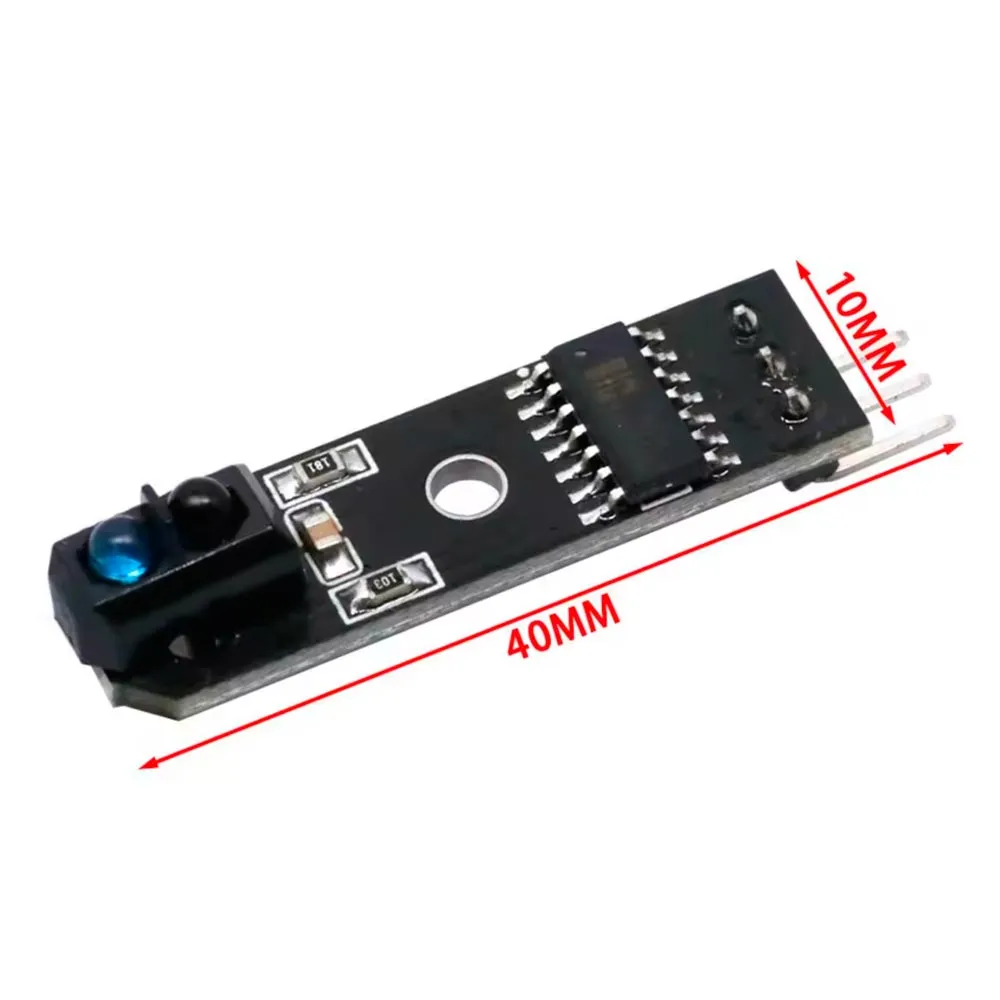
- Approximate dimensions: 40 × 10 mm.
- Mounting: central fixing hole.
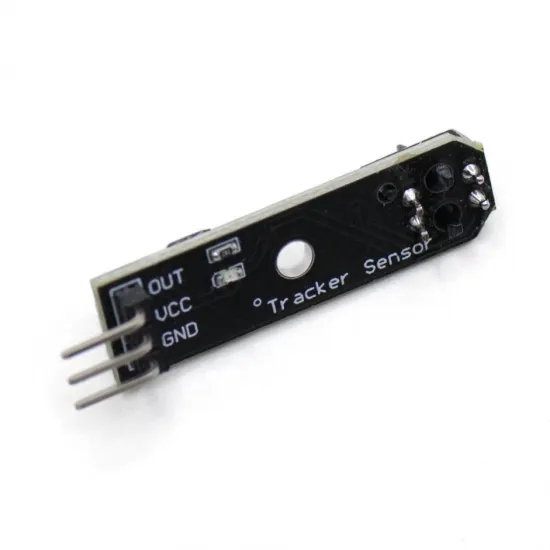
- Connection: three-pin header.
Connection
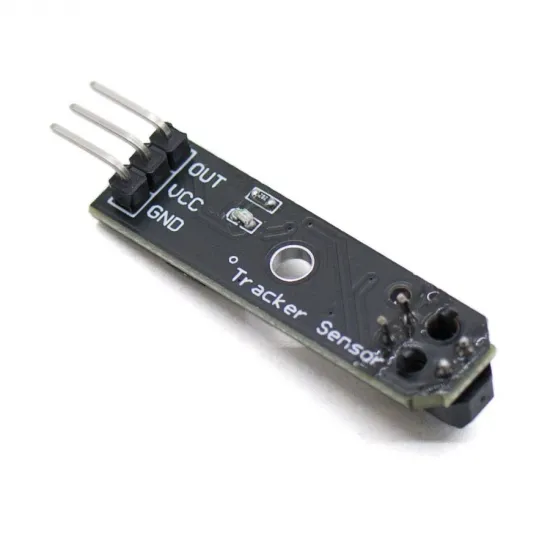
The pins are marked directly on the PCB:
- OUT: digital output.
- VCC: 5 V supply.
- GND: ground.
On this module variant, weak reflection or no target normally produces a low output, while sufficient reflection changes the output to a high level and activates the indicator. Always verify the actual polarity in the finished installation before using the signal to control a mechanism.
Microcontroller compatibility
It can be connected to controllers with 5 V-compatible digital inputs, including many 5 V Arduino Uno, Mega and Nano boards.
Caution with 3.3 V controllers: while the module is powered from 5 V, treat OUT as a 5 V logic signal. Before connecting it to an ESP32, Raspberry Pi, Raspberry Pi Pico or another 3.3 V-only input, verify its electrical tolerance or use a suitable resistor divider or logic-level converter.
Never power the module from 12 or 24 V. The OUT pin is not intended to drive motors, relays, solenoids or other power loads directly.
Adjustment and installation
- Position the TCRT5000 facing directly towards the target surface.
- Begin with a distance of approximately 2–3 mm.
- Test switching against the actual light and dark surfaces.
- Avoid strong infrared light shining directly into the receiver.
- Keep the optical window clean.
- Secure the module so vibration cannot change its distance or angle.
This version has no potentiometer, so its sensitivity cannot be adjusted on the PCB. Adjustment is mainly achieved by changing the distance, orientation and contrast of the target surface.
Important limitations
Do not confuse this product with a distance sensor, optical break-beam sensor or 3D-printer bed-levelling probe. It also cannot guarantee universal filament detection: black, transparent, glossy and translucent materials may produce very different infrared reflections.
Measuring the movement of a shaft, wheel or filament requires a mark, disc or mechanism that generates periodic contrast changes. The module should not be used as a safety device without appropriate validation, redundancy and additional protection.
Package contents
- 1 × TCRT5000 infrared reflective sensor module.