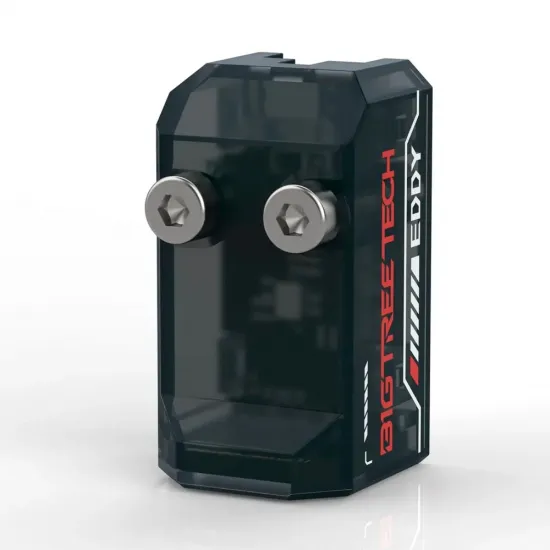
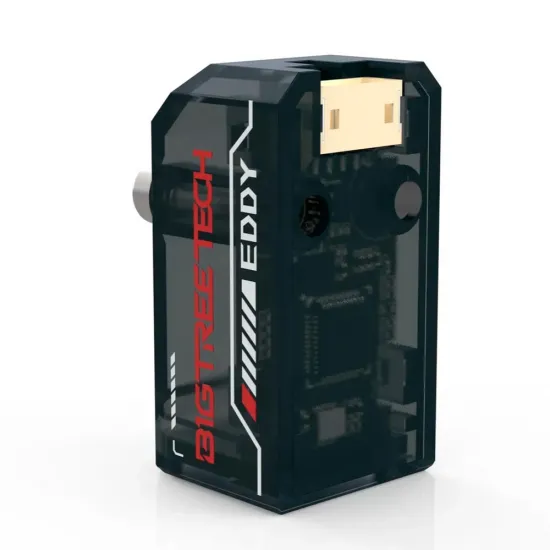
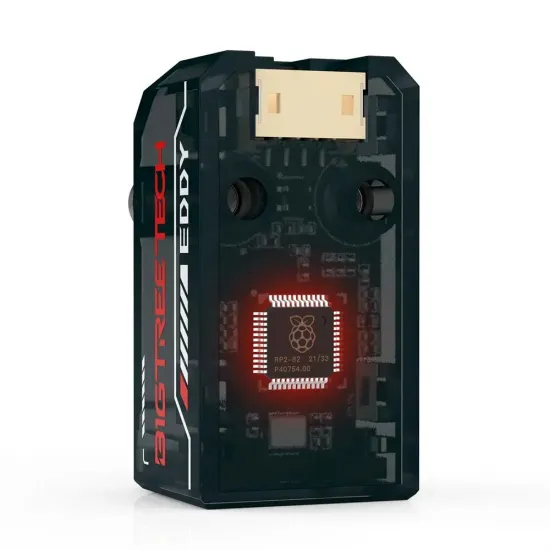
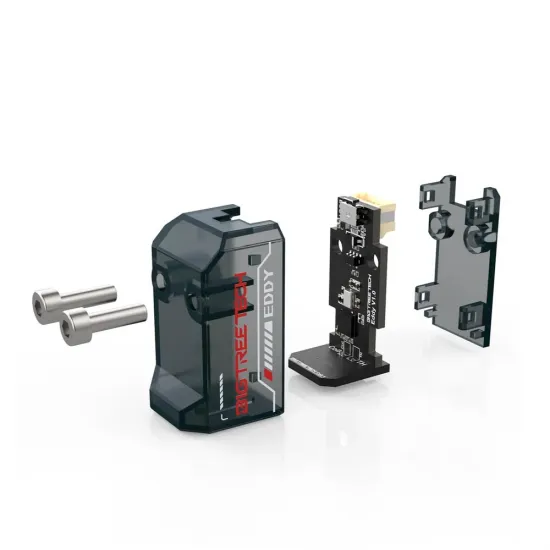


- Stock: 2
- Model: Eddy Duo

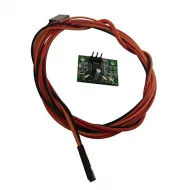
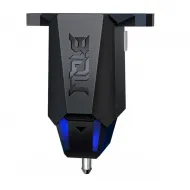
BIGTREETECH Eddy Duo USB V1.0 is an eddy-current inductive probe designed to create fast, detailed bed meshes on 3D printers running Klipper. It measures the change in its coil's resonant frequency as it approaches a metal bed, allowing it to scan the surface without physical contact or necessarily stopping at every point.
Its low weight, USB connection and continuous scanning capability make it particularly interesting for fast machines, dense meshes and systems such as Voron. However, Klipper firmware must be installed on its RP2040 and the printer must be configured and calibrated. USB simplifies wiring, but does not eliminate these installation steps.
Main features
- Non-contact eddy-current inductive probe.
- Designed for an up-to-date mainline Klipper installation.
- Standard, scan and rapid_scan probing methods.
- Integrated temperature sensor for software thermal-drift compensation.
- Onboard RP2040 microcontroller and USB communication with the host.
- Declared weight of only 6 g.
- BIGTREETECH-declared standard error: 0.5 µm.
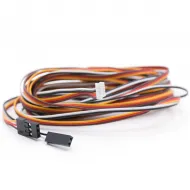
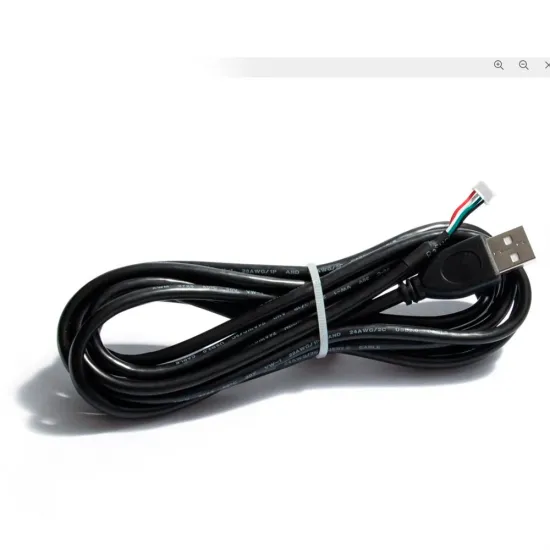
- Custom 2.5 m USB cable included.
- Mechanically compatible with the PL-08N mounting position used on Voron 2.4.
Accuracy note: the 0.5 µm figure is the sensor's standard error declared by the manufacturer. Final system accuracy also depends on printer mechanics, bed material, mounting, electrical and metallic interference, temperature and correct calibration.
Fast bed scanning
Because it does not need to touch the bed, Eddy Duo can collect readings while the toolhead moves horizontally. BIGTREETECH advertises levelling times of approximately 20 seconds, but the real result depends on bed size, mesh density, configured speed, kinematics and the selected probing method.
Current Klipper versions provide two particularly useful bed-mesh methods:
- METHOD=scan: measures the bed without descending at each point, but may stop while taking samples. This is generally the preferred option for the best accuracy during normal printing.
- METHOD=rapid_scan: takes measurements during continuous movement. It can reduce the time required for dense meshes and diagnostic scans, although Klipper notes that it may be less accurate than regular scanning.
The bed must be reasonably parallel to the XY plane before scanning. On compatible machines, Z_TILT_ADJUST or QUAD_GANTRY_LEVEL should be completed first. A safe scanning height and reachable mesh limits must also be configured.
Build-surface compatibility
Eddy Duo detects the proximity of a conductive metal target. It is suitable for aluminium and steel beds, as well as systems where a detectable metal sheet remains within its working range.
- A PEI sheet or another thin coating over metal may be used when the metal substrate remains detectable and the complete assembly is correctly calibrated.
- It should not be considered directly compatible with glass, G10, FR4 or other non-metallic beds unless a suitable metal substrate is present within detection range.
- Changing the build plate, coating, material or thickness may alter the sensor response. Height should be checked and recalibration performed when necessary.
- Magnets, screws and other nearby metal components can affect readings, so mounting geometry must remain stable.
Dimensions and mounting
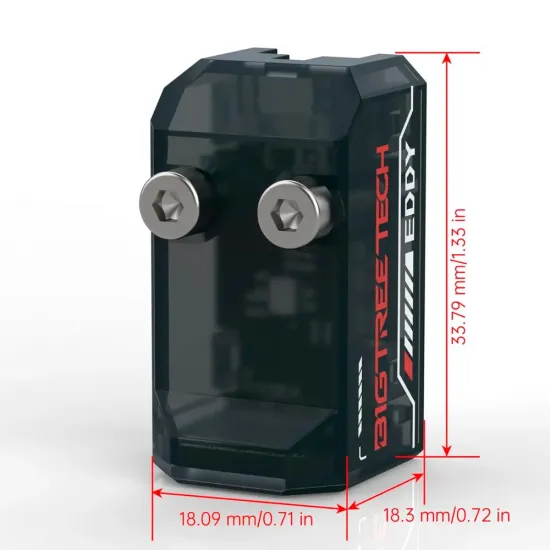
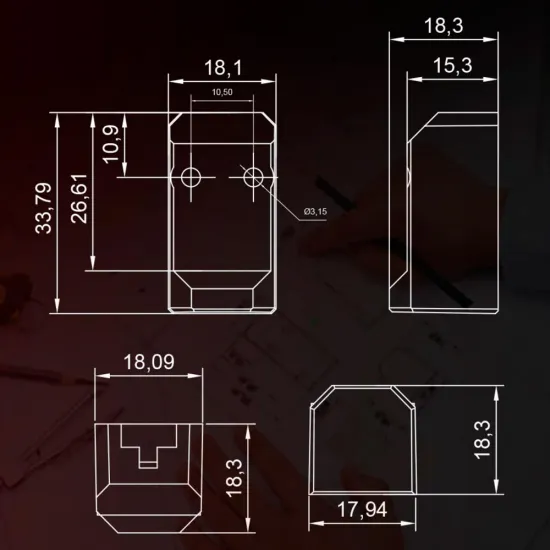
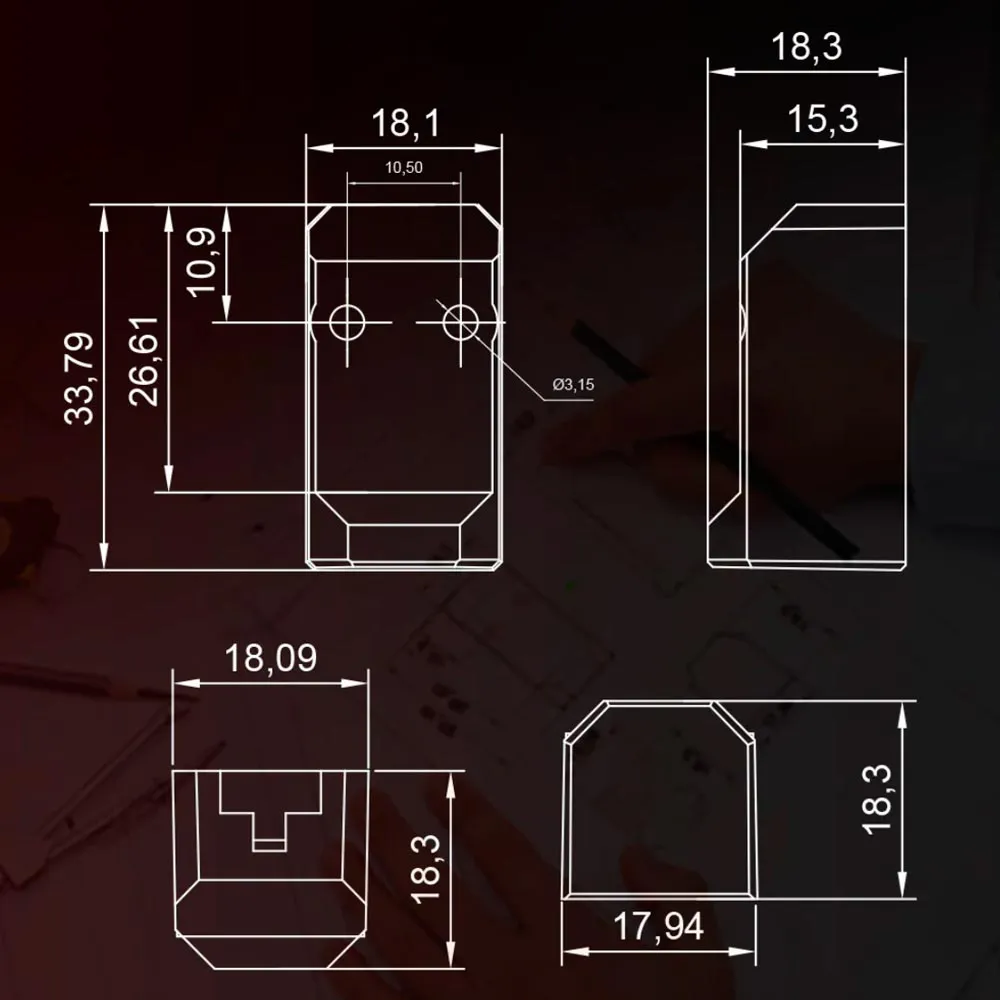
- Approximate dimensions: 33.79 × 18.09 × 18.30 mm.
- Two mounting holes measuring approximately 3.15 mm.
- Mounting-hole centre distance: 10.5 mm.
- Recommended installation height: the bottom of the probe should normally remain 2–3 mm above the bed when the nozzle is touching it.
- Declared operating ambient temperature: up to 60 °C.
The 2–3 mm mounting height must not be confused with the temporary 20 mm distance used during drive-current calibration.
The rear side containing the electronics should be positioned as far from the hotend as practical. The USB cable should also be kept away from stepper wiring and other electrically noisy cables. If excess cable remains, BIGTREETECH recommends arranging it in a figure-eight rather than winding it into a coil.
Printer and controller compatibility
BIGTREETECH documents Eddy Duo for FDM printers running Klipper and provides USB connection examples for the Manta M5P, Manta M8P V2.0, Octopus V1.1, Octopus Pro V1.0/V1.0.1 and Octopus Pro V1.1, among other configurations.
In a USB installation, the cable normally connects to the computer running Klipper —such as a Raspberry Pi, BIGTREETECH Pi, CB1 or equivalent host— or to a port that actually provides USB-host functionality. It should not be assumed that every USB connector on a printer control board can operate as a host.
On a Voron 2.4, the probe can occupy the mechanical position originally used by a PL-08N and can be secured with the two included M3×25 screws. This describes a shared mounting position; it does not mean that Eddy Duo electrically connects to the TL-Q5MC2 inductive sensor.
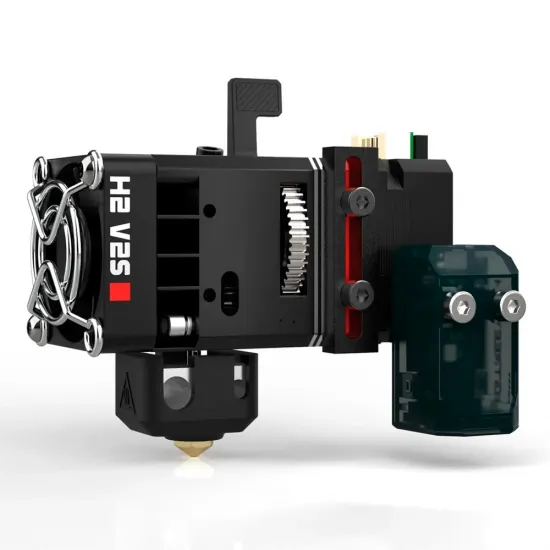
Mounts are also available for other machines, including installations intended for Ender-3 printers and H2-series hotends. The exact bracket, probe offsets, available travel and hotend clearance must be checked for each installation.
USB and CAN
BIGTREETECH documents both USB and CAN communication for the Eddy Duo hardware. This kit includes the 2.5 m USB cable and is supplied for a USB installation. A later conversion to CAN requires moving the sensor's selector, providing suitable CAN wiring and compiling and installing the corresponding firmware; it is not simply a connector change.
Basic Klipper configuration
Eddy Duo is designed for Klipper. An equivalent official configuration is not provided for Marlin or RepRapFirmware. Klippy must use a Python 3 virtual environment, and an up-to-date mainline Klipper version is recommended.
For USB firmware without Katapult, BIGTREETECH specifies:
- Architecture: Raspberry Pi RP2040/RP235x.
- Processor: RP2040.
- Bootloader: no bootloader.
- Flash chip:
GENERIC_03H with CLKDIV 4. - Communication interface:
USBSERIAL.
After flashing, a USB installation will normally contain a separate MCU, the LDC1612 probe and its temperature sensor:
[mcu eddy]
serial: /dev/serial/by-id/usb-Klipper_rp2040_...

[probe_eddy_current btt_eddy]
sensor_type: ldc1612
i2c_mcu: eddy
i2c_bus: i2c0f
x_offset: MEASURE_ON_THE_PRINTER
y_offset: MEASURE_ON_THE_PRINTER

[temperature_probe btt_eddy]
sensor_type: Generic 3950
sensor_pin: eddy:gpio26
The USB identifier, X/Y offsets, homing position and mesh boundaries are specific to each printer. Values from official examples must not be copied without checking them against the actual machine.
Recommended calibration sequence
- Temporarily position the probe approximately 20 mm above the bed and run:
LDC_CALIBRATE_DRIVE_CURRENT CHIP=btt_eddy - Store the calculated drive current with:
SAVE_CONFIG - Map probe frequency readings to actual nozzle height using BIGTREETECH's official template or:
PROBE_EDDY_CURRENT_CALIBRATE CHIP=btt_eddy - Carefully complete Klipper's requested paper test and run
SAVE_CONFIGagain. - Measure and verify X/Y offsets, mesh limits, safe homing position and full axis travel.
- Level the gantry or bed, where applicable, before generating a mesh.
- For a normal bed mesh, use:
BED_MESH_CALIBRATE METHOD=scan - For continuous rapid scanning, after checking safe travel:
BED_MESH_CALIBRATE METHOD=rapid_scan
Eddy Duo can also act as the virtual Z endstop through probe:z_virtual_endstop, but this requires the appropriate homing template and its specific initial-calibration procedure. Alternatively, a separate Z endstop may be retained while Eddy Duo is used only for probing and bed-mesh generation.
Thermal compensation
Like other inductive probes of this type, Eddy Duo can experience thermal drift. Its integrated temperature sensor allows Klipper to model and compensate for part of this variation through TEMPERATURE_PROBE_CALIBRATE.
Calibration should be performed according to the official documentation and under thermal conditions representative of normal printing. It can compensate for both sensor drift and part of the printer's thermal expansion, but it does not make the system immune to every change in temperature, mounting geometry or build surface.
When should a different probe be considered?
If the printer uses a non-metallic bed, must run Marlin or RepRapFirmware, or requires physical contact detection, the BIGTREETECH MicroProbe V2.0 or a removable contact system such as the Klicky Probe for Voron may be more suitable. The choice should be based on firmware, build-surface construction and the available mounting system.
Package contents
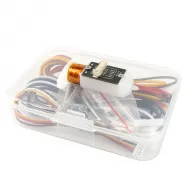
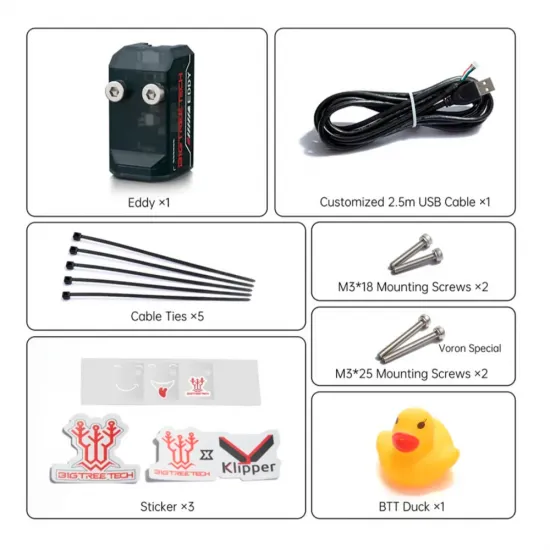
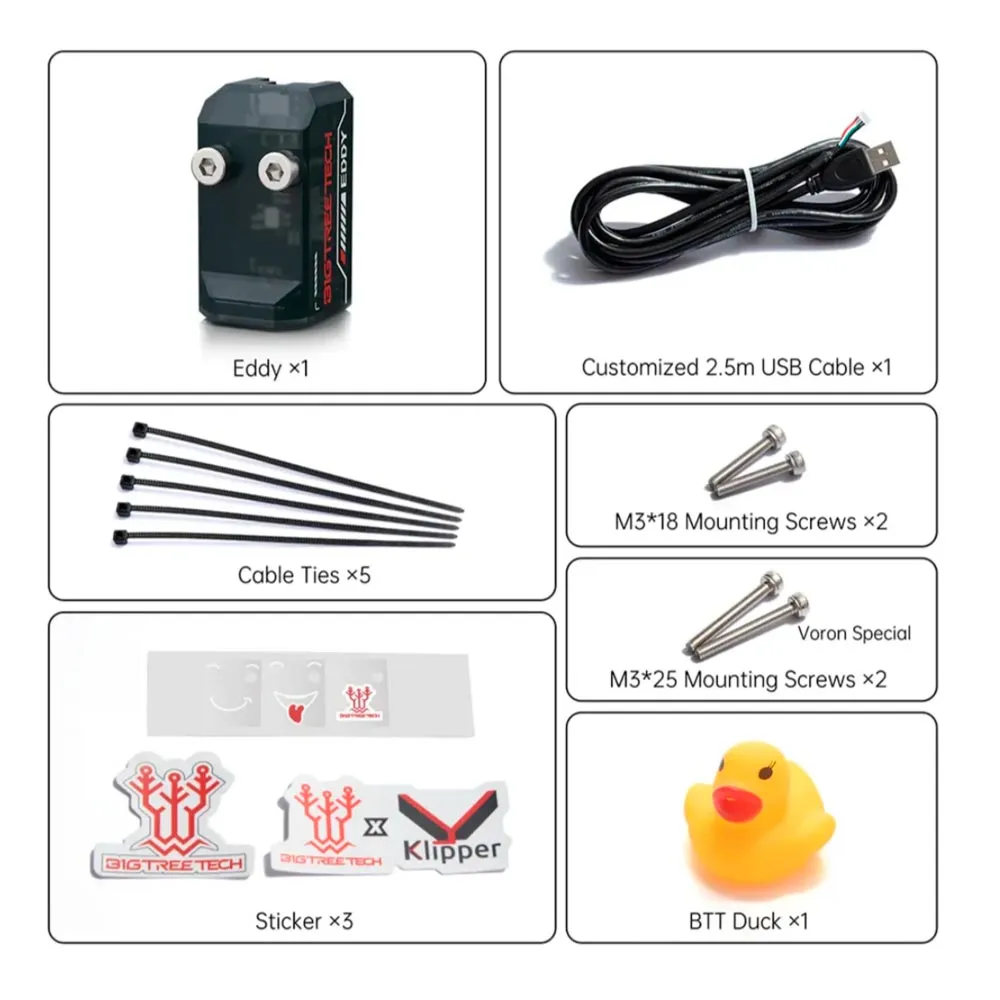
- 1 BIGTREETECH Eddy Duo probe.
- 1 custom 2.5 m USB cable.
- 5 cable ties.
- 2 M3×18 screws.
- 2 M3×25 screws for the documented Voron mounting position.
- 3 stickers.
- 1 BIGTREETECH rubber duck.
Technical documentation and configuration files are available from the official BIGTREETECH Eddy repository and the Klipper eddy-current probe guide.