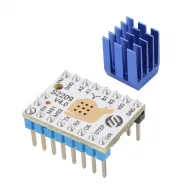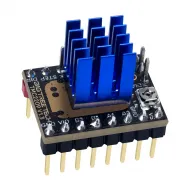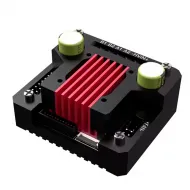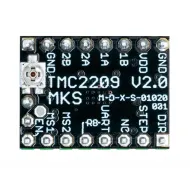


- Stock: 10
- Model: TMC5160Tpro-BTT

Model:

TMC2130 SPI

TMC2130 STEP/DIR

TMC2208 UART

TMC2209 - UART

TMC2225 UART

TMC2226 UART - STEP/DIR

TMC2240 SPI

TMC5160 pro SPI
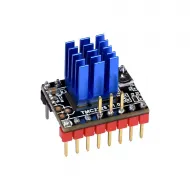
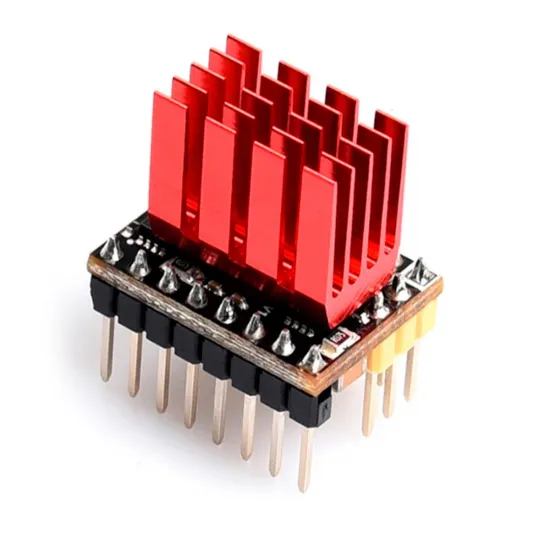
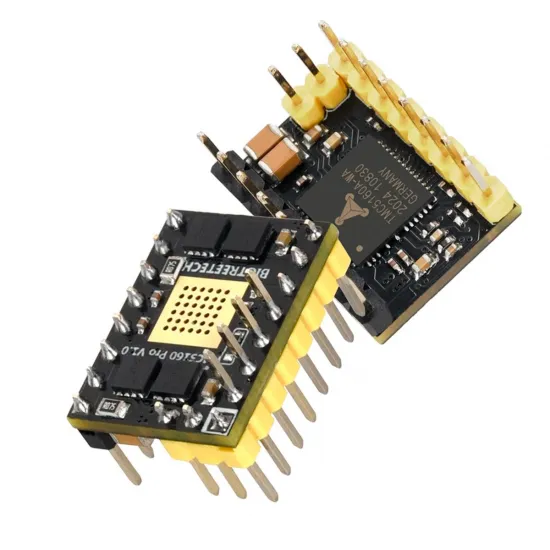
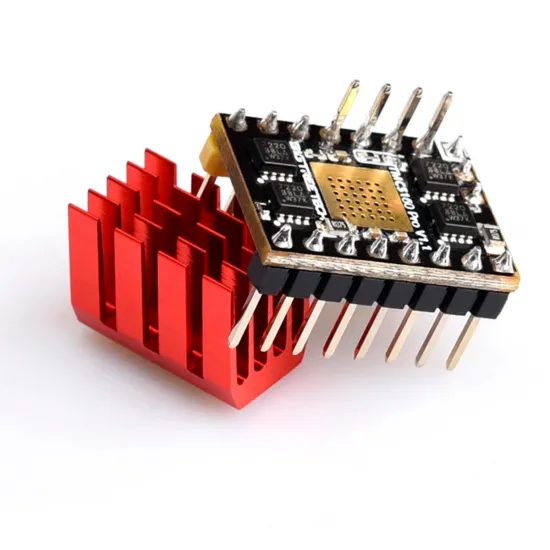
The BIGTREETECH TMC5160 Pro V1.1 is an SPI driver for two-phase bipolar stepper motors, designed for machines requiring more voltage and current headroom than common compact drivers can provide. It combines Trinamic TMC5160 control with an external-MOSF power stage while retaining features such as StealthChop2, SpreadCycle, StallGuard2, CoolStep and DcStep.
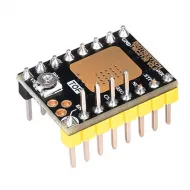
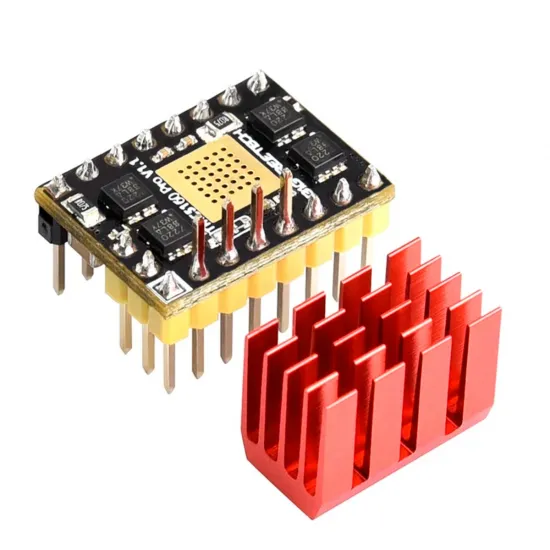
This item is the board physically marked TMC5160 Pro V1.1, included by BIGTREETECH in its TMC5160(T) Pro family. It is supplied in its SPI configuration and uses STEP/DIR signals to generate motion.
Main features
- Motor supply: 8-56 V DC according to BIGTREETECH.
- Published module maximum: up to 3 A, subject to the motor, mainboard, wiring, airflow and temperature.
- Control: STEP/DIR motion with SPI configuration and diagnostics.
- Power stage: external MOSFETs provide greater electrical headroom than a conventional integrated stage.
- Resolution: 1 to 256 microsteps with compatible internal interpolation.
- Sense resistor: 0.075 Ω.
- StealthChop2: quiet operation in suitable applications.
- SpreadCycle: firm dynamic response for fast or demanding motion.
- StallGuard2: load estimation and possible sensorless homing after proper calibration.
- CoolStep: adaptive current control when supported by the firmware and configuration.
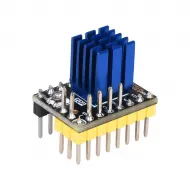
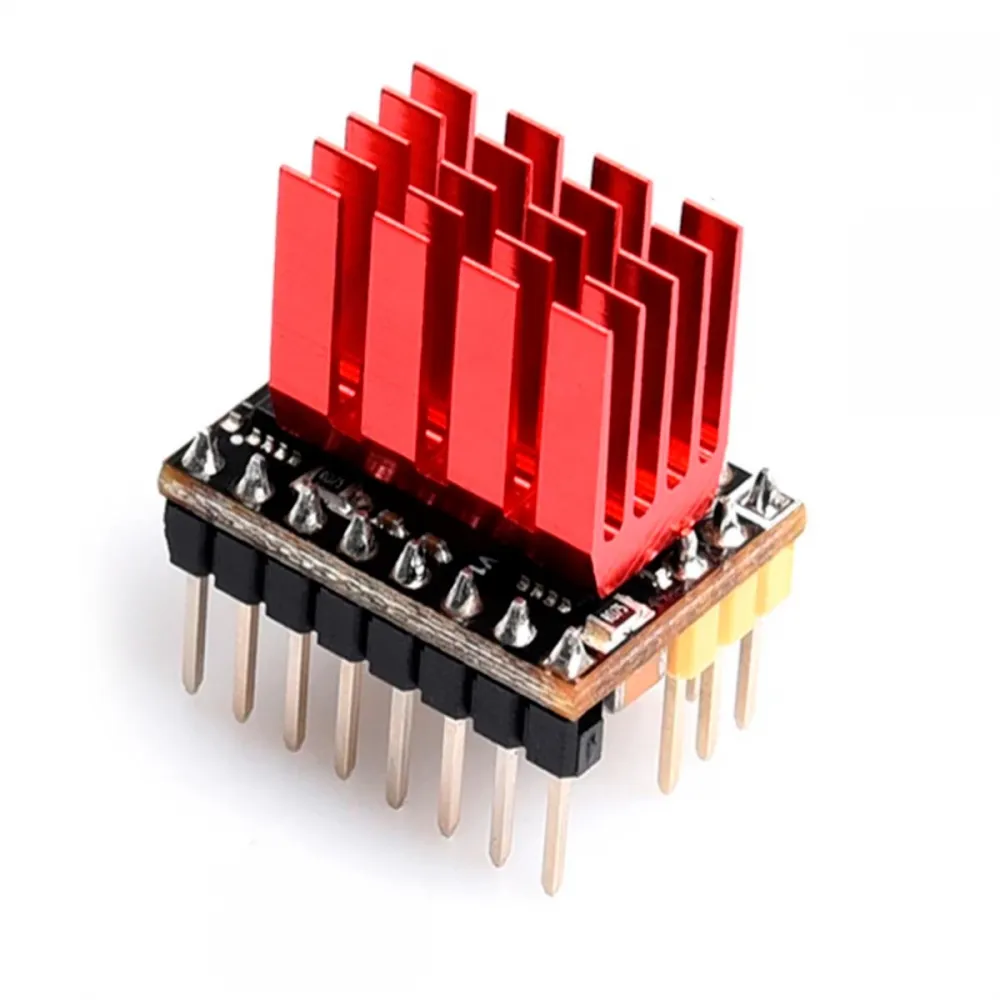
- Heatsink included.
Technical specifications
| Parameter | Value |
|---|---|
| Identified model | BIGTREETECH TMC5160 Pro V1.1 |
| Motor type | Two-phase bipolar stepper |
| VM supply | 8-56 V DC |
| Published maximum current | 3 A, limited by the module and its 2.54 mm headers |
| Sense resistor | 0.075 Ω |
| Configuration interface | SPI |
| Motion signals | STEP/DIR |
| Microsteps | 1-256 |
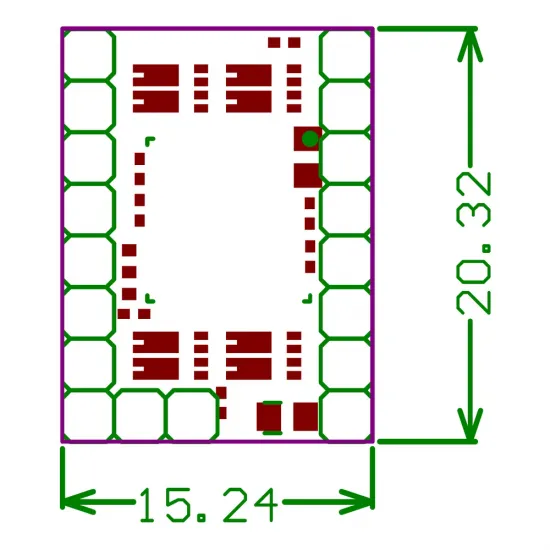
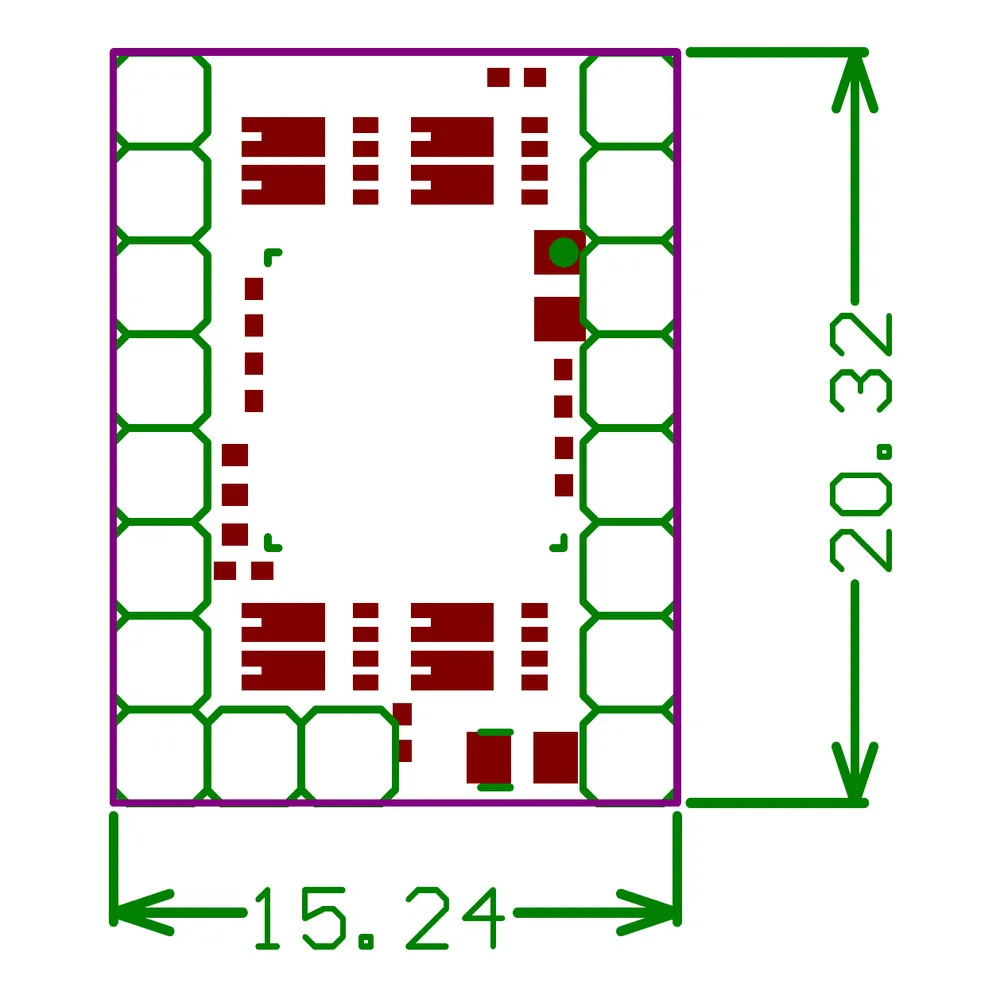
| PCB dimensions | 15.24 × 20.32 mm |
| Cooling | Heatsink included; active airflow recommended above 1 A or 40 V |
3 A is the published module maximum, not the correct setting for every motor. Usable continuous current depends on cooling, ambient temperature, socket, connectors, wiring, motor and duty cycle. Begin with a conservative setting and validate temperatures and reliability under real operating conditions.
Why external MOSFETs?
The TMC5160 separates motion control from the switching power stage. External MOSFETs make it possible to provide more voltage and current headroom than many integrated drivers. This makes the module useful for demanding motors, heavy axes, light CNC machines or fast 3D printers, provided that the complete electronics system is rated for the selected voltage and current.
A familiar plug-in footprint does not automatically turn every mainboard into a high-voltage solution. The socket, capacitors, connectors, PCB tracks, protection and motor-rail selection must all support the applied voltage.
StealthChop2 or SpreadCycle
StealthChop2 prioritises quiet and smooth motion, particularly at moderate speeds. SpreadCycle generally gives more consistent behaviour as speed, acceleration or load increases. The quietest mode is not necessarily the best choice for every axis.
StallGuard2 estimates motor load without a dedicated mechanical sensor. It can be used for sensorless homing, but requires compatible DIAG wiring and individual calibration. Sensitivity varies with current, speed, temperature, belt tension, moving mass and friction.
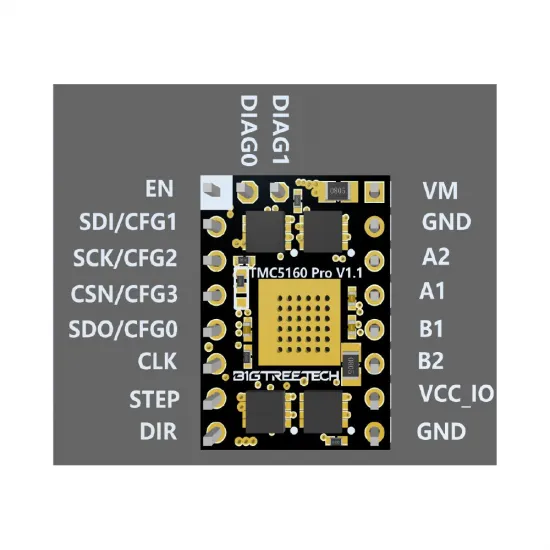
Pinout and orientation
| Control side | Function | Power side | Function |
|---|---|---|---|
| EN | Enable | VM | Motor supply |
| SDI / CFG1 | MOSI | GND | Power ground |
| SCK / CFG2 | SPI clock | A2 / A1 | Coil A |
| CSN / CFG3 | SPI chip select | B1 / B2 | Coil B |
| SDO / CFG0 | MISO | VCC_IO | Logic supply |
| CLK / STEP / DIR | External clock and motion | GND | Logic ground |
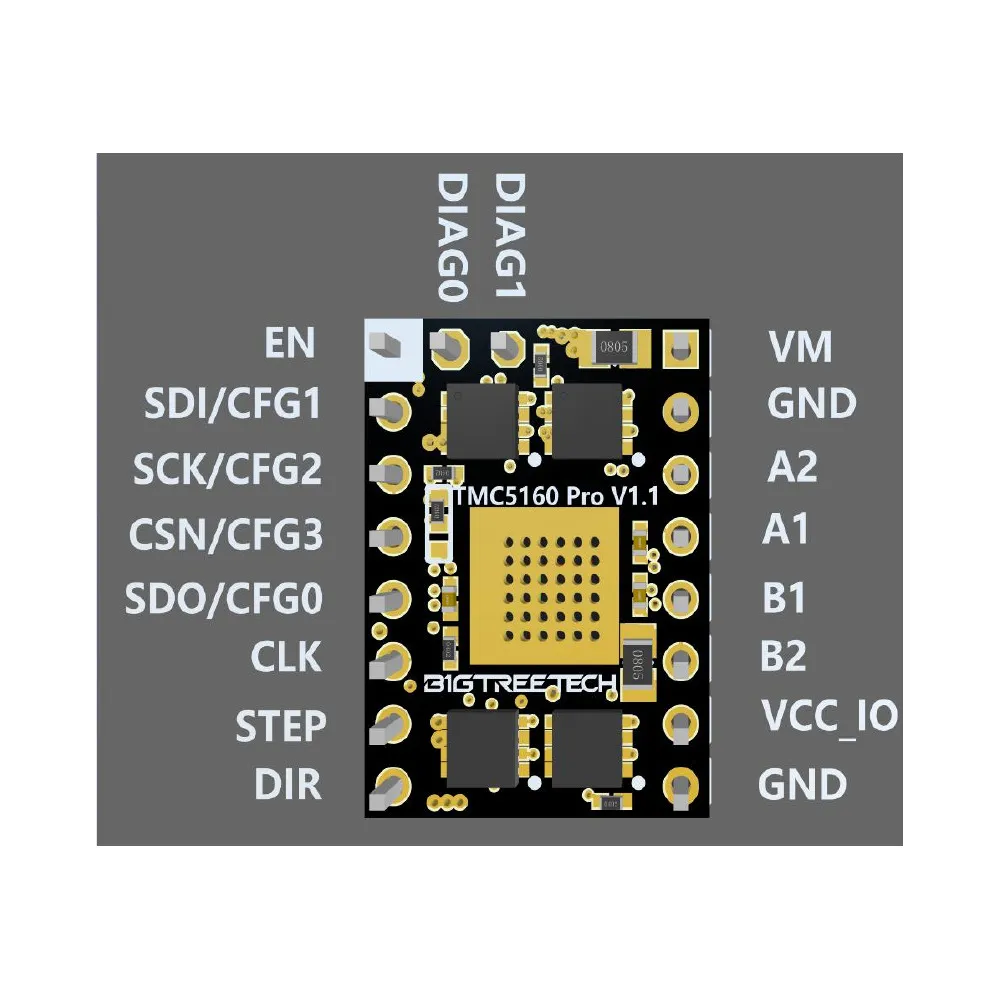
The white marking beside EN helps identify orientation. Always confirm that VM, GND and EN match the mainboard pinout before inserting the module. DIAG0 and DIAG1 are separate pads and may require additional wiring depending on the board.
Safe installation
- Switch off the main power supply and disconnect USB power.
- Check the pinout and exact revision of the mainboard.
- Configure the socket jumpers for SPI as documented by that board.
- Physically verify orientation, VM, GND, VCC_IO and motor-rail selection.
- Install the heatsink where it cannot touch pins or solder joints.
- Connect the motor coils to A1/A2 and B1/B2 only while powered off.
- Configure SPI, sense resistor, current and microsteps before commanding motion.
- Verify communication and perform short movements at low speed.
- Check driver, connector and motor temperatures before increasing performance.
High voltage: 56 V is the published maximum for this module, not a recommended operating voltage without headroom. Motors and wiring can generate regenerative spikes. Use a stable supply, suitable protection and margin below the limit. BIGTREETECH recommends active cooling above 40 V and warns against touching the module while powered above 36 V.
A BIGTREETECH Octopus Pro H723 may be suitable when its motor power bank is configured correctly. This does not mean that the whole board or every installed driver can run at 48 or 56 V: verify the revision, jumpers and limits of every component.
Basic Klipper configuration
Klipper provides a dedicated [tmc5160] section. The CS pin and SPI bus depend on the board and socket and must not be copied from another controller merely because it looks similar. A cautious starting structure is:
[tmc5160 stepper_x]
cs_pin: BOARD_CS_PIN
spi_bus: BOARD_SPI_BUS
run_current: RMS_CURRENT_MATCHED_TO_MOTOR
sense_resistor: 0.075
stealthchop_threshold: 0
run_current is specified in RMS amps and must suit the motor and cooling. Klipper discourages using hold_current unless there is a specific need. stealthchop_threshold: 0 keeps SpreadCycle active; if StealthChop is enabled, validate torque, temperature and stability throughout the motion range.
If no suitable hardware SPI bus is available, Klipper also supports software SPI through spi_software_sclk_pin, spi_software_mosi_pin and spi_software_miso_pin. Use one method only and follow the mainboard schematic.
Before moving the axis, run DUMP_TMC STEPPER=stepper_x. If communication fails, power down and inspect orientation, logic supply, jumpers, CS, SPI bus and soldering.
Sensorless homing in Klipper
Sensorless homing requires DIAG0 or DIAG1 to reach a compatible input and the actual board pin to be configured. A typical structure, which must be adapted and calibrated, includes:
diag1_pin: ^!ACTUAL_DIAG_PIN
driver_SGT: CALIBRATED_VALUE
There is no universal driver_SGT value. Calibrate one axis at a time, at moderate speed and with immediate access to power-off. We do not recommend applying a generic recipe to Z when a false trigger could drive the nozzle into the bed.
Basic Marlin configuration
BIGTREETECH documents SPI operation with Marlin 2.0 or later. Select the controller for each required axis in Configuration.h:
#define X_DRIVER_TYPE TMC5160
#define Y_DRIVER_TYPE TMC5160
Then configure RMS current, microsteps and the 0.075 Ω sense resistor in Configuration_adv.h, along with the CS pins and SPI bus defined for the mainboard. If the electronics requires software SPI, enable TMC_USE_SW_SPI and assign the pins from its actual pinout rather than inventing a generic mapping.
Compile for the exact mainboard model, revision and microcontroller. After flashing, use M122 to verify communication before commanding motion. M906 can query or adjust current where enabled, but the value must match the motor rather than the driver maximum.
Compatibility checklist
- Mechanical: enough room for the module, heatsink and airflow.
- Pinout: compatible orientation and signal arrangement; the 2 × 8 footprint alone is insufficient.
- Electrical: VM between 8 and 56 V, compatible VCC_IO and a supply with transient headroom.
- Motor: two-phase bipolar construction with its coils and required current correctly identified.
- Firmware: TMC5160 SPI support with CS and SPI assigned for the exact board revision.
- Thermal: correctly installed heatsink and airflow suitable for current, voltage and enclosure temperature.
- Sensorless homing: DIAG connected to a valid input and sensitivity calibrated for each axis.
The motor's NEMA size alone does not establish compatibility. Two NEMA 17 or NEMA 23 motors may require very different current and voltage conditions.
Which driver should you choose?
This TMC5160 Pro is particularly useful when a plug-in module with more voltage or current headroom is needed and sufficient cooling space is available. For systems up to 36 V that prioritise modern diagnostics and a compact footprint, the BIGTREETECH TMC2240 may be a better alternative. For a more recent TMC5160-family solution aimed at higher loads, also consider the BIGTREETECH TMC5160T Plus, while checking footprint, current, voltage and installation requirements.
This product is for you if
- You need an SPI driver with an external power stage and greater electrical headroom.
- Your board explicitly documents TMC5160 integration and allows the socket to be configured correctly.
- You want firmware control over current, motion modes and diagnostics.
- You have active cooling and will monitor temperatures during commissioning.
- You understand that sensorless homing needs dedicated wiring and calibration.
This product is not for you if
- You need a basic 12/24 V driver requiring no SPI configuration.
- Your mainboard only shares the socket shape but does not document compatible pinout, SPI and power.
- You plan to use 48/56 V without verifying every motor-bank component.
- You cannot provide airflow to the module.
- You need a guaranteed current figure without thermal testing in your machine.
Package contents
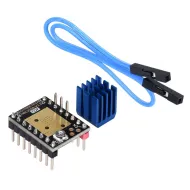
- 1 × BIGTREETECH TMC5160 Pro V1.1 driver.
- 1 × heatsink.
Schematics, manuals and future updates are available from the official BIGTREETECH repository and Klipper's TMC5160 configuration reference.