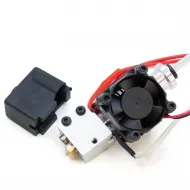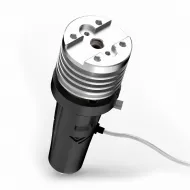



- Stock: Out of Stock
- Model: Dragon2-HF-Ceramic

Model:

Dragon SF Standard Flow

Dragon HF High Flow

Dragon SF Standard Flow Ceramic Heatbreak

Dragon HF High Flow Ceramic Heatbreak

Dragon ACE - 104NT-4
Dragon ACE - PT1000

Dragon ACE Volcano 104NT-4
Dragon ACE Volcano PT1000
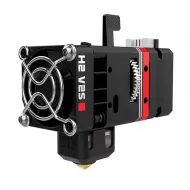
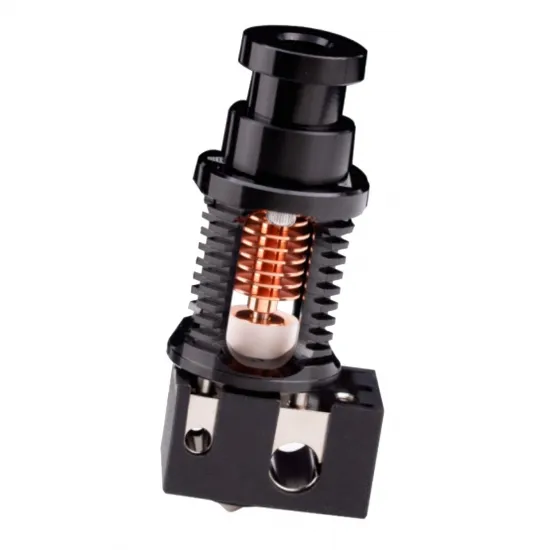
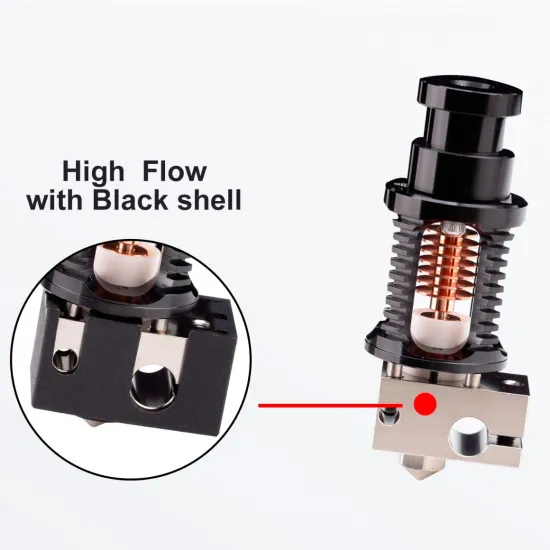
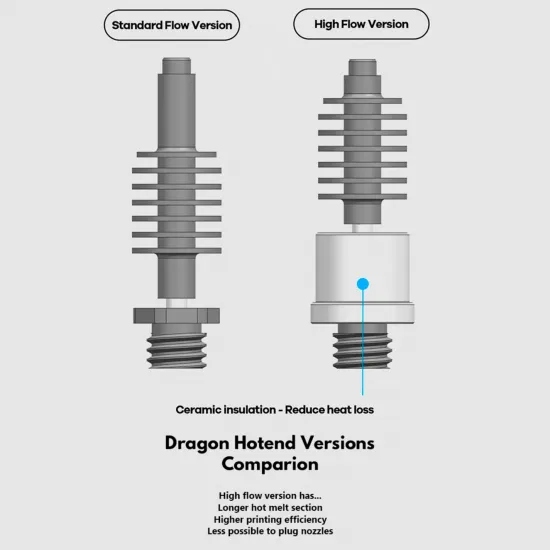
The Trianglelab Dragon V2.0 HF with ceramic heatbreak is the high-flow member of the Dragon V2.0 family for 1.75 mm filament. It retains the compact outer envelope of the SF model while extending the melt zone to transfer more energy into the filament when a print demands high volumetric flow.
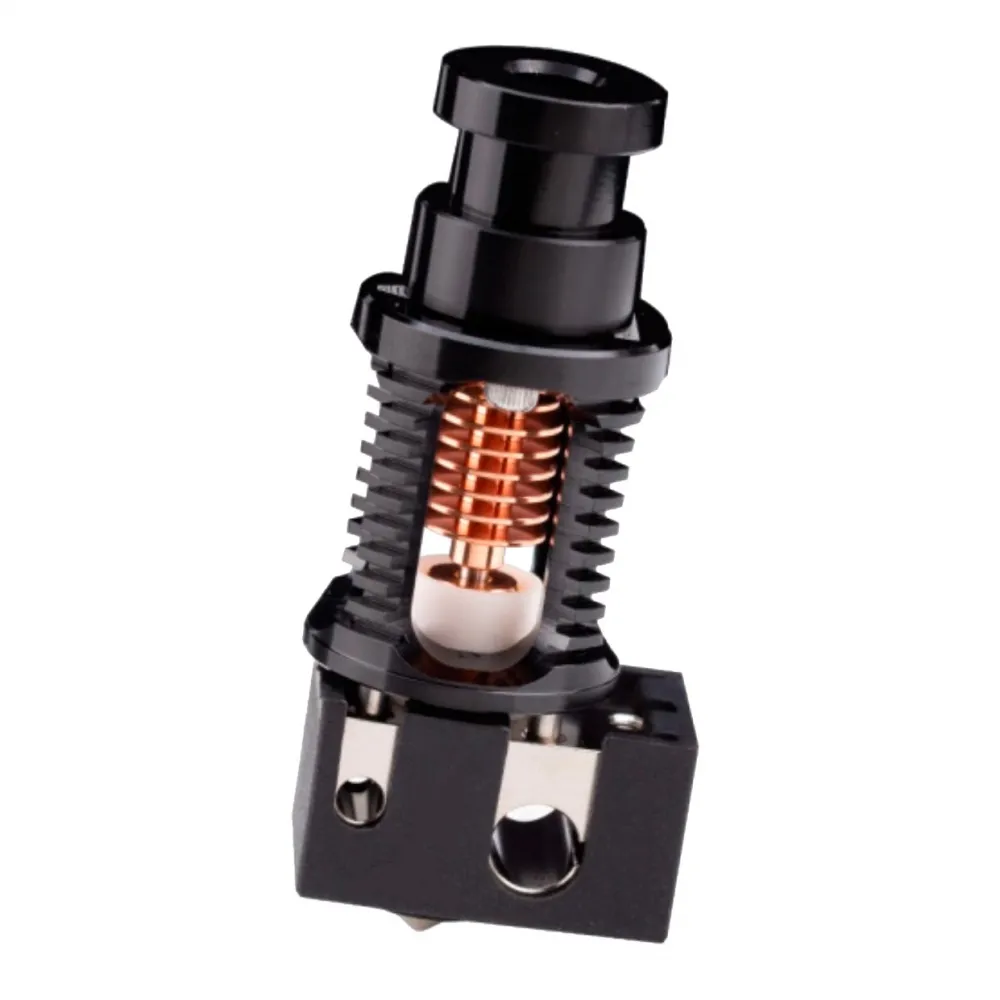
Its longer hot zone is particularly useful with larger nozzles, wide layers and fast profiles. HF does not automatically make a printer faster: extruder, heater, cooling, material, acceleration and slicer settings must all support the requested flow.
Main features
- High Flow melt zone: extended hot path to increase potential melting capacity without adopting a longer Volcano-style outer envelope.
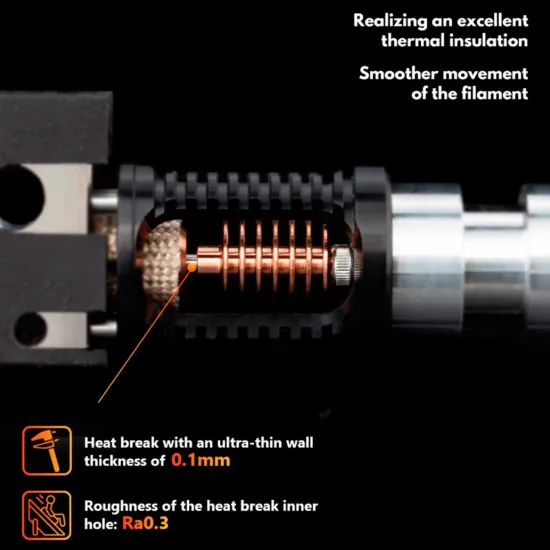
- Ceramic heatbreak: low heat transfer towards the heatsink; the manufacturer states a 0.1 mm wall and Ra 0.3 internal finish.
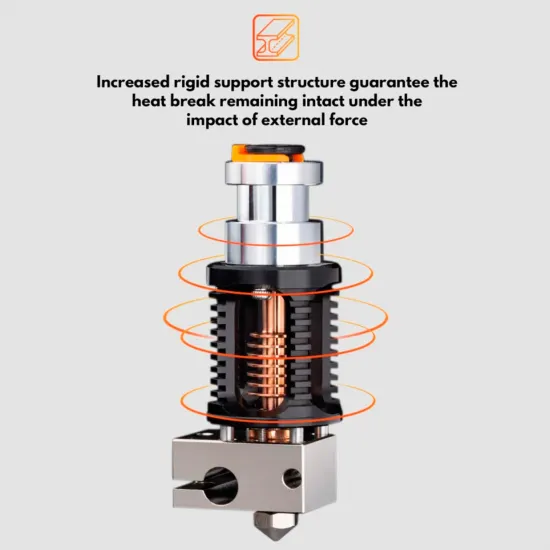
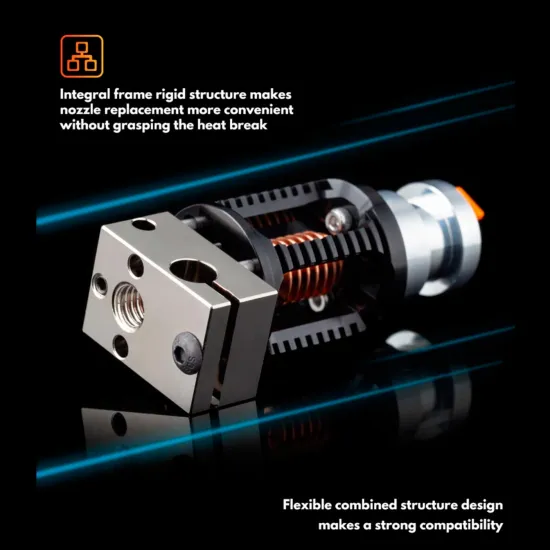
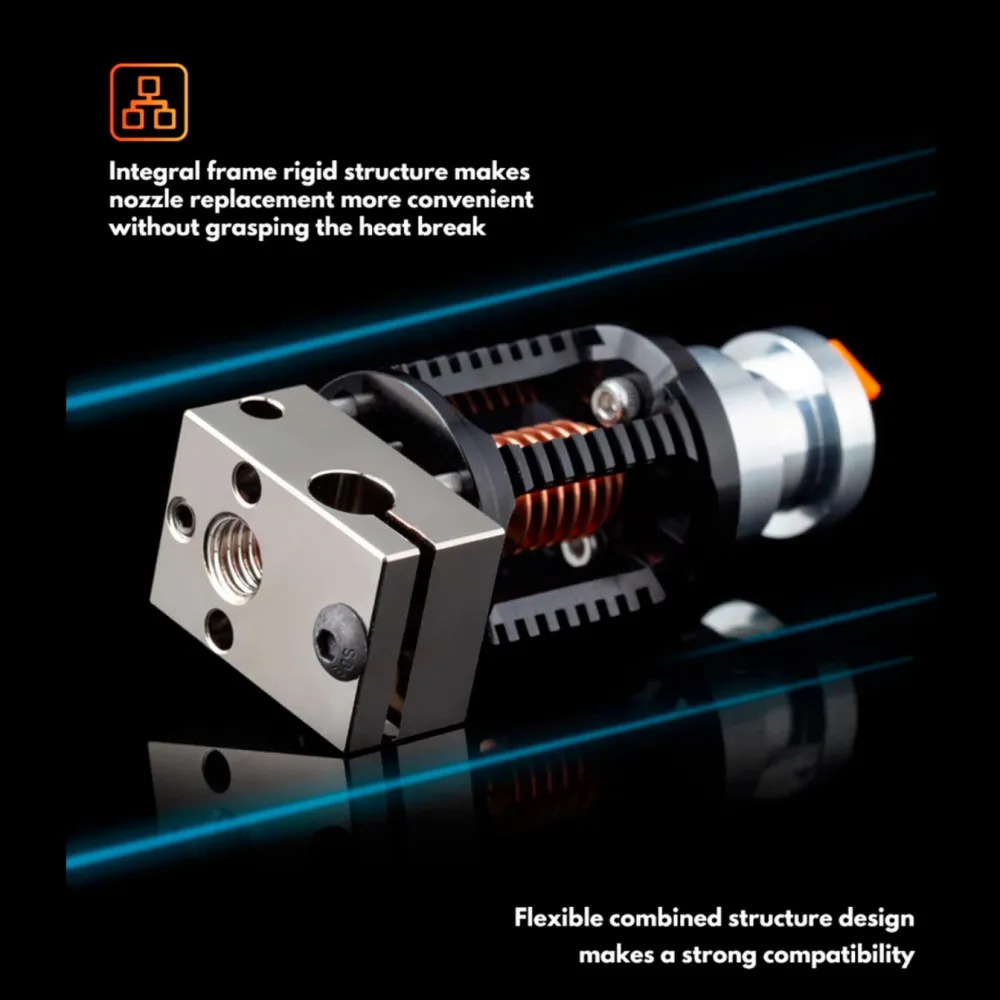
- Rigid Dragon structure: external supports join block and heatsink so that the heatbreak does not carry mechanical loads alone.
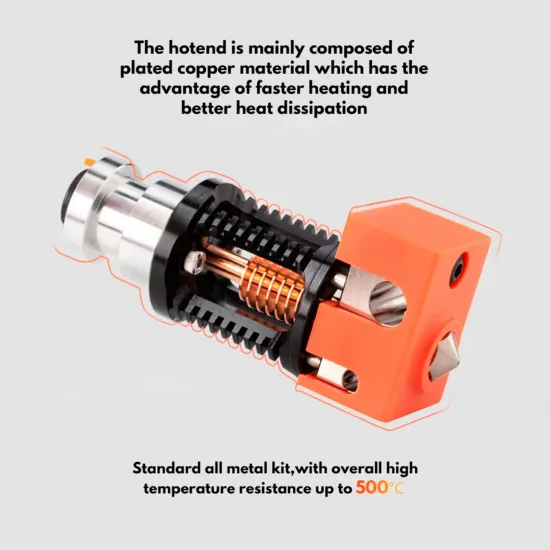
- Nickel-plated copper block: greater hot-zone copper mass in the HF version to sustain heat exchange.
- Included T-V6 nozzle: nickel-plated copper, 0.4 mm, for 1.75 mm filament.
- V6 or rigid mounting: included Groove Mount adaptor and four M2.5 points for Dragon toolheads.
Technical specifications
| Manufacturer and model | Trianglelab Dragon V2.0 HF |
|---|---|
| Variant | High Flow, ceramic heatbreak |
| Filament | 1.75 mm |
| Included nozzle | 0.4 mm nickel-plated copper T-V6 |
| Heater block | Nickel-plated copper alloy; extended HF hot-zone configuration |
| Compatible heater | 6 mm cylindrical cartridge; voltage, power and length to match the machine |
| Compatible sensor | 3 mm cartridge sensor; curve and electronics to match the machine |
| Nominal hotend temperature | Up to 450 °C according to Trianglelab; the lowest-rated component takes precedence |
| Published flow | Up to 62.51 mm³/s in the manufacturer's PLA test at 215 °C; not guaranteed |
| Approximate height | 62.2 mm with nozzle and Groove Mount adaptor; same outer envelope as SF |
| Rigid mounting | 4 × M2.5 on a 16 mm bolt circle |
What high flow actually provides
HF uses a heatbreak with a longer hot zone than the standard-flow Dragon V2.0 SF. Keeping filament in a heat-transfer region for longer increases the margin before material reaches the nozzle insufficiently molten.
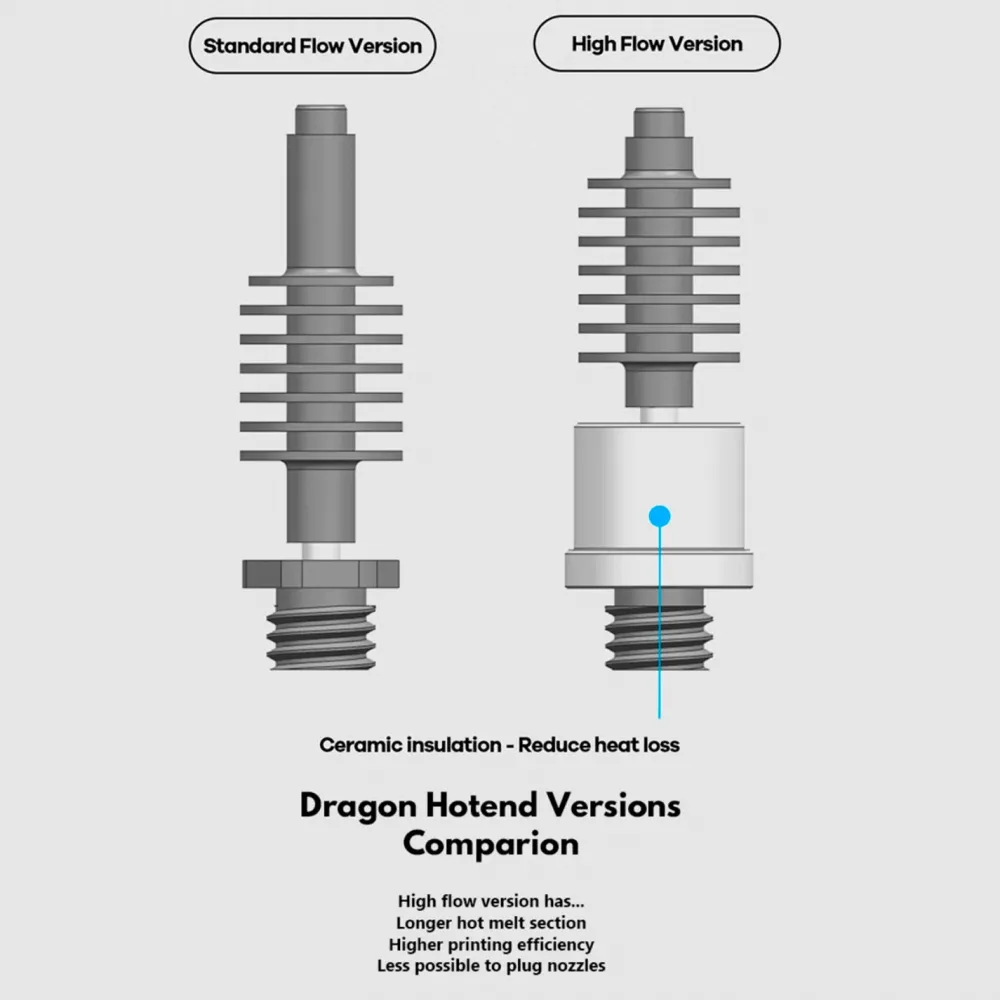
Trianglelab states up to 62.51 mm³/s with PLA at 215 °C. This is a manufacturer test result rather than a promise for every installation, because not all parameters required for reproduction are published. Determine the actual limit with the filament, temperature, nozzle and quality criterion you intend to use.
Speed and flow are related by:
flow (mm³/s) = line width (mm) × layer height (mm) × speed (mm/s)For example, a larger nozzle will not guarantee more output if the extruder skips, the heater cannot maintain temperature or the profile demands more flow than the polymer can absorb.
When to choose HF or SF
- HF: large nozzles, wide layers, bulky parts and fast profiles with high volumetric demand.
- SF: general use, moderate flow, small nozzles and simpler thermal tuning.
HF also works at low flow, but its longer hot zone may require temperature, retraction and residence-time adjustments to limit oozing or degradation. Do not compensate for a poor profile by excessively reducing heatsink cooling.
V6 mounting and compatibility with specific machines
SF and HF share the same outer envelope. The included adaptor provides a V6/Groove Mount interface; removing it exposes the four rigid Dragon mounting points. Mechanical compatibility does not automatically confirm the sensor, heater, connectors, cooling or firmware.
- Prusa i3 MK3 and MK3S: Trianglelab states compatibility through the V6 interface. Check the toolhead revision, wiring, length and thermal limits.
- Voron 2.4 and Voron Trident with Stealthburner: use the P-DRG printhead and four M2.5 × 8 mm screws specified by the official project. Verify printed parts, probe position, duct and nozzle height.
- V6, Titan and DDB toolheads: possible when the complete geometry matches; verify interference and cooling before installation.
The Voron Stealthburner Beta printed-parts kit includes a Dragon cartridge option, but the correct revision must be selected and verified.
Heater, sensor and required power
The heater and sensor are sold separately. Choose a cartridge according to voltage and board capacity, not simply the highest-looking power rating. Output, MOSFET, connector, wiring and power supply must support the current with margin.
- 12 V, 40 W heater cartridge: approximately 3.33 A nominal.
- 24 V, 40 W heater cartridge: approximately 1.67 A nominal.
- 24 V, 50 W heater cartridge: approximately 2.08 A nominal.
- 3 mm 100K NTC Beta 3950 thermistor for configurations within its supported temperature range.
High flow requires maintaining temperature under load. If temperature drops during a test, check actual voltage, PID/MPC tuning, cartridge contact, insulation, sensor reading and the complete circuit's electrical capability before increasing power.
Firmware configuration with a 100K NTC B3950
The following references apply only when the linked Beta 3950 thermistor is installed and the input uses the expected electronics.
Marlin
#define TEMP_SENSOR_0 11Compile and flash the firmware where required. Then run PID autotuning at a representative temperature—for example M303 E0 S230 C8—check stability and save with M500 if EEPROM is enabled.
Klipper
[extruder]
sensor_type: Generic 3950
sensor_pin: <actual board pin>
max_temp: <safe assembly limit>
First verify the cold reading. Then use PID_CALIBRATE HEATER=extruder TARGET=230 or a temperature representative of actual use and save with SAVE_CONFIG.
RepRapFirmware
Define the sensor with M308 as a 100 kΩ, Beta 3950 thermistor using the controller's actual pin and pull-up resistance. There is no universal line valid for every board.
Nozzles and materials
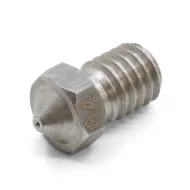
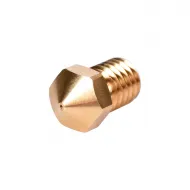
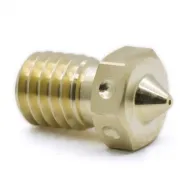
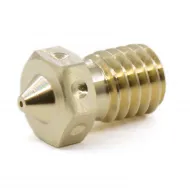
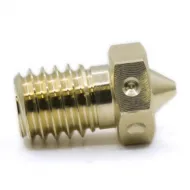
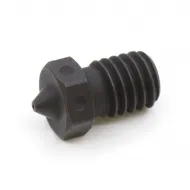
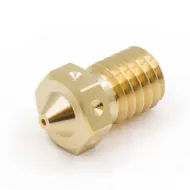
A 0.4 mm nickel-plated copper T-V6 nozzle is included. Brass T-V6 nozzles are available in 0.3 mm, 0.4 mm and 0.5 mm. Before installing another M6 nozzle, compare length, sealing face, thread depth and geometry: a shared thread does not guarantee sealing.
Larger diameters are often useful for exploiting HF, but diameter should be selected for resolution, line width and material rather than speed alone. Abrasive filaments require a wear-resistant nozzle; the ceramic heatbreak does not prevent erosion of a copper or brass nozzle.
The hotend can process many thermoplastics when the rest of the printer meets their requirements. PEEK, PEI and other very-high-temperature materials are not considered universally compatible merely because the hotend body has a 450 °C nominal rating.
Installation and safety
- Install with the machine cold, switched off and unplugged. Do not strike or flex the ceramic heatbreak.
- Do not remove the small internal screws unless you have the correct tools and procedure.
- Fully insert and secure the heater and sensor, routing wires away from moving or hot parts.
- Check room-temperature reading, correct heating direction and protection before reaching working temperature.
- Keep the heatsink fan active and correctly directed throughout use.
- When changing the nozzle, hold the block without loading the heatbreak or supports. Establish the thermal seal within the configuration's safe limit.
- Supervise the first heat-up, check for leakage and retune PID/MPC, first layer, flow, retraction and Advance.
Contents
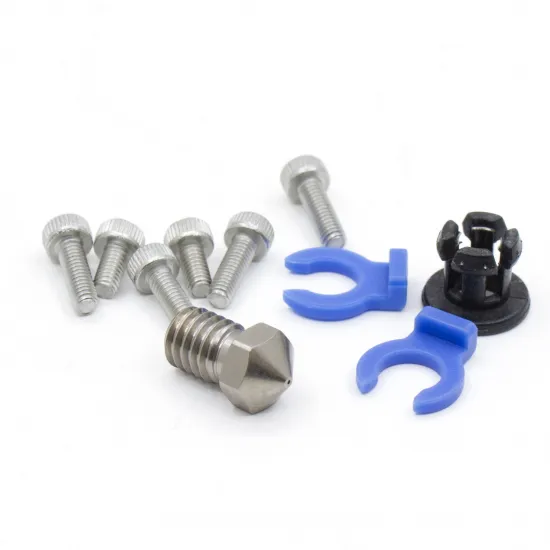
- 1 × Dragon V2.0 HF hotend with ceramic heatbreak.
- 1 × nickel-plated copper block and 1 × 0.4 mm nickel-plated copper T-V6 nozzle.
- 1 × silicone sock.
- 1 × V6/Groove Mount adaptor.
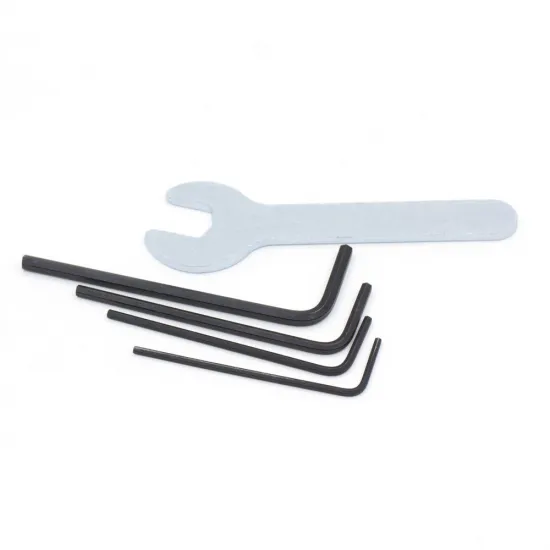
- Mounting screws and keys.
Heater cartridge, temperature sensor and fan are not included.
This is for you if
- Your profile requires high volumetric flow and the rest of the printer can supply it.
- You use larger nozzles, wide layers or need to reduce production time for bulky parts.
- You want Dragon/V6 rigidity and mounting while retaining the SF model's outer envelope.
This is not for you if
- You mainly print fine detail with small nozzles and moderate flow; SF may be better balanced.
- You expect to reach the published flow without testing and calibration.
- You require a complete hotend with heater, sensor and fan already fitted.