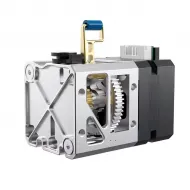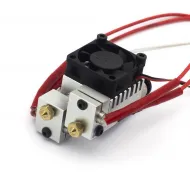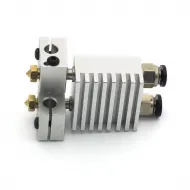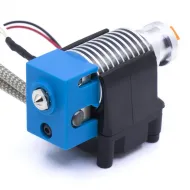



- Stock: 1
- Model: Dragon-ACE-V-PT1000

Model:

Dragon SF Standard Flow

Dragon HF High Flow

Dragon SF Standard Flow Ceramic Heatbreak

Dragon HF High Flow Ceramic Heatbreak

Dragon ACE - 104NT-4
Dragon ACE - PT1000

Dragon ACE Volcano 104NT-4
Dragon ACE Volcano PT1000
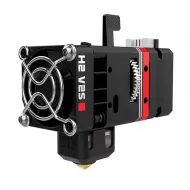
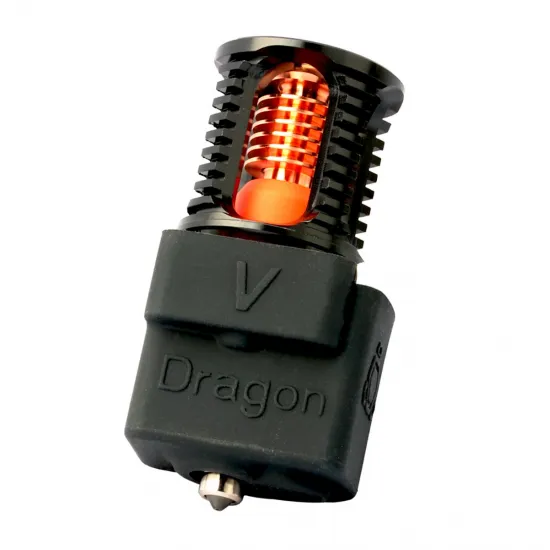
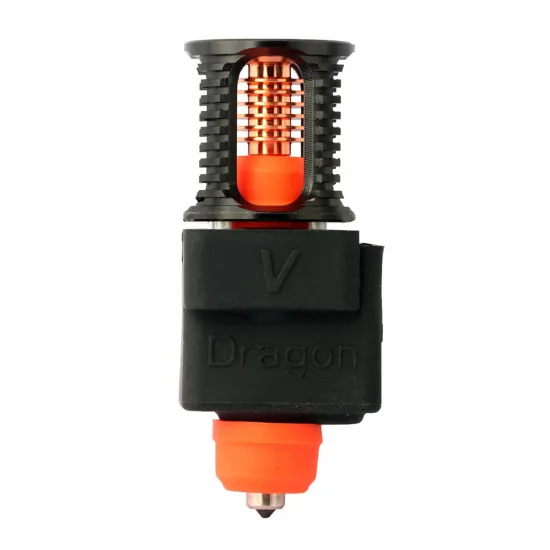
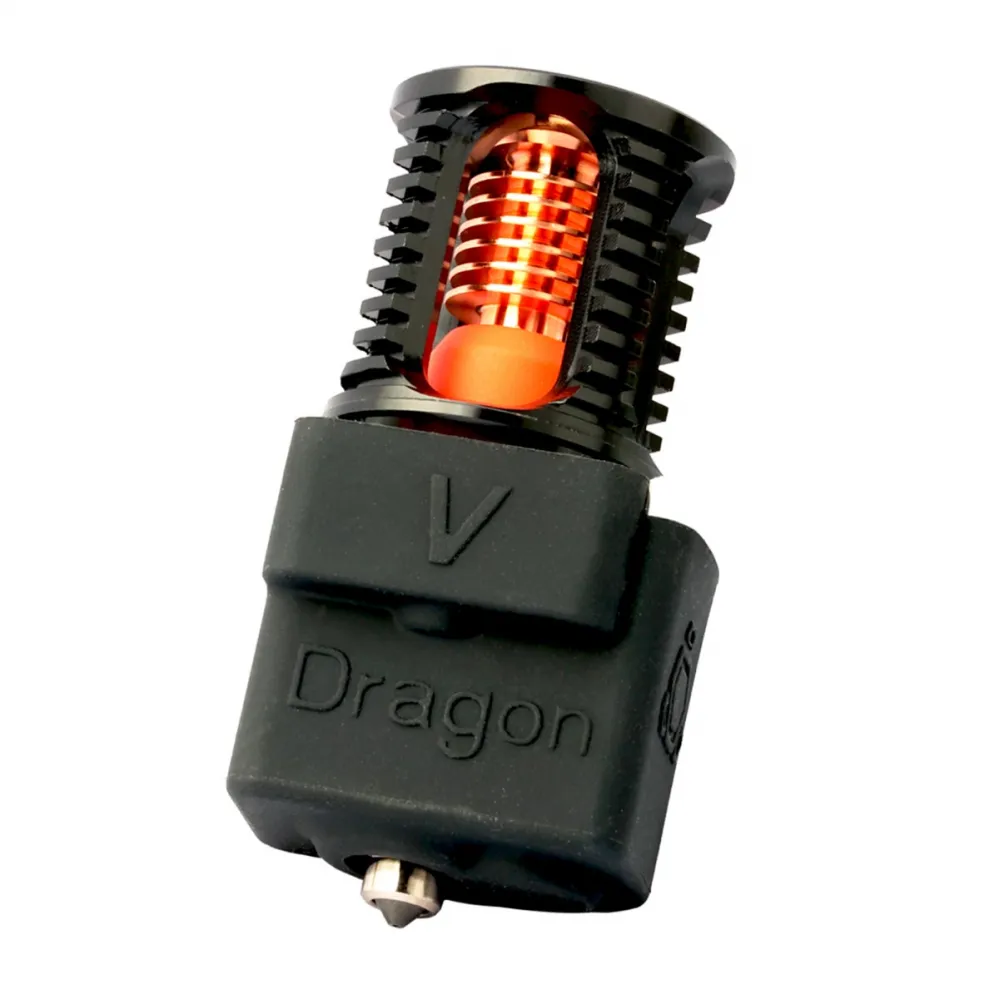
The Trianglelab Dragon ACE Volcano with PT1000 is a high-flow hotend for 1.75 mm filament. It combines the rigid Dragon ACE structure with a long Volcano-style block, a 24 V 70 W heater cartridge and a 3 mm cartridge PT1000 temperature sensor.
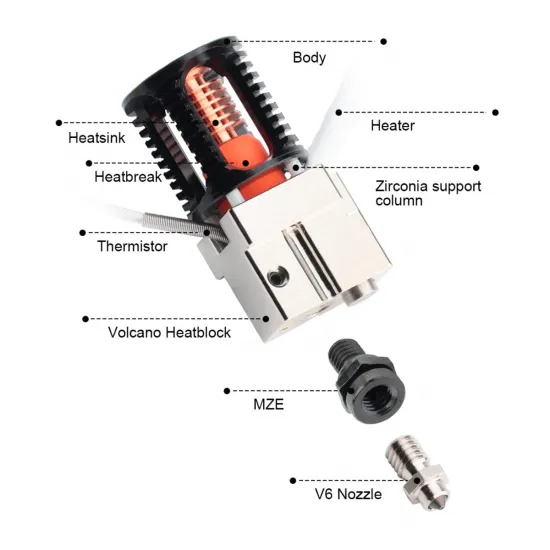
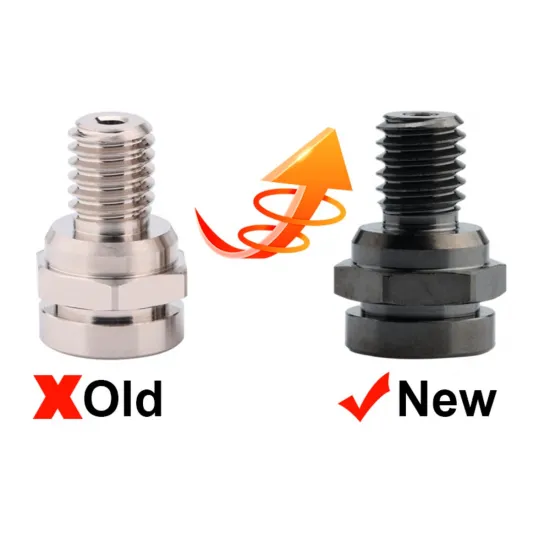
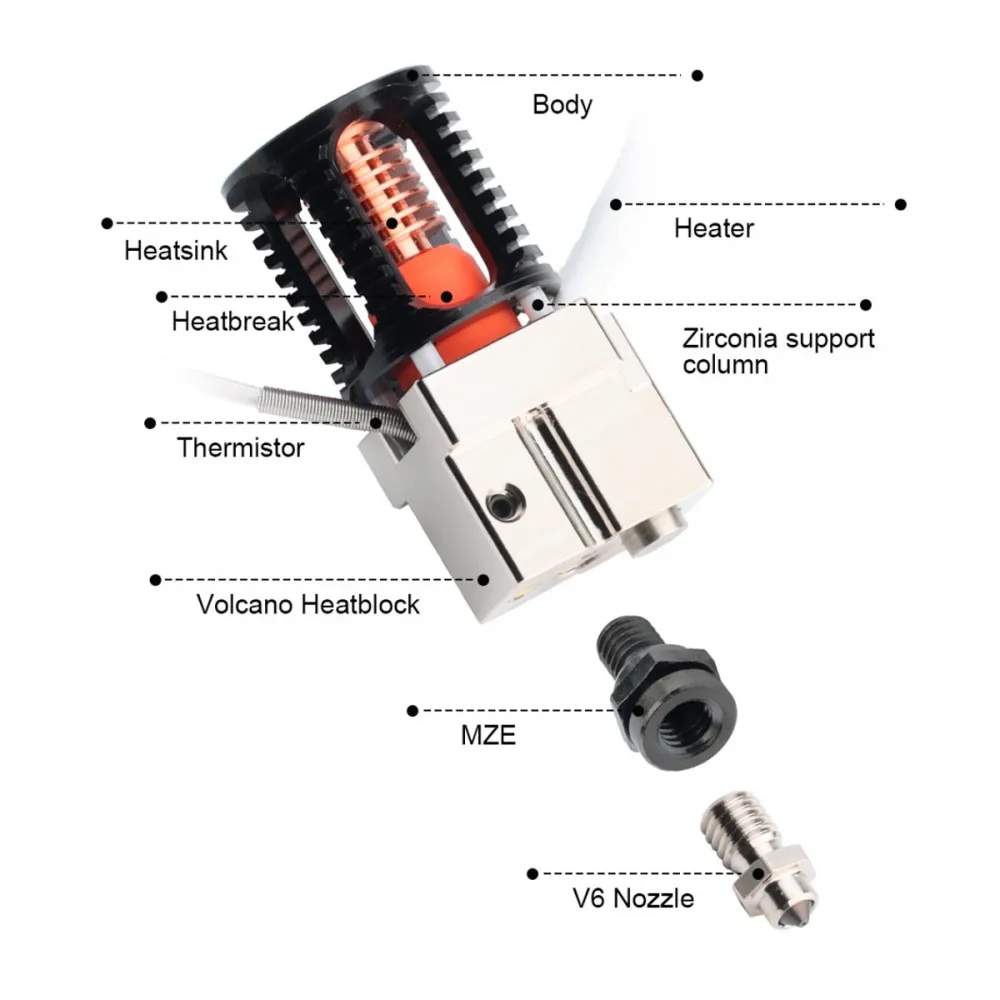
Its architecture allows the nozzle to be changed while holding the block with one hand and uses an MZE melt-zone extender. The extender lengthens the hot path without requiring a long Volcano nozzle: the assembly retains a V6 nozzle interface with M6 × 1 thread and 7.5 mm threaded length.
What makes the Volcano version different
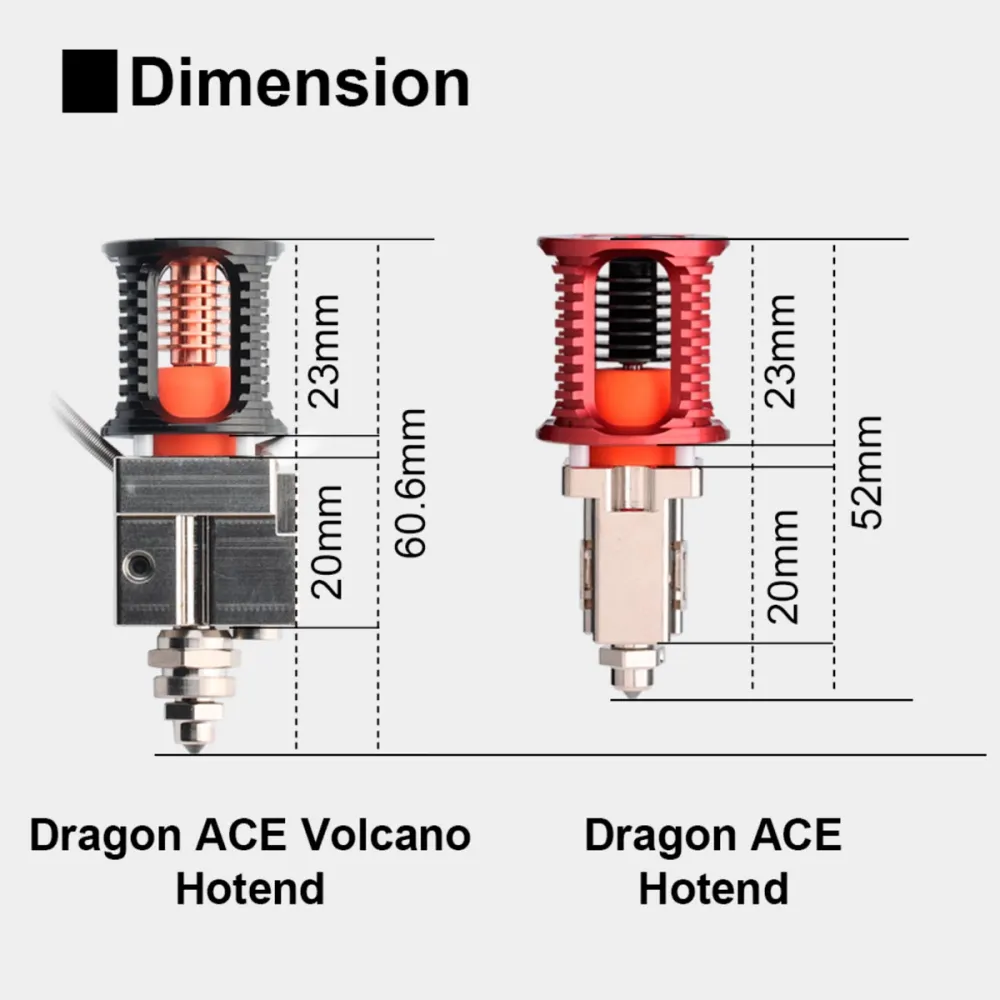
The Volcano version uses a 20 mm tall block and an MZE extender between the heatbreak and nozzle. Trianglelab states a hot section up to 40 mm long and a practical flow up to 74 mm³/s in its PETG test with a 1.2 mm nozzle. This is a manufacturer test reference, not a guaranteed rate: actual results depend on polymer, temperature, nozzle, extruder, cooling and the chosen quality threshold.
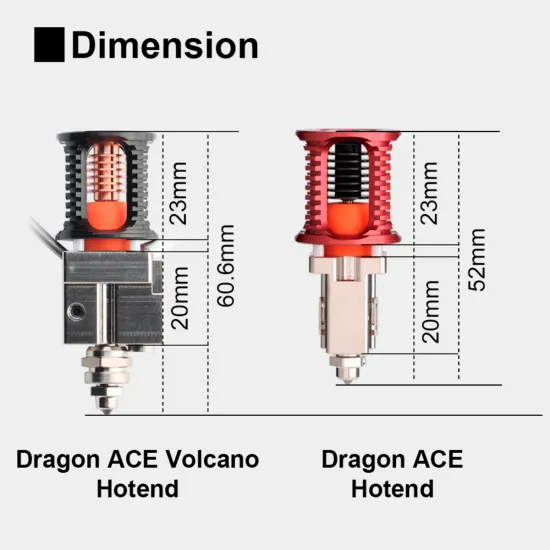
The current gallery shows an approximate total height of 60.6 mm, compared with 52 mm for the standard Dragon ACE shown in the same diagram. This changes the nozzle position and may require a different part-cooling duct, probe position, mount or travel limits.
Technical specifications
| Manufacturer and variant | Trianglelab Dragon ACE Volcano, PT1000 sensor |
|---|---|
| Filament | 1.75 mm |
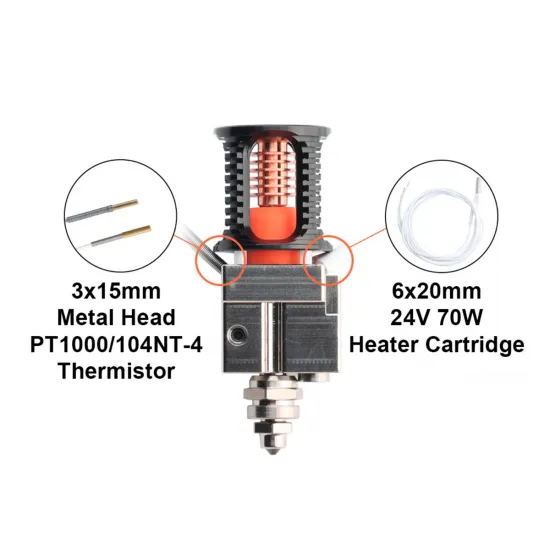
| Included heater | Ø6 × 20 mm cylindrical cartridge, 24 V DC, 70 W |
| Included sensor | Two-wire PT1000, Ø3 × 15 mm metal cartridge |
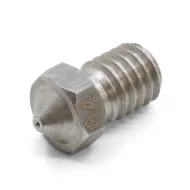
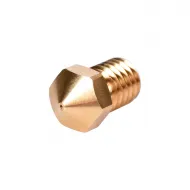
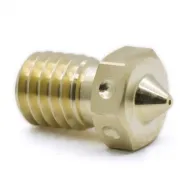
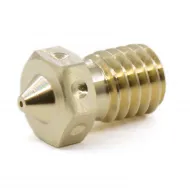
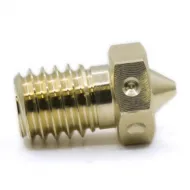
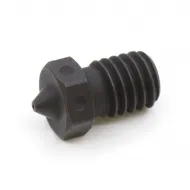
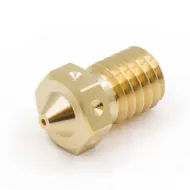
| Compatible nozzle | V6 type for 1.75 mm, M6 × 1 and 7.5 mm threaded length; it does not use a long Volcano nozzle |
| Block / extension | Volcano-style block and MZE extender included |
| Approximate height | 60.6 mm in the pictured configuration |
| Rigid mount | 4 × M2.5 threads on a 16 mm pattern; check screw length and mount |
| Stated maximum temperature | Up to 350 °C, always limited by the lowest-rated component and the machine |
| Advertised maximum flow | Up to 74 mm³/s under specific manufacturer conditions: PETG, MZE and 1.2 mm nozzle |
Mechanical compatibility
It can be installed through the rigid four-M2.5 mount or a suitable V6 Groove Mount adapter. The V6 interface makes adaptation easier, but does not make this a universal drop-in replacement. Check the exact mount, clearance around the heatsink, nozzle height, Z travel, part-cooling duct, heatsink fan, probe position, cable routing and filament path.
In toolheads designed for a standard Dragon, the nozzle will sit lower unless a Volcano/MZE-specific variant is used. Compatibility with Prusa, Voron, RatRig, Ender, CR-10, HPRO and other modifiable printers depends on the actual toolhead and installed files, not on the printer name alone.
For a shorter hotend and more moderate flow demand, consider the standard Dragon ACE with PT1000. The Dragon ACE silicone sock is a related spare, but its geometry must match the block in use.
PT1000: electrical and firmware compatibility
A PT1000 is a resistive RTD, not a 100K thermistor. Do not configure it as Beta 3950 or connect it to an arbitrary two-wire temperature input. The controller must support a direct PT1000 or use a suitable interface, and the input pull-up resistance must be known.
| Firmware | Safe starting point |
|---|---|
| Marlin | Select the table matching the real input: 1047 for PT1000 with a 4.7 kΩ pull-up, 1022 for 2.2 kΩ or 1010 for 1 kΩ. Do not copy a table without checking the controller schematic or manual and the Marlin version. |
| Klipper | On a compatible input use sensor_type: PT1000 and the real sensor_pin. pullup_resistor defaults to 4700 Ω; change it only when the controller documents a different value. |
A MAX31865 or another amplifier/converter requires different wiring and configuration from a directly connected PT1000. Before enabling the heater, the reading must be plausible and stable at room temperature. Switch off and inspect the installation if it is incorrect, reversed or out of range.
70 W heater and commissioning
The included cartridge theoretically draws approximately 2.92 A at 24 V. The power supply, MOSFET, controller output, connectors and wiring must support it with adequate margin. Do not connect it to 12 V, 48 V or an unknown voltage. The 24 V 70 W, Ø6 × 20 mm heater cartridge shares the nominal electrical and mechanical size, but cable length, termination and physical fit must also be checked.
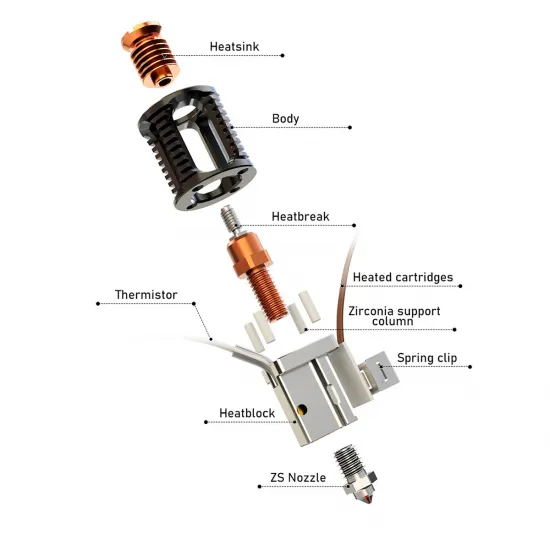
The flat ceramic heater used by the standard Dragon ACE is not a spare for this Volcano variant. They share part of the product family but use different blocks and heaters.
- With power disconnected, check continuity, insulation, voltage, pinout and the PT1000 reading.
- Secure the sensor without crushing its cartridge and provide strain relief for heater and sensor wiring.
- Enable thermal-runaway protection and begin with a conservative temperature limit.
- Personally supervise the first heat-up and inspect connectors and cables.
- Run a PID tune near the normal operating temperature using the procedure for your firmware.
For Marlin hotend 0, a common example is M303 E0 C8 S250 U1 followed by M500 when EEPROM is enabled. In Klipper use PID_CALIBRATE HEATER=extruder TARGET=250 followed by SAVE_CONFIG. Adapt the heater index/name and temperature to the actual machine.
Nozzle, flow and maintenance
The nozzle must seal against the MZE extender inside the block, not against the block face. Hot-tighten it while holding the block and follow the lowest torque limit among the installed components; Trianglelab states a maximum of 2 N·m. Check for polymer leakage around the nozzle, block and extender afterwards.
To use its high-flow capability, establish a maximum volumetric flow through progressive slicer tests. A larger nozzle may increase potential flow, but also increases extruder load, thermal demand and possible detail loss. Use a wear-resistant nozzle for abrasive filament.
After installing the hotend or changing its nozzle, sensor or heater, review PID, Z offset, retraction, pressure/linear advance and flow. The 350 °C and 74 mm³/s figures are conditional ceilings, not recommended operating targets.
This is for you if
- you need high flow with V6 nozzles and are prepared to calibrate the profile;
- your electronics support a 24 V 70 W heater and a correctly configured PT1000;
- your toolhead has a mount or adapter for the Volcano/MZE length;
- you value a rigid structure and one-handed block holding during nozzle changes.
This is not for you if
- you need a drop-in replacement without checking mount, height, cooling, probe and wiring;
- your board supports only a 100K thermistor or its temperature input circuit is unknown;
- your system is 12 V or the hotend output cannot handle the required current;
- you expect to use long Volcano nozzles: this assembly uses short V6 nozzles with an MZE extender.
Package contents
- Trianglelab Dragon ACE Volcano hotend assembled with long block and MZE extender.
- Ø3 × 15 mm cartridge PT1000 sensor.
- Ø6 × 20 mm, 24 V 70 W heater cartridge.
- V6-type nozzle and silicone sock shown on the assembled unit.
Sock colour and minor finish details may vary between batches without changing the technical variant.