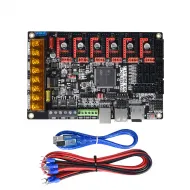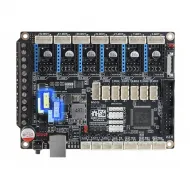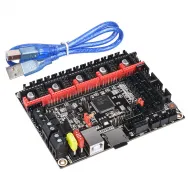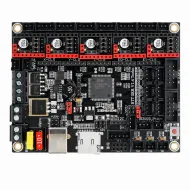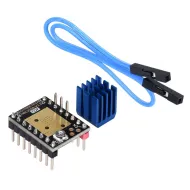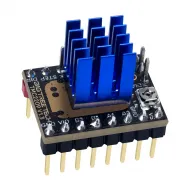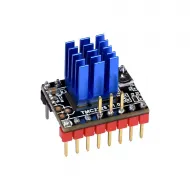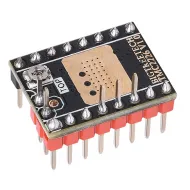


- Stock: 59
- Model: TMC2208-Fysetc

Model:

TMC2208

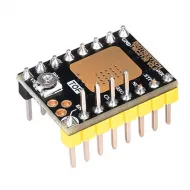
TMC2130

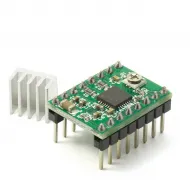
TMC2209
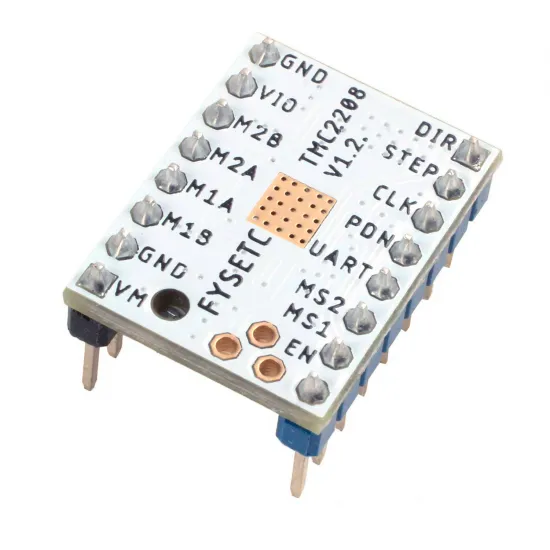
The FYSETC TMC2208 V1.2 is a StepStick driver for two-phase bipolar stepper motors, designed to substantially reduce motion noise and provide accurate control in 3D printers, small CNC machines, robots and automation projects. It can operate through standard STEP/DIR signals or use UART to configure current, microsteps, interpolation and operating mode from firmware.
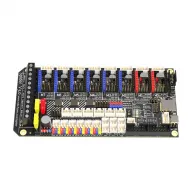
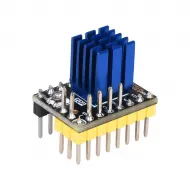
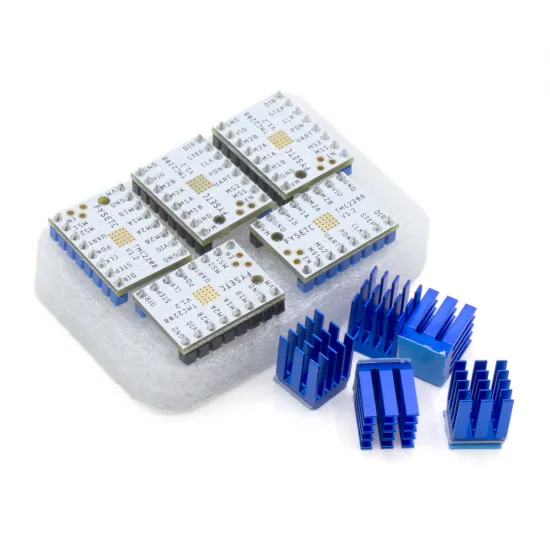
This listing is specifically for revision V1.2, factory-prepared for UART. FYSETC developed this revision for its F6 controller, although it may also be conditionally used in other boards with compatible StepStick sockets. It includes one driver and one long blue heatsink.
Main features
- StealthChop2: particularly quiet operation at suitable speeds and loads.
- SpreadCycle: current regulation intended for a more dynamic response where torque and stability are priorities.
- MicroPlyer: internal interpolation up to 256 microsteps for smoother motion without requiring that pulse frequency from the MCU.
- UART: firmware configuration and monitoring when the controller, jumpers and serial pins are compatible.
- STEP/DIR: also operates as a conventional driver when UART communication is not used.
- Automatic standby-current reduction: available through a compatible configuration.
Technical specifications
| Feature | Value |
|---|---|
| Manufacturer and revision | FYSETC TMC2208 V1.2 |
| Driver IC | Trinamic / Analog Devices TMC2208 |
| Motors | Two-phase bipolar stepper motors |
| VM motor supply | 5.5-36 V DC according to the module technical table |
| VIO logic supply | 3-5 V |
| Declared module current limit | 1.2 A RMS and 2 A peak, subject to cooling and temperature |
| Sense resistors | 0.11 Ω |
| Interfaces | EN, STEP, DIR and single-wire UART |
| Microsteps | Standalone selection of 1/2, 1/4, 1/8 or 1/16; configuration and interpolation up to 1/256 |
| Chopper modes | StealthChop2 and SpreadCycle |
| Format | StepStick with soldered header pins |
| Contents | 1 FYSETC TMC2208 V1.2 driver and 1 long blue heatsink |
Features this TMC2208 does not provide
The TMC2208 does not provide StallGuard, CoolStep or dcStep. It therefore cannot perform StallGuard sensorless homing or stall detection. These functions appear in a contradictory promotional section of an older FYSETC page, but the manufacturer's TMC2208-specific technical table and the IC documentation state that they are unavailable on this model.
If the project requires StallGuard4, sensorless homing or a newer generation, consider the FYSETC S2209 V4.0 TMC2209 driver, while still checking controller, pinout, UART, DIAG and cooling.
Compatibility depends on the controller
The FYSETC TMC2208 V1.2 can be used in controllers with replaceable StepStick sockets that support its electrical assignment, orientation, motor voltage and logic voltage. UART also requires a compatible serial route and the correct jumper or wiring arrangement.
FYSETC documents this V1.2 revision for its F6 board. The BIGTREETECH SKR 3 also supports StepStick drivers over UART, but its own manual must be followed for jumper placement and driver orientation. Other SKR, MKS, FYSETC or RAMPS controllers may require a different connection.
It is not a direct replacement for boards with soldered drivers, proprietary connectors or a different pinout. Compatibility must not be guaranteed from the printer name alone: an Ender, Prusa, Voron or another machine may contain different controllers and revisions.
It can drive bipolar NEMA 17 motors, such as our 1.7 A NEMA 17 motor, but driver RMS current must be selected for the actual motor and mechanics. Do not copy the motor nameplate current directly into the TMC2208 setting.
Standalone STEP/DIR and UART modes
Standalone STEP/DIR
The controller uses EN, STEP and DIR without communicating with the TMC2208 registers. Microsteps are selected through MS1/MS2 and current is adjusted with the VREF potentiometer. This mode provides quiet motion, but not firmware current adjustment or full diagnostic access.
UART
Revision V1.2 is factory-prepared for UART. When supported by the controller and firmware, it provides RMS-current, microstep, interpolation, StealthChop2, SpreadCycle and diagnostic configuration. Serial pins and jumpers are controller-specific; do not copy wiring from another board or module revision.
Standalone microstep selection
| MS2 | MS1 | Input microsteps | Interpolation |
|---|---|---|---|
| GND | VIO | 1/2 | 1/256 |
| VIO | GND | 1/4 | 1/256 |
| GND | GND | 1/8 | 1/256 |
| VIO | VIO | 1/16 | 1/256 |
Other resolutions may be selected over UART. Firmware microstep configuration must match the driver setting to preserve correct distances and speeds.
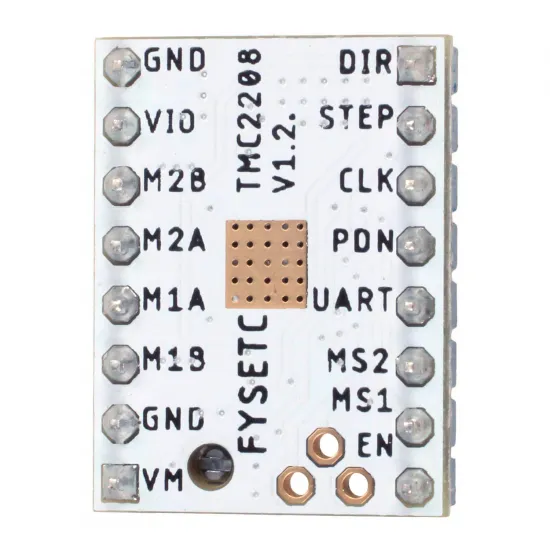
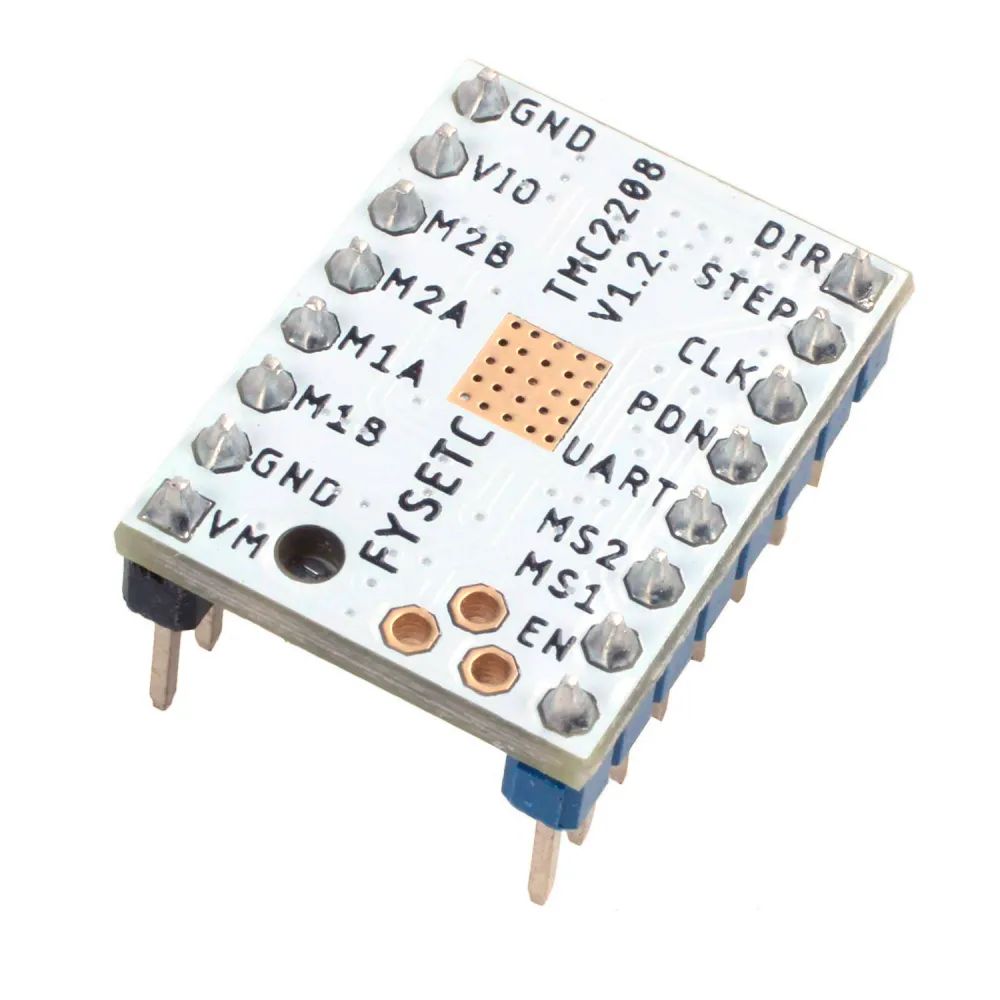
Pinout and orientation
| Group | Pins visible on V1.2 | Function |
|---|---|---|
| Control | EN, STEP, DIR | Enable, step pulse and direction |
| Configuration | MS1, MS2, CLK, PDN | Microsteps, optional clock and power-down/UART control |
| Communication | UART | Single-wire serial configuration |
| Motor | M1A, M1B, M2A, M2B | Outputs for both motor coils |
| Power | VM, VIO and GND | Motor supply, logic supply and ground |
Safe installation
- Disconnect the main power supply and USB cable.
- Consult the pinout and jumper diagram for the exact controller revision.
- Verify orientation using VM/GND and EN/DIR before inserting the module.
- Configure the socket for UART or standalone operation as specified by that controller manual.
- Place the heatsink on the large upper thermal area without touching the potentiometer or causing a short circuit.
- Connect both motor coils correctly.
- Set a conservative initial current and begin with short, slow movements.
- Check communication, temperature, torque, noise and missed steps before increasing speed or acceleration.
Never connect or disconnect the motor, insert or remove the driver, or change jumpers while the electronics are powered.
VREF and current adjustment
FYSETC documents 0.11 Ω sense resistors and the following relationship for manual adjustment:
Irms (A) ≈ Vref (V) × 0.71
Vref (V) ≈ Irms (A) × 1.41
The manufacturer recommends not exceeding 1 V VREF on this module and requires a heatsink. To measure VREF, power the controller from its main input, leave the motor disconnected and measure between GND and the metal centre of the potentiometer. USB power alone is not a valid reference for this check.
Insufficient current may cause missed steps; excessive current increases motor and driver temperature and may trigger thermal protection. In UART mode it is generally preferable to configure RMS current from firmware. In either mode, verify the result under the actual mechanical load.
Cooling
The supplied heatsink improves heat transfer but does not replace airflow. The datasheet warns that at around 1 A RMS sustained and above, PCB thermal design becomes particularly important. A closed enclosure, high ambient temperature, several adjacent drivers or prolonged movement may require active airflow at lower currents.
Marlin configuration
For UART operation, declare the relevant axis driver as TMC2208. For example:
#define X_DRIVER_TYPE TMC2208When used only as a standalone STEP/DIR driver, this may be appropriate:
#define X_DRIVER_TYPE TMC2208_STANDALONEIn Configuration_adv.h, review RMS current, microsteps, interpolation and the 0.11 Ω sense resistance for every axis. Serial pins and jumper arrangement must come from the actual controller pin file and manual.
M122: checks communication and reports driver status.M906: reads or changes current in mA when UART is working.M913: adjusts the hybrid threshold if that feature is enabled.
StealthChop, SpreadCycle and hybrid threshold are separate options. The TMC2208 does not support sensorless homing: do not configure StallGuard, DIAG as a virtual endstop or M914 for this module.
Klipper configuration
A base section follows this structure, replacing the placeholders with the actual controller pin and motor current:
[tmc2208 stepper_x]
uart_pin: <controller_UART_pin>
run_current: <suitable_RMS_current>
sense_resistor: 0.110
interpolate: True
stealthchop_threshold: 0
run_current is expressed in RMS amperes and has no universal value. stealthchop_threshold: 0 keeps SpreadCycle enabled. For permanent StealthChop, Klipper proposes a very high value such as 999999; choose a stable mode after considering noise, torque and accuracy, because switching mode while moving may produce inconsistent results.
Klipper generally recommends leaving hold_current undefined unless there is a justified need. DUMP_TMC STEPPER=stepper_x checks communication and registers. Do not add diag_pin or a virtual endstop: the TMC2208 is not StallGuard-capable.
RepRapFirmware use
Advanced compatibility depends on the controller and its specific RepRapFirmware port. The module can operate as an external STEP/DIR/EN driver where a compatible socket and signals are provided:
M569configures direction and, where applicable, external-driver timing.M350must match physically selected microsteps when UART control is unavailable.M906only changes current when that electronics and firmware version can actually communicate with the driver; it cannot turn a standalone module's potentiometer.
There is no universal UART block for connecting this external TMC2208 to every RepRapFirmware controller. The controller and firmware-version documentation must take priority. M915 must not be configured because the TMC2208 does not provide StallGuard.
Contents
- 1 × FYSETC TMC2208 V1.2 UART driver.
- 1 × long blue heatsink.
The FYSETC TMC2208 V1.2 is a compact, quiet solution for controllers with StepStick sockets, particularly useful when current and operating modes need to be configured over UART. Reliable operation requires checking controller revision, orientation, jumpers, motor current, cooling and firmware configuration before applying power.