

- Stock: 16
- Model: Destornillador-Cerámico
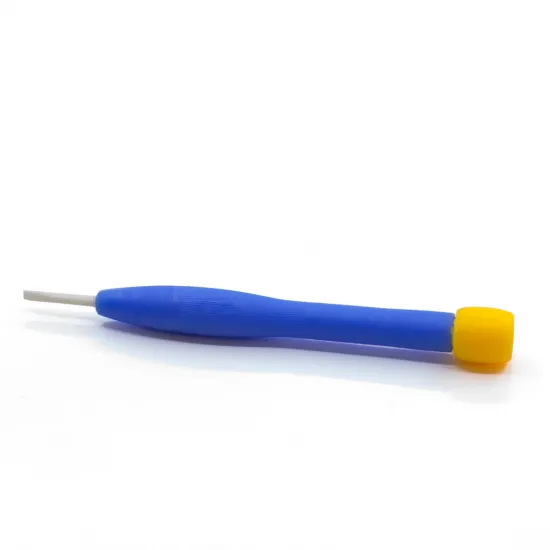
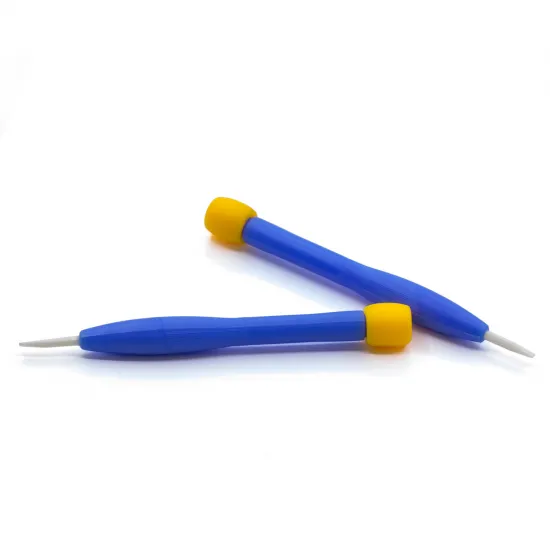
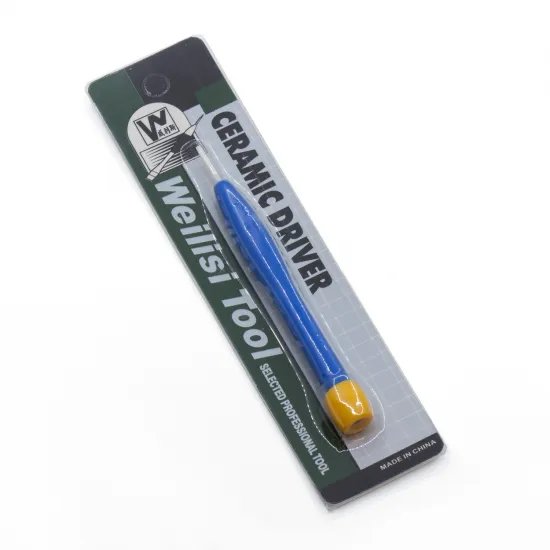
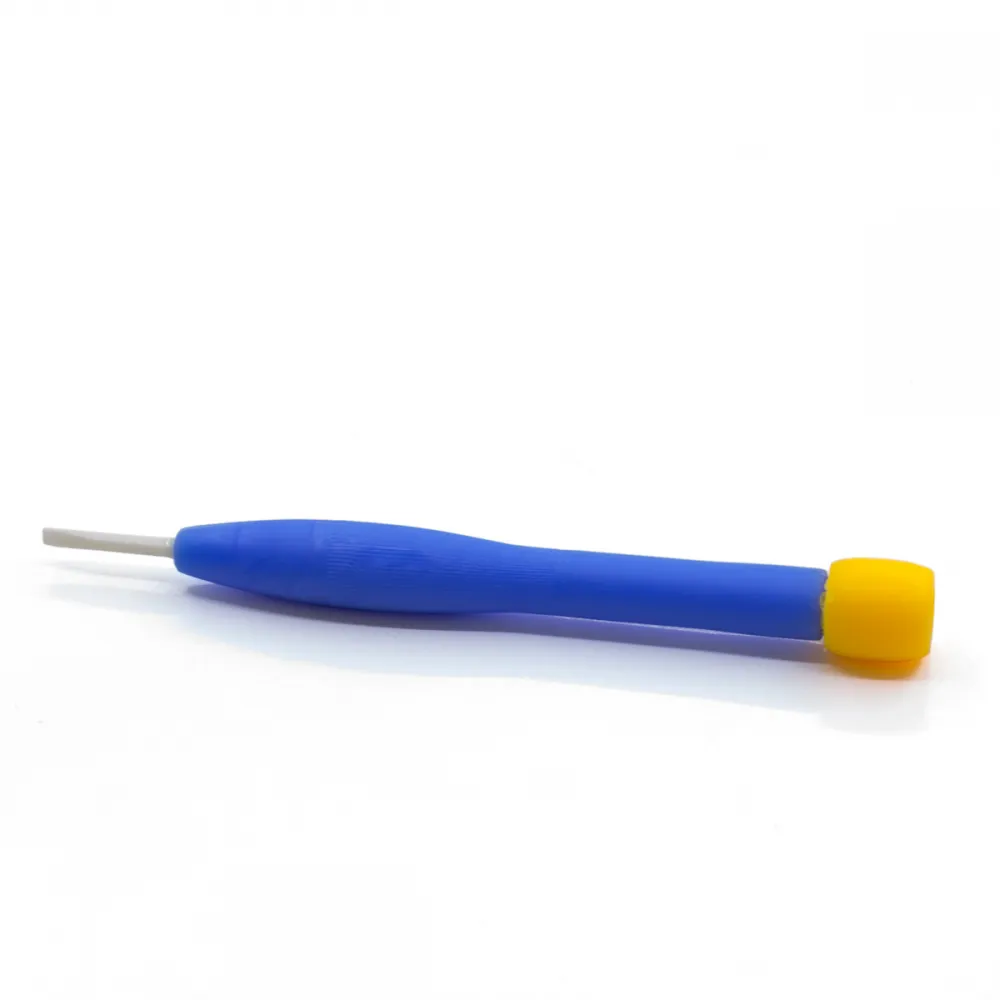
This 0.4 × 1.3 mm slotted ceramic adjustment screwdriver is designed for potentiometers, trimmers and other adjustable electronic components with a compatible slot. Its non-metallic tip supports precise work in confined areas while reducing the magnetic and inductive influence associated with a steel tool.
It is particularly useful for adjusting the reference voltage or VREF on stepper motor drivers fitted with a manual potentiometer, as well as for alignment work on electronic equipment, coils and inductors. The stated size is the nominal thickness and width of the slotted tip: 0.4 × 1.3 mm.
Main specifications
| Feature | Value |
|---|---|
| Tool type | Ceramic adjustment screwdriver |
| Tip shape | Slotted |
| Nominal tip size | 0.4 mm thick × 1.3 mm wide |
| Tip material | Zirconia ceramic |
| Tip properties | Non-magnetic, non-inductive and electrically insulating as a material |
| Handle | Plastic, commercially described as antistatic |
| Contents | 1 screwdriver |
Why use a ceramic tip?
A metal tip can accidentally bridge adjacent contacts and may influence some magnetic or high-frequency circuits while they are being adjusted. Zirconia is non-magnetic and non-inductive, allowing the component to be adjusted with less disturbance while reducing the risk of directly bridging nearby contacts with the tip.
These properties are useful for single-turn and multi-turn potentiometers, variable capacitors, coils and adjustable inductors. The tool must still match the actual slot: an oversized tip will not fit, while an undersized tip may concentrate stress, damage the adjuster or break.
Adjusting VREF on stepper drivers
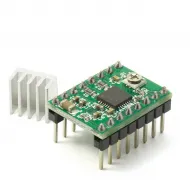
The 0.4 × 1.3 mm tip may suit the potentiometer fitted to certain manually adjusted drivers, such as the A4988 or DRV8825, provided the slot on the actual revision accepts this size. Check the fit visually before applying force.
- Consult the procedure and current formula for the exact driver model and revision.
- Fully disconnect the machine before installing the driver, changing jumpers, or connecting and disconnecting the motor.
- If the procedure requires VREF to be measured while powered, immobilise the machine and work only on the low-voltage electronics.
- Place the multimeter probe on the documented test point and prevent it from slipping onto adjacent pins.
- Turn the potentiometer in very small increments without pressing down or forcing its end stop.
- Measure again after every correction, then check temperature, torque and missed steps during a controlled test.
Precautions and limitations
- Not a high-torque screwdriver: ceramic is hard and wear resistant, but it can break under excessive torsion, impact, drops or levering.
- Do not force potentiometers: these are delicate components and can be damaged at their end stop.
- Not equivalent to a VDE-rated tool: no working-voltage rating or certification for mains-connected circuits is supplied.
- Do not work on open 230 V power supplies: a ceramic tip does not remove electric-shock hazards from the rest of the tool, circuit or surroundings.
- ESD: the handle is described as antistatic, but no standard or surface-resistance value is specified; it must not be treated as a certified ESD tool.
- Use eye protection where tip breakage could present a risk, and keep the tip clean and protected in storage.
Typical applications
- Manual VREF adjustment on compatible 3D-printer and light-CNC drivers.
- Potentiometer and trimmer adjustment in low-voltage electronics.
- Alignment of coils, inductors and radio-frequency circuits.
- Maintenance and calibration of audio, communications, laboratory and automation equipment.
Supplied as one screwdriver with a 0.4 × 1.3 mm slotted tip.