

- Stock: 38
- Model: TPU GST3D

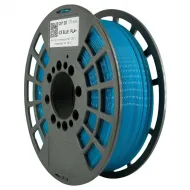
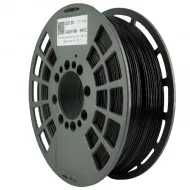
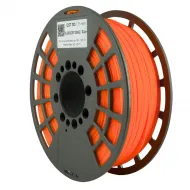
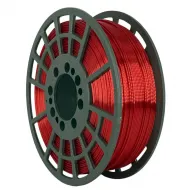
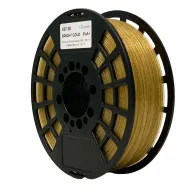
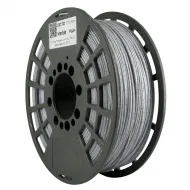
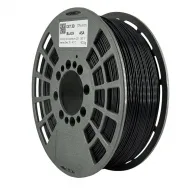
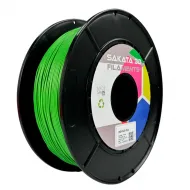
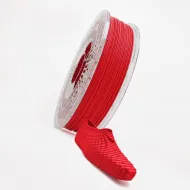
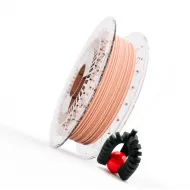
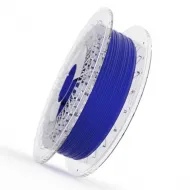
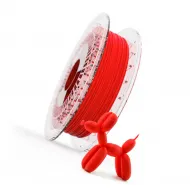
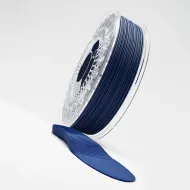
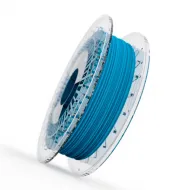
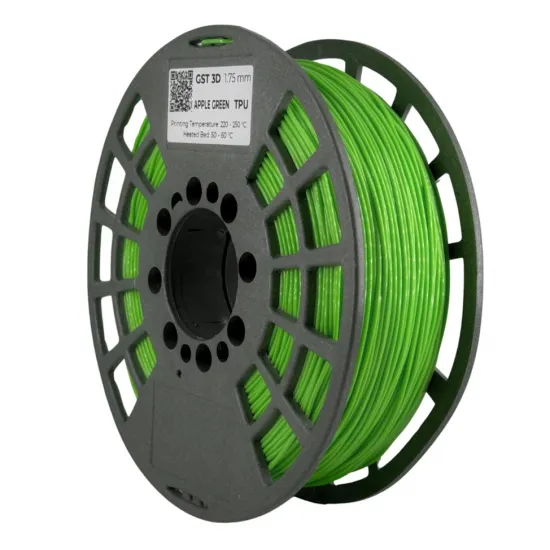
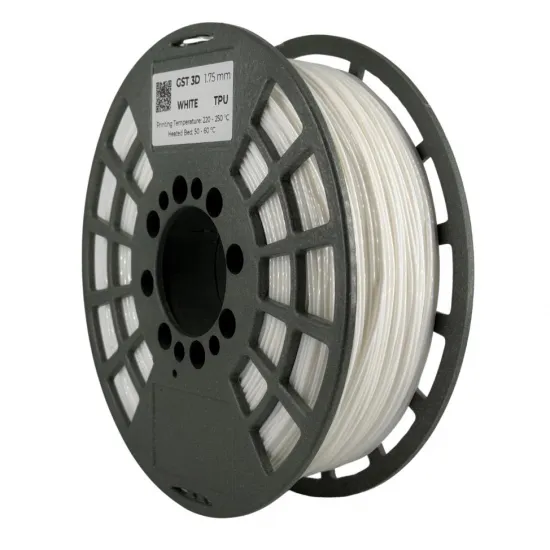
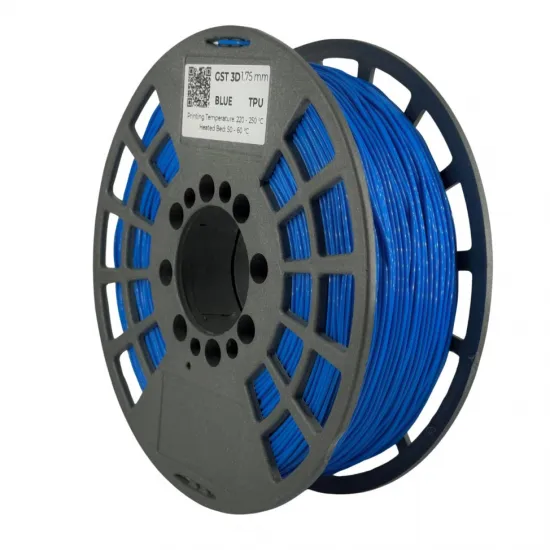
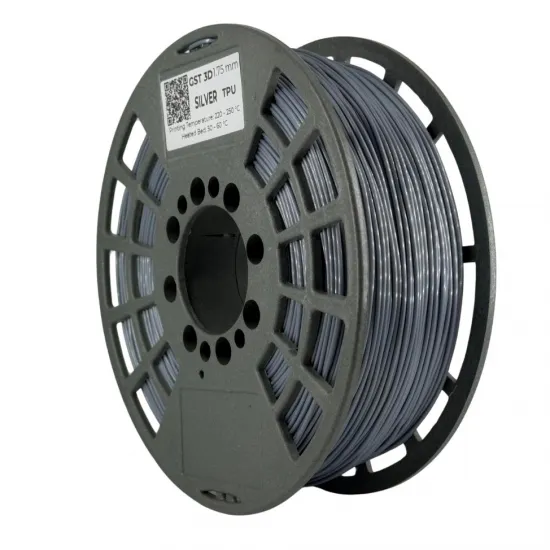
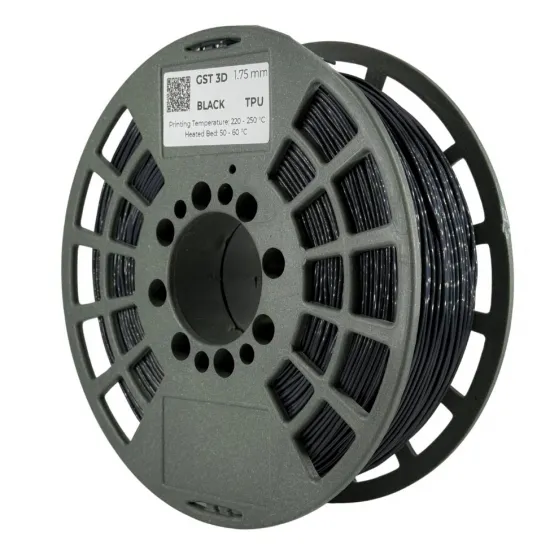
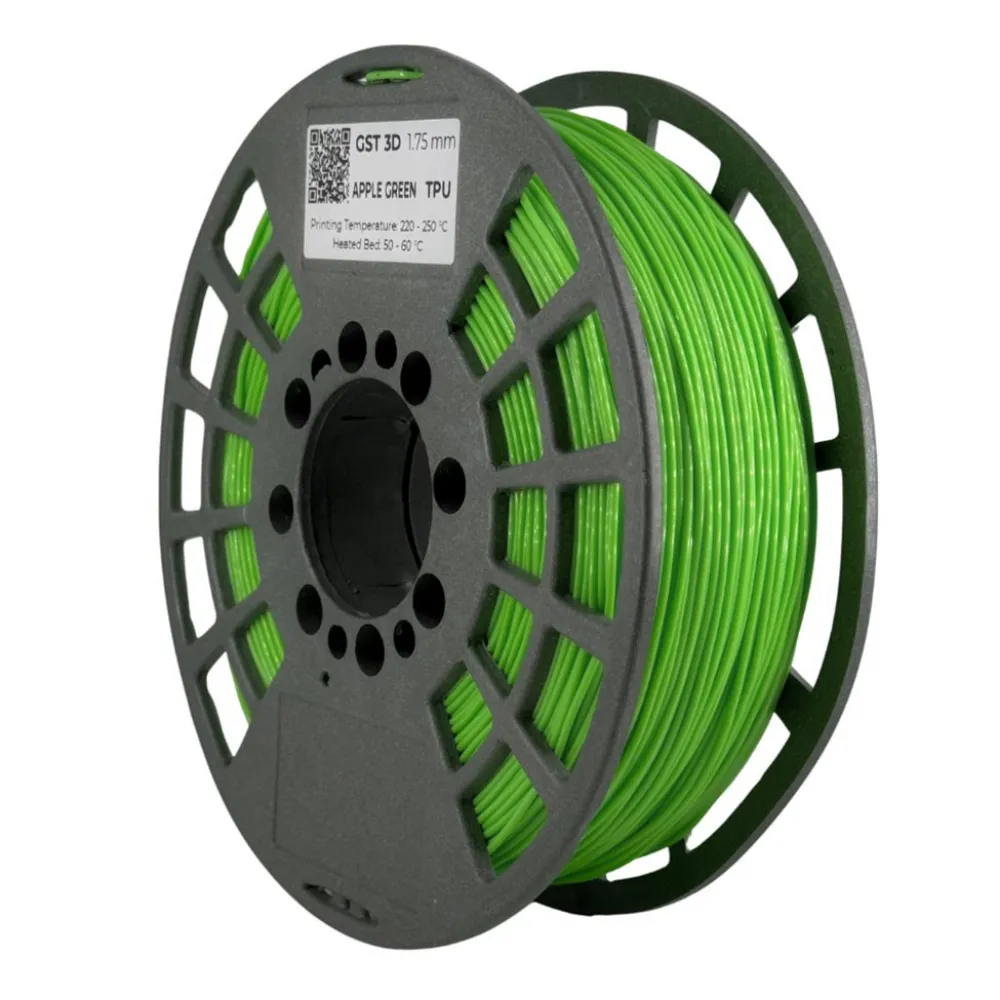
GST3D 1.75 mm TPU 93A is a flexible filament for making guards, cases, stops, grips, damping feet and other parts that need to bend, absorb impacts or withstand rubbing. It is supplied on a 1 kg spool and is available in white, blue, apple green, silver or black.
Its nominal 93 Shore A hardness, as declared by GST3D, provides a practical balance between flexibility and feeding ease. It is not as soft as an 85A or 60A TPU: it retains its shape better and is generally more approachable for a first flexible material, although it still requires a suitable extruder and print profile.
Key features
| Feature | Value |
|---|---|
| Brand | GST3D |
| Material | Flexible TPU |
| Nominal hardness | 93 Shore A |
| Diameter | 1.75 mm |
| Net weight | 1 kg |
| Available colours | White, blue, apple green, silver and black |
| Recommended extruder | Direct drive |
| Packaging | Vacuum-packed spool |
What does 93A mean?
The Shore A scale compares elastomer hardness, but it does not by itself determine how a printed part will bend. With the same spool, a thin wall and low infill can be very flexible, while a thick section, extra perimeters or high infill will produce a much firmer part.
This 93A grade suits applications that need elasticity without the extreme softness of other flexible filaments. For a softer result, compare it with Sakata 3D RE-FLEX 85A; each formulation still needs its own profile.
Starting print settings
GST3D does not currently publish a complete printing table for this TPU. The values below come from the reference used by HTA3D and should be treated as a starting point. The label on the spool received, the slicer profile and tests on the actual machine take priority.
| Setting | Starting point | How to tune it |
|---|---|---|
| Nozzle | 210-230°C | Run a temperature tower within the range printed on the spool. |
| Speed | 20-40 mm/s | Start at the low end and increase only while feeding remains stable. |
| Retraction | Low | Tune distance and speed with a short test; excess retraction can deform the filament or cause jams. |
| Acceleration | Moderate | Reduce abrupt flow changes if under-extrusion appears. |
| Bed and cooling | According to surface and profile | Follow the spool label and build-surface instructions; different coatings do not all need the same settings. |
Direct drive and Bowden
The manufacturer recommends a direct-drive extruder. The smaller the free gap between the drive gears and the hotend inlet, the less opportunity the flexible filament has to buckle or escape from its path.
A Bowden system may also print 93A TPU when the tube is short, well guided and the extruder properly constrains the filament, but accepting 1.75 mm filament alone does not guarantee compatibility. Lower speed and restrained retraction are generally appropriate.
- Set drive-gear pressure high enough to feed TPU without crushing it.
- Ensure the spool turns freely and the path has no tight bends.
- Reduce retraction, acceleration and speed before making large temperature increases.
- Avoid leaving the hotend hot and idle for long periods with filament loaded.
3D printer compatibility
With a suitable profile and feed path, it can be used in 1.75 mm FDM/FFF printers such as HTA3D HPRO, Creality Ender-3 S1, Creality K1/K1C, Prusa MK3/MK4, Bambu Lab A1/P1/X1 and Voron. These are examples of platforms that can process flexible materials in certain configurations, not a guarantee for every revision, extruder or accessory.
Do not infer compatibility with automatic or multi-material systems from diameter alone. Explicitly check whether the manufacturer allows 93A TPU in the feeder, as well as spool dimensions and the internal path. When the system requires TPU to be fed from an external spool holder, follow that instruction and do not load it into an AMS, AMS Lite or another enclosed feeder.
Moisture, storage and surface quality
Keep the spool sealed with desiccant. If crackling, bubbles, a rough surface or new stringing appear, consider moisture before greatly increasing retraction. Dry the material using a TPU-suitable method while respecting the spool's allowable temperature; a generic drying cycle should not be applied without checking those limits.
An even first layer helps prevent failures, but avoid excessive squish. Final flexibility, impact behaviour and wear resistance depend on geometry, orientation, layer bonding, perimeters, infill and service conditions; validate them when making functional parts.
Typical applications
- Impact-resistant cases, guards and covers.
- Stops, feet, dampers and anti-vibration spacers.
- Grips, bands, straps and parts designed to flex.
- Non-critical gaskets and custom-fit components.
- Prototype tyres, wheels and parts exposed to rubbing.
Do not assume watertightness, electrical insulation, biocompatibility, food contact or structural suitability without specific testing and documentation for the final item.
This is for you if
- You need a flexible 93A TPU that is easier to handle than much softer grades.
- Your printer uses 1.75 mm filament and has a well-guided path, preferably direct drive.
- You want a 1 kg spool in white, blue, apple green, silver or black.
This is not for you if
- You need a rigid part; consider GST3D PLA+ or GST3D PETG instead.
- Your extruder leaves an open gap where the filament can buckle and the path cannot be modified.
- You require a different hardness, certified mechanical values or a specific approval.