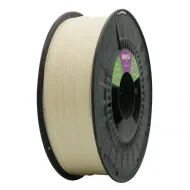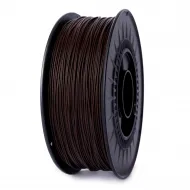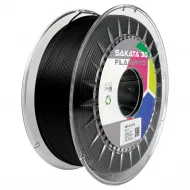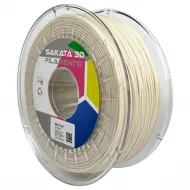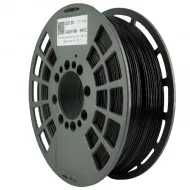
-550x550.webp "Sakata 3D OBC black filament 1.75 mm - polyethylene copolymer - 750 g")
-550x550.webp "Sakata 3D OBC black filament 1.75 mm - polyethylene copolymer - 750 g")
-80x80.webp "Sakata 3D OBC black filament 1.75 mm - polyethylene copolymer - 750 g")
-80x80.webp "Sakata 3D OBC black filament 1.75 mm - polyethylene copolymer - 750 g")

- Stock: 1
- Model: OBC-1.75mm-SAKATA3D

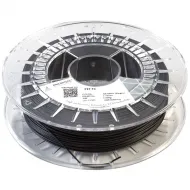
Sakata 3D OBC is a technical polyethylene copolymer filament for FDM/FFF 3D printing. It combines low density, flexibility, impact resistance and strong interlayer bonding, making it particularly useful for lightweight parts, living hinges, containers and components that need to deform without behaving like a soft TPU.
This product is made in Spain and supplied in black, 1.75 mm diameter and a 750 g spool. Its density of 0.905 g/cm³ provides approximately 345 m of filament: a length similar to a 1 kg spool of 1.75 mm PLA, with less mass for the same volume.
-1000x1000.webp)
What is OBC filament?
OBC stands for Olefin Block Copolymer. Sakata 3D describes it as a semi-crystalline polyethylene copolymer developed to retain useful polyolefin properties while reducing printing problems commonly associated with polypropylene, including warping and curling.
Its Shore D 53 hardness and low flexural modulus allow parts to bend and recover more readily than rigid PLA or PETG parts. It must not, however, be confused with a Shore A TPU: OBC retains more body and stability and is intended for flexible technical parts rather than soft objects such as seals or soles.
Technical specifications
| Feature | Value |
|---|---|
| Brand | Sakata 3D Filaments |
| Material | OBC, semi-crystalline polyethylene copolymer |
| Manufacture | Spain |
| Diameter | 1.75 ±0.05 mm |
| Maximum roundness deviation | 0.05 mm |
| Net weight | 750 g |
| Available colour | Black |
| Specific gravity | 0.905 g/cm³, ASTM D792 |
| Hardness | Shore D 53, ASTM D2240 |
| Approximate theoretical length | 345 m, calculated from nominal diameter and density |
Lightweight parts without a foaming filament
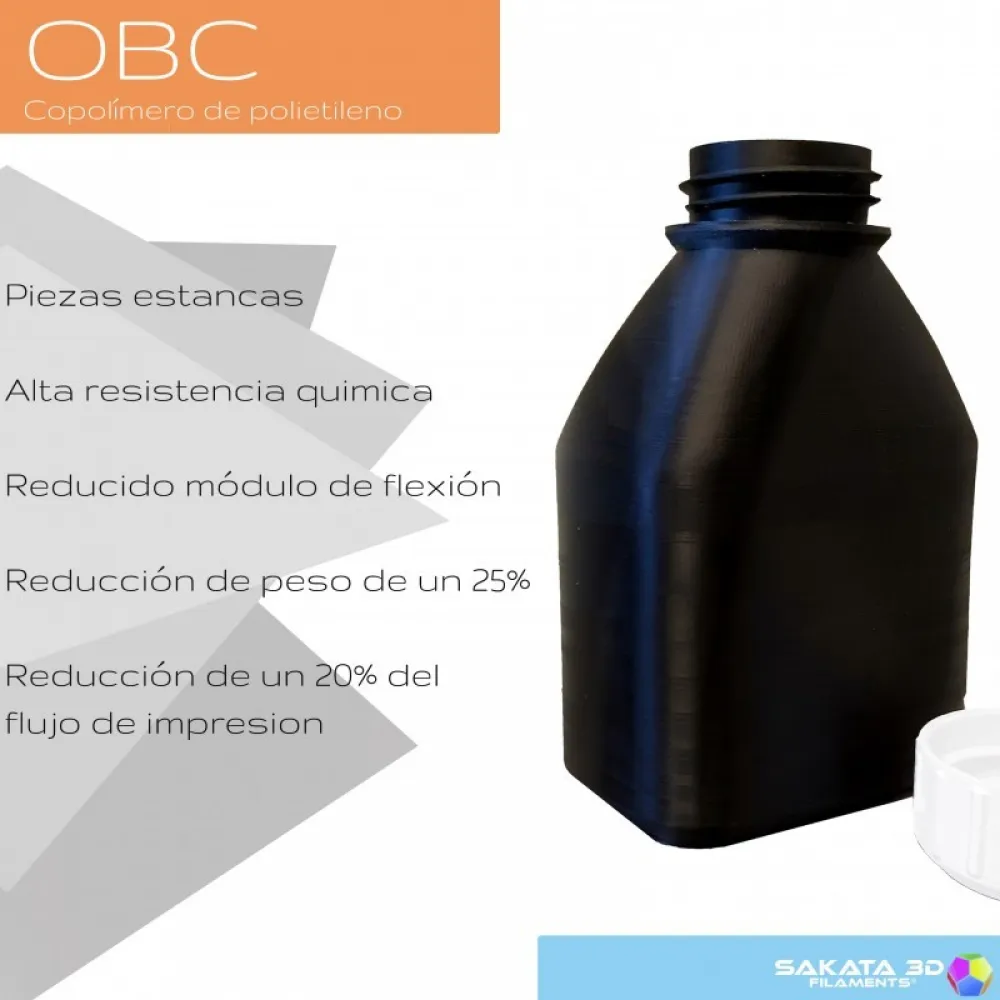
Sakata states that parts can be up to 25% lighter. The reduction comes from the polymer's low density rather than controlled expansion as found in foaming filaments. For the same geometry and volume, the relationship between 0.905 g/cm³ for OBC and approximately 1.24 g/cm³ for PLA is consistent with this difference.
The actual percentage depends on the comparison material, calibrated flow, walls, infill and design. A 750 g spool does not contain less useful material simply because its mass is lower: its nominal polymer volume is slightly greater than that of 1 kg of PLA at a density of 1.24 g/cm³.
Flexibility, impact and interlayer bonding
Sakata's technical data sheet publishes the following results for printed specimens. They are comparative reference values obtained at 200 °C, with a 65 °C bed, 20 mm/s, two shells and 45° infill; they do not guarantee the performance of every part.
| Property | Method | Representative value |
|---|---|---|
| Tensile strength | ASTM D1708 | 14 MPa |
| Elongation at break | ASTM D1708 | 700% |
| Flexural modulus | ASTM D790 | 244 MPa |
| Flexural strength | ASTM D790 | 7.8 MPa |
| Notched Izod impact | ASTM D256 | 347 J/m |
The manufacturer also states that its semi-crystalline structure can retain more than 70% of the XY mechanical performance in the Z direction. This highlights its interlayer bonding potential, but orientation, temperature, flow, cooling and geometry remain decisive.
-1000x1000.webp)
Recommended print settings
| Setting | Starting point |
|---|---|
| Nozzle temperature | 170-210 °C; 200 °C was used for the reference specimens |
| Bed temperature | 80-100 °C in the TDS; the catalogue and specimen test also show 65 °C with an appropriate surface |
| Build surface | Polyolefin film or tape recommended by Sakata; test any other surface first |
| Part-cooling fan | 100% official reference |
| Layer height | 0.20 mm |
| Wall thickness | 0.8-1.6 mm |
| Print speed | 10-30 mm/s |
| Flow | Sakata states approximately 20% less than PLA; it must be calibrated on the actual printer and part |
Calibrating flow without causing under-extrusion
The “20% less flow” statement can be used as an initial experiment: if the profile begins at a 100% multiplier, a value around 80% can be tested and measured. It must not be applied blindly or interpreted as an automatic 20% increase in print speed.
- First verify filament diameter, extruder operation and actual filament feed.
- Print a small single-wall object or calibration pattern at low speed.
- Measure wall thickness, inspect for gaps and check bonding between lines and layers.
- Adjust the multiplier in small steps until walls are continuous without visible excess.
- Repeat with the temperature and speed intended for the final part.
For containers or loaded components, also validate mass, dimensions, seam and mechanical behaviour. Excessively low flow can weaken bonding and remove the very advantages sought from OBC.
Build-plate adhesion
Polyolefins have particular surface-adhesion behaviour. Sakata recommends polyolefin film or tape and makes bed temperature dependent on the selected surface. PEI, glass, lacquer or another adhesive must not be assumed to behave identically.
- Clean the surface according to its manufacturer's instructions and remove grease and dust.
- Run a small test before occupying the entire build plate.
- Use a slow, even first layer without excessive squish.
- If corners lift, review surface, temperature, drafts and geometry before increasing flow indiscriminately.
- Avoid removing a strongly bonded part while hot if the build surface may be damaged.
Containers, leak resistance and chemicals
Strong interlayer bonding makes OBC an interesting candidate for containers and components intended to limit leaks. Even so, the filament alone does not guarantee a leak-tight part. Continuous walls, seams, temperature, flow, thickness and geometry determine the result.
- Use several continuous perimeters and avoid excessively thin walls.
- Place the seam in a controlled position and inspect layer changes, bridges and overhangs.
- Carry out a prolonged test using the actual fluid and service temperature.
- Do not use it as a pressure vessel or for gases without a specific design, test programme and safety factor.
- Chemical resistance must be checked for the actual substance, concentration, temperature, exposure time and mechanical stress.
It is not certified for food contact or medical applications. A printed container must not be assumed suitable for drinking water, fuel, solvents or hazardous products without independent professional validation.
3D printer compatibility
It can be used in 1.75 mm FDM/FFF printers whose hotend reaches 210 °C and whose bed supports the required temperature and build surface. HTA3D HPRO 330 and HPRO 400, Bambu Lab X1/P1/A1, Creality K1/K1C and current Ender machines, Original Prusa MK3S+/MK4/MK4S/XL and Voron V0/Trident/2.4 have sufficient thermal capability in their usual configurations.
These names indicate conditional thermal compatibility, not official profiles or guaranteed results. Every printer requires a custom profile, build-surface test, calibrated flow and a low initial speed. For AMS, MMU and other automatic feeding systems, check spool fit, filament stiffness and the complete path; use direct external feeding if loading or friction problems occur.
Storage and safety
- Keep the spool sealed and protected from moisture, dust, heat and direct light, preferably with desiccant.
- The reviewed TDS does not provide an official drying cycle; avoid improvised temperatures that could deform the filament or spool.
- Maintain good general ventilation during printing.
- No service temperature or HDT is published: nozzle temperature is not the allowable temperature of the finished part.
Comparison with other materials
- Sakata 3D PLA 850 is a stiffer, easier-to-profile alternative for general parts requiring fine detail.
- Sakata 3D PETG offers more conventional functional behaviour when OBC's low density and flexibility are not required.
- Recreus Filaflex 82A is more appropriate when a substantially softer and more deformable elastomer is needed.
This is for you if
- You need lightweight, impact-resistant parts that can flex more than PLA or PETG.
- You want to experiment with living hinges, containers, deformable housings or polyolefin applications.
- You can prepare an appropriate surface and spend time calibrating flow, temperature and speed.
- You need approximately the length of a 1 kg PLA spool with only 750 g of material.
This is not for you if
- You need a material as soft as TPU or a completely rigid part.
- You want a fast universal profile that works without calibration or build-surface testing.
- You require certification for food, medical use, pressure or a specific chemical.
- Your bed cannot reach the required temperature or use a compatible build surface.