- Stock: Out of Stock
- Model: PA-GF20-FR-1.75mm-SAKATA3D

Type:

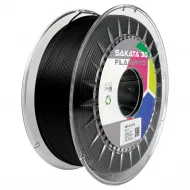
PA-NT - Copolyamide without reinforcement - 1.75mm - Sakata 3D

PA-GF20-FR Glass Fiber Nylon

PA-CF15 Nylon with carbon fiber
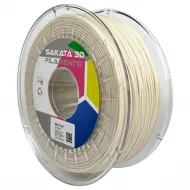
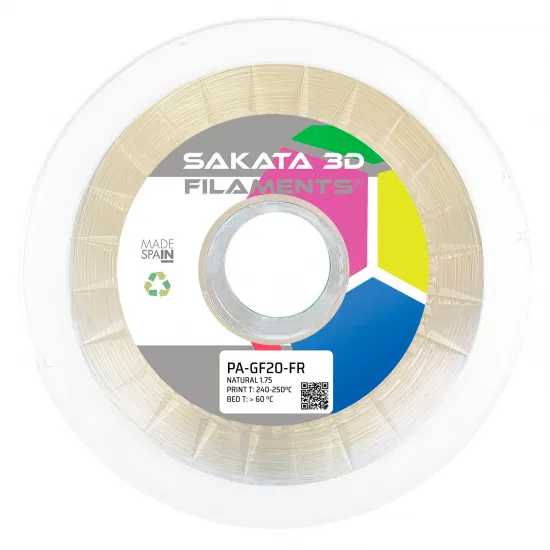
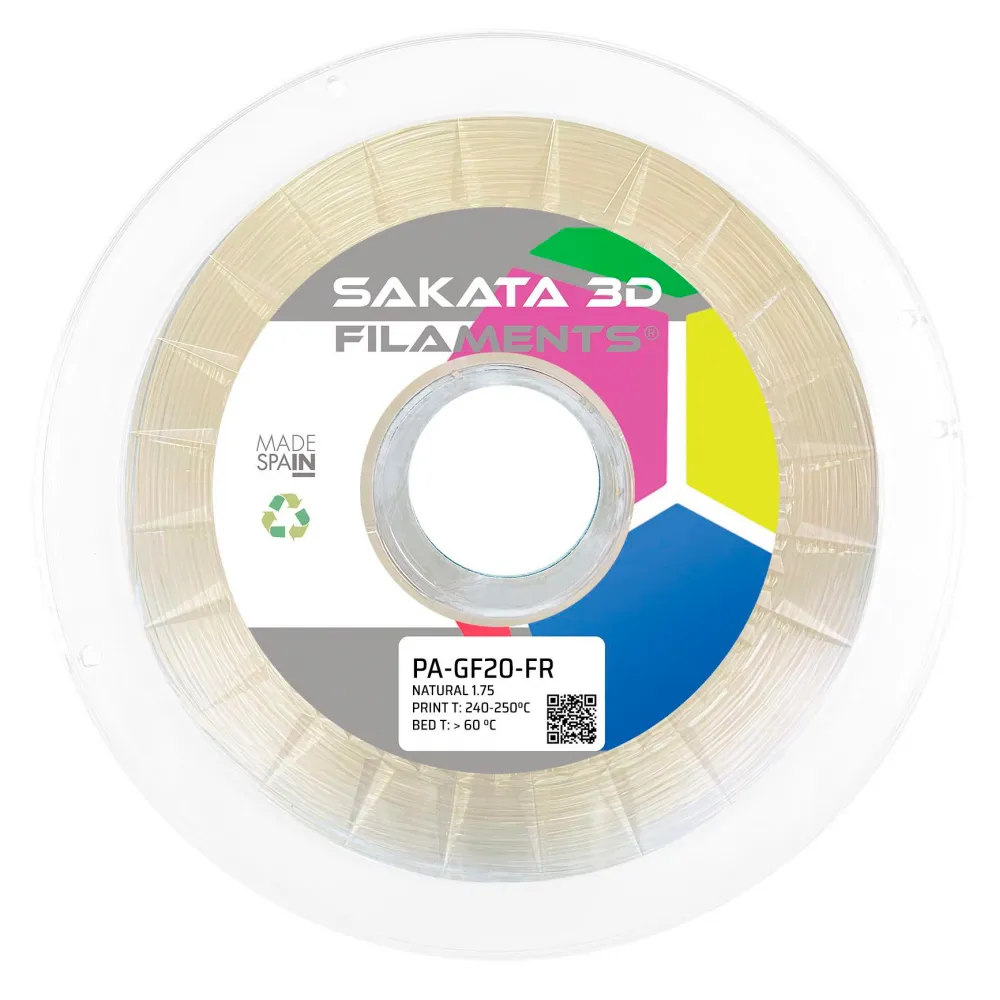
Sakata 3D PA-GF20-FR is a technical filament made in Spain from a heat-stabilised copolyamide or Nylon reinforced with 20% glass fibre and formulated with a flame-retardant additive. It is intended for functional parts, tooling, supports and housings requiring dimensional stability, stiffness and documented reaction-to-flame data.
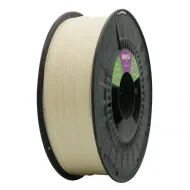
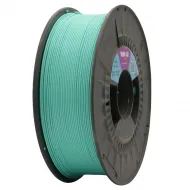
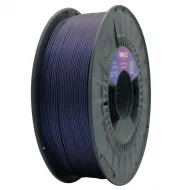
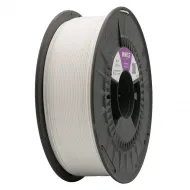
It is supplied in Natural colour on an 850 g net spool, with a diameter of 1.75 ± 0.03 mm. This is an advanced, abrasive material: reliable processing requires an enclosed printer, a wear-resistant nozzle and strict moisture control.
Main features
- Copolyamide reinforced with 20% glass fibre.
- Lower shrinkage and warping than unreinforced Nylon, according to the manufacturer.
- UL94 V-2 material rating at 0.8 and 1.5 mm.
- Declared GWFI of 960°C at 1.5 mm.
- Reference HDT of 180°C at 0.45 MPa.
- Made in Spain by Sakata 3D.
Specifications
| Feature | Official value | Reference |
|---|---|---|
| Material | Copolyamide + 20% glass fibre + flame-retardant additive | Heat stabilised |
| Diameter | 1.75 ± 0.03 mm | Maximum roundness deviation: 0.03 mm |
| Net weight | 850 g | Natural spool |
| Density | 1.31 g/cm³ | ISO 1183 |
| Moisture / water absorption | 1.5% / 6.0% | ISO 62 |
Print settings
| Setting | Starting point | Notes |
|---|---|---|
| Printer | Enclosed | The documentation does not require an actively heated chamber or specify a chamber temperature. |
| Nozzle temperature | 240-250°C | Official product-page starting range; the TDS allows 235-260°C. |
| Nozzle material | Hardened steel | Glass fibre rapidly wears Brass and other soft materials. |
| Bed | Above 65°C | Glass or PEI; the manufacturer requires adhesive. |
| Part cooling | 0% | Official starting value; validate bridges and small details. |
| Layer height | 0.2-0.3 mm | Practical starting point from earlier official documentation; adapt to nozzle and geometry. |
| Speed | 30-100 mm/s | Start low and increase only after validating flow and layer bonding. |
| Pre-drying | More than 8 h at 70°C | Use a dryer and spool suitable for this temperature. |
| While printing | Drybox at 70°C | Prevents the dry spool from taking up moisture again. |
These values are a starting point, not a universal profile. The complete hotend, sensor, heater, wiring, connectors and internal tube must safely support the selected temperature.
Drying, nozzle and first layer
Nylon is hygroscopic. Popping, steam, bubbles, stringing, rough surfaces or weak layers are signs consistent with moisture. Dry the spool first and calibrate afterwards; extra temperature or retraction cannot remove absorbed water.
The 20% glass-fibre content makes this filament abrasive. Use a hardened-steel nozzle or an equivalent explicitly intended for filled compounds, and inspect gears and guides exposed to friction. Sakata does not specify a minimum outlet diameter, so a generic recommendation should not be presented as a requirement for this product.
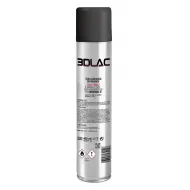
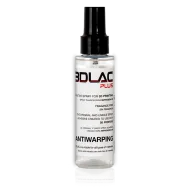
Adhesive is required on glass or PEI. You can use 3DLAC print-bed adhesive when it is suitable for the surface and its instructions are followed. On PEI, an intermediate layer may also help control excessive adhesion and aid release.
What UL94 V-2 and GWFI 960°C mean
The TDS declares UL94 V-2 at 0.8 and 1.5 mm and GWFI 960°C at 1.5 mm. These are material results under standardised tests and specified specimen thicknesses. They do not mean the filament is non-combustible, that a printed part can operate at 960°C or that a finished housing or machine is certified.
V-2 is not the same as V-0. Geometry, print orientation, porosity, perimeters, thickness, moisture and processing may alter behaviour. For electrical cabinets, automotive, railway, machinery or other regulated uses, test the finished component and verify the applicable standard.
Material reference properties
| Property | Standard | Unconditioned value |
|---|---|---|
| Tensile modulus / strength | ISO 527 | 5,000 MPa / 80 MPa |
| Elongation at break | ISO 527 | 3% |
| Flexural modulus / strength | ISO 178 | 4,000 MPa / 110 MPa |
| Unnotched / notched Charpy impact | ISO 179 | 25 / 4 kJ/m² |
| HDT at 0.45 MPa | ISO 75 | 180°C |
| CTI | IEC 60112 | 600 V |
| Volume / surface resistivity | IEC 60093 | 10E13 Ω·m / 10E14 Ω |
These figures refer to tested, unconditioned material. An FFF part may perform differently because of moisture, orientation, perimeters, infill, layer bonding, geometry, load and time. In particular, an HDT of 180°C at 0.45 MPa is not a guaranteed continuous service temperature, and CTI or resistivity alone does not certify a printed part as electrical insulation.
3D-printer compatibility
Compatibility is conditional: the printer must process 1.75 mm filament, be enclosed, safely reach 260°C, use a wear-resistant nozzle and filament path, provide a suitable bed and adhesive, and feed from a dry spool.
- HTA3D HPRO: suitable for evaluating this material when the specific configuration includes the required enclosure, hotend, nozzle and drybox.
- Bambu Lab X1 Carbon and P1S: enclosure alone is insufficient; check the nozzle, extruder gears, filament path and feeding-system support for abrasive compounds.
- Creality K1C/K1 Max and Prusa CORE One: may be suitable platforms when installed hardware meets every requirement and a dedicated profile is created.
- Voron 2.4 and Voron Trident: compatibility depends entirely on the hotend, extruder, nozzle, surface and thermal management selected by the builder.
- Open-frame printers: are not the direct recommendation because the TDS specifies an enclosed machine. Any added enclosure must be safe for electronics, motors and internal parts.
Do not assume compatibility with AMS, MMU, CFS or another automatic feeder. Confirm that its manufacturer permits abrasive filament and that spool, path and drying arrangements are suitable. Direct feeding from a drybox is usually the most cautious approach.
This material is for you if
- You need reinforced Nylon with good dimensional stability and documented flammability data.
- You have an enclosed printer, hardened nozzle and a drybox capable of maintaining 70°C.
- You can print test specimens and validate the part under its actual conditions.
This material is not for you if
- You want a simple material to print from an open spool or through a Brass nozzle.
- You need a very flexible part or high elongation before breaking.
- You expect a raw-material rating to replace certification of the finished product.
- The application requires food contact or medical use: this material is not certified for either.
Alternatives in our catalogue
If reinforcement and an FR rating are unnecessary and you prefer a less abrasive, more ductile polyamide, see Sakata 3D PA-NT. If you need carbon-reinforced Nylon and prioritise stiffness, consider Sakata 3D PA-CF15. These are different materials: neither is a universal upgrade nor automatically inherits the PA-GF20-FR V-2 rating.
Storage and safety
After printing, keep the spool in an airtight container with desiccant. Maintain good ventilation. When cutting, sanding or machining parts, control dust and use appropriate protection. Validate the finished part for any electrical, thermal, structural or safety-related function.
Contents: 1 Natural spool containing 850 g net of Sakata 3D PA-GF20-FR, 1.75 mm diameter.