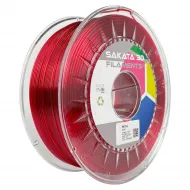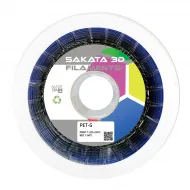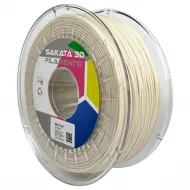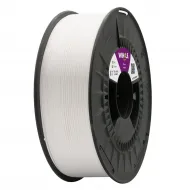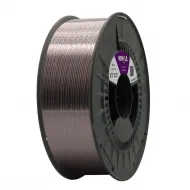
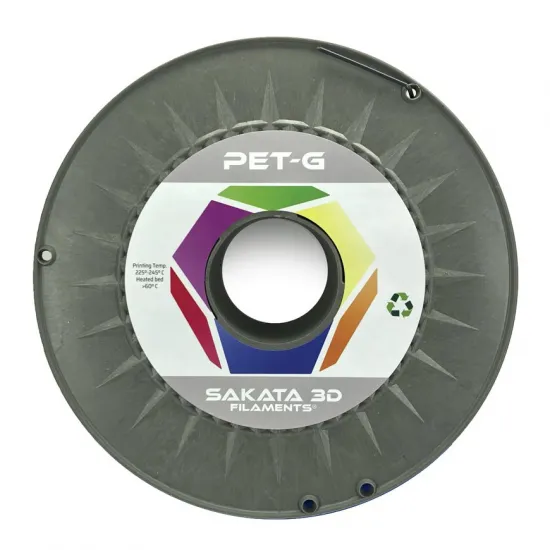
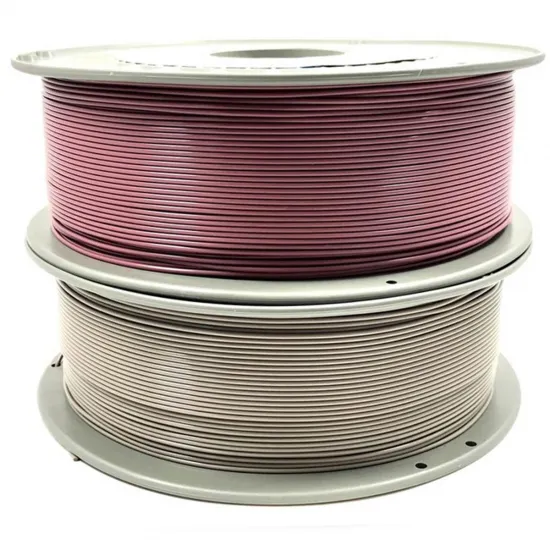


- Stock: 31
- Model: RE-PETG-Sakata-1.75mm

Type:

PETG

PETG Transition

Recycled PETG

PETG CF-15
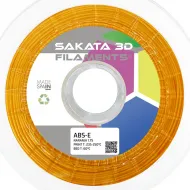
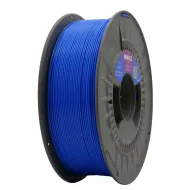
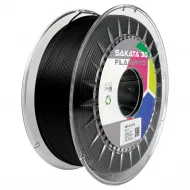
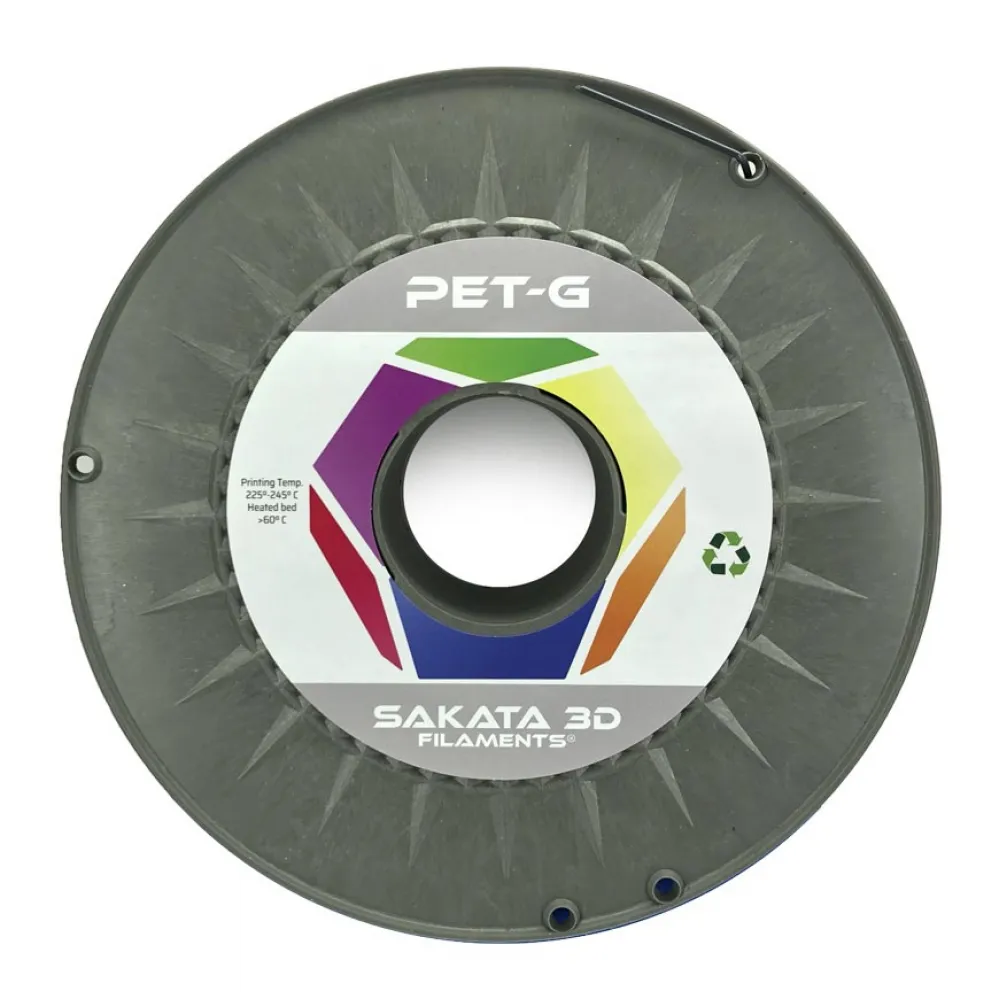
Sakata 3D RE-PETG is a Spanish-made PET-G filament produced from material recovered within Sakata's own manufacturing process. According to its technical data sheet, it uses internally recovered PETG filament and contains no externally recycled PETG material, while retaining properties similar to the brand's standard PET-G under the stated test conditions.
What RE-PETG means
- Made from PETG recovered within Sakata's filament manufacturing process.
- No externally recycled PETG is added, according to the manufacturer's data sheet.
- Properties described as similar to standard Sakata PET-G under standardised tests.
- Variable colour resulting from the composition of the recovered material.
- Made in Spain by Sakata 3D Filaments.
It is particularly useful for prototypes, tooling, models, cosplay and functional parts where an exact shade is not critical. Colour variation is inherent to this product and does not by itself indicate a material defect.
Technical specifications
| Property | Reference value |
|---|---|
| Material | PET-G recovered from the internal manufacturing process |
| Diameter | 1.75 ± 0.05 mm |
| Maximum roundness deviation | 0.05 mm |
| Net weight | 1 kg |
| Density | 1.27 g/cm³, ASTM D792 |
| Hardness | R110, ASTM D785 |
| Colour | Variable; neither selectable nor guaranteed between spools |
| Origin | Made in Spain |
Material properties
| Property | Standard | Declared value |
|---|---|---|
| Tensile yield strength | ASTM D638 | 50 MPa |
| Tensile strength at break | ASTM D638 | 28 MPa |
| Elongation at break | ASTM D638 | 140% |
| Flexural strength | ASTM D790 | 73 MPa |
| Notched Izod impact | ASTM D256 | 100 J/m |
| HDT | ASTM D648 | 64–70 °C |
| Vicat softening temperature | ASTM D1525 | 85 °C |
These are standardised values for the reference material, not guaranteed performance figures for every printed part. Orientation, wall count, infill, geometry, moisture, layer bonding and load duration affect the result. HDT and Vicat do not by themselves define a universal continuous service temperature.
Suggested starting profile
| Setting | Starting point |
|---|---|
| Nozzle temperature | 235–250 °C on the current official product page |
| Heated bed | 60 °C as the current commercial reference; tune for the surface |
| Part-cooling fan | 20% as an initial reference |
| Layer height | 0.10–0.30 mm |
| Conservative starting speed | 40–80 mm/s; increase only after validating flow and layer bonding |
| Flow | Calibrate; the TDS suggests testing a 4–6% reduction |
The 2023 TDS states 225–245 °C and a bed above 60 °C, while the current commercial page shows 235–250 °C and 60 °C. Give priority to the label on the supplied spool, as it identifies its batch more closely, then complete tuning with a temperature tower and first-layer test.
The same TDS gives conflicting maximum speeds in its two languages, so adopting a maximum without testing is not recommended. Hotend flow, nozzle, line width and height, acceleration, cooling and geometry determine the practical speed.
Bed adhesion, flow and finish tuning
- Clean the build surface and set the first layer without excessively squashing PET-G.
- Calibrate flow with a known-wall test. The 4–6% reduction stated by the TDS is an initial trial, not a mandatory setting for every printer.
- Start with moderate retraction and tune it for direct-drive or Bowden extrusion.
- If stringing or soft details appear, slightly reduce temperature or review retraction and drying. If layer bonding is weak, increase temperature or reduce cooling.
- On glass or highly adhesive surfaces, a thin layer of 3DLAC aerosol or 3DLAC Plus may serve as an adhesion aid or release layer, following the surface instructions.
- Allow the part to cool before removal to reduce the risk of damaging the build surface or finish.
3D-printer compatibility
It is functionally compatible with FDM/FFF printers designed for 1.75 mm filament whose hotend and bed can reach the required temperatures. With a calibrated profile it can be used on HTA3D HPRO machines and families such as Bambu Lab A1, P1 and X1; Creality Ender-3 and K1; Original Prusa MK3, MK4, MINI and CORE One; and Voron 0.2, Trident or 2.4 builds.
AMS, MMU, CFS and other automatic-feeder compatibility must be checked for spool dimensions and condition, path and friction. Use external feeding when in doubt; universal compatibility is not guaranteed.
Storage and use limitations
Store the spool sealed with desiccant and protected from moisture, heat and direct light. If popping, bubbles, excessive stringing or a rough surface appear, dry the filament only with a cycle compatible with PET-G, the spool and the dryer used; the reviewed product-specific documentation does not specify a drying cycle.
Chemical resistance depends on the substance, concentration, temperature, time and stress on the part. Test the actual application before prolonged chemical exposure, heat or critical loads. It is not certified for food contact or medical applications.
This product is for you if
- You want to use PETG recovered within the manufacturing process.
- You print prototypes, models, cosplay, tooling or functional parts where exact colour is not critical.
- You want a Spanish-made PET-G with good toughness and low warping tendency.
This product is not for you if
- You need to choose an exact colour or repeat the same shade between batches.
- You need guaranteed maximum speed without calibrating printer flow.
- The application requires food-contact or medical certification, or critical properties without testing.
If you need selectable, repeatable colours, see standard Sakata 3D PET-G. For a random colour-change effect along the filament, choose Sakata 3D PET-G Transition.
Printing in a space with suitable general ventilation is recommended.