

- Stock: 3
- Model: Manta-8MP-V2

Model:

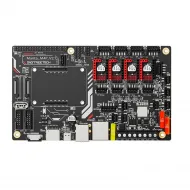
Manta M4P

Manta M8P

Manta M8P V2
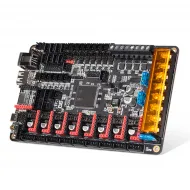
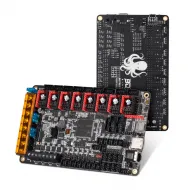
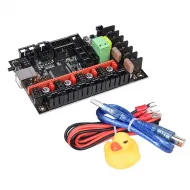
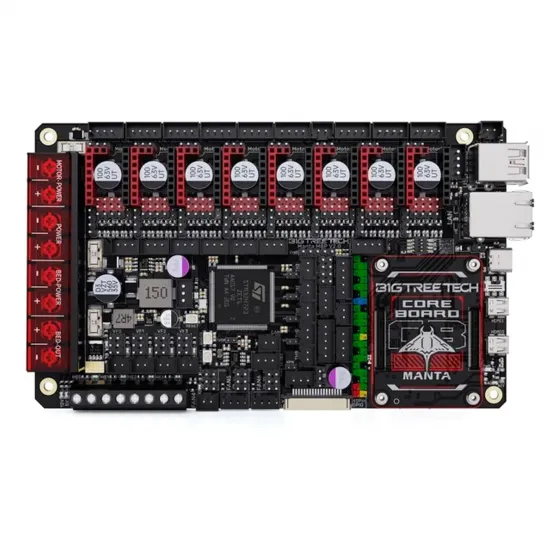
The BIGTREETECH Manta M8P V2.0 is a 32-bit controller for advanced 3D printers, CoreXY machines and projects requiring several independent motors. It combines a 550 MHz STM32H723ZET6 Cortex-M7, eight replaceable driver sockets and a BTB connector that accepts a compatible Linux module to run Klipper in a compact assembly.
Its main advantage is not merely its connector count: each driver can be powered from the regular VBB rail or a separate HV input, while CAN, four hotend-heater outputs, a bed output and a broad selection of fan, sensor and expansion interfaces support demanding builds.
Main specifications
| Item | Specification |
|---|---|
| MCU | STM32H723ZET6, ARM Cortex-M7, 550 MHz |
| Drivers | 8 replaceable sockets; STEP/DIR and, depending on module, UART or SPI |
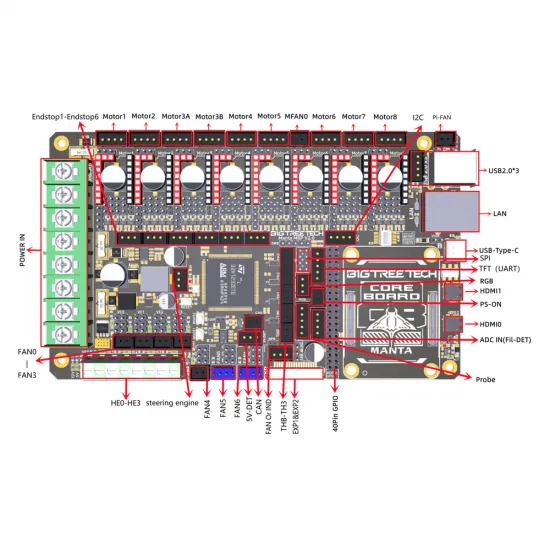
| Motors | 8 independent channels and 9 physical connectors; both Motor3 outputs are wired in parallel |
| Board power | 12 or 24 V DC |
| Bed power | 12 or 24 V DC, separate input |
| Driver power | VBB or separate HV input; manufacturer rating for HV is 24-60 V |
| Heating | 1 bed and 4 HE0-HE3 heater outputs |
| Temperature | 5 inputs for 100 kΩ NTC; TH0-TH3 can also be configured for PT1000 |
| Fans | 5 two-pin PWM, 2 four-pin, Pi-FAN and always-on output |
| Communications and expansion | USB-C, CAN, SPI, I2C, RGB, TFT, FPC EXP, probe, servo, PS-ON and GPIO |
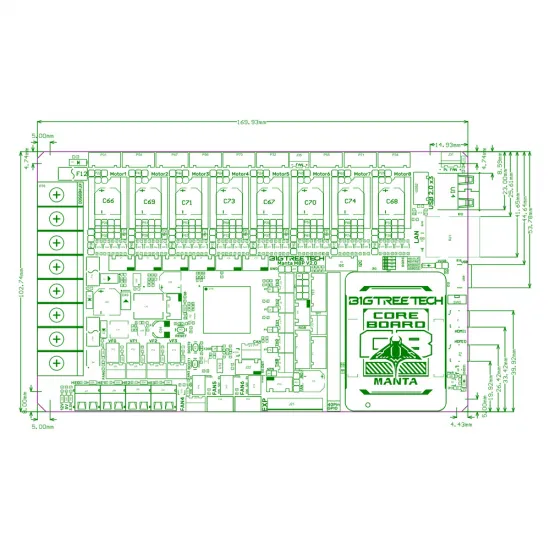
| Dimensions | 170 × 102.7 mm |
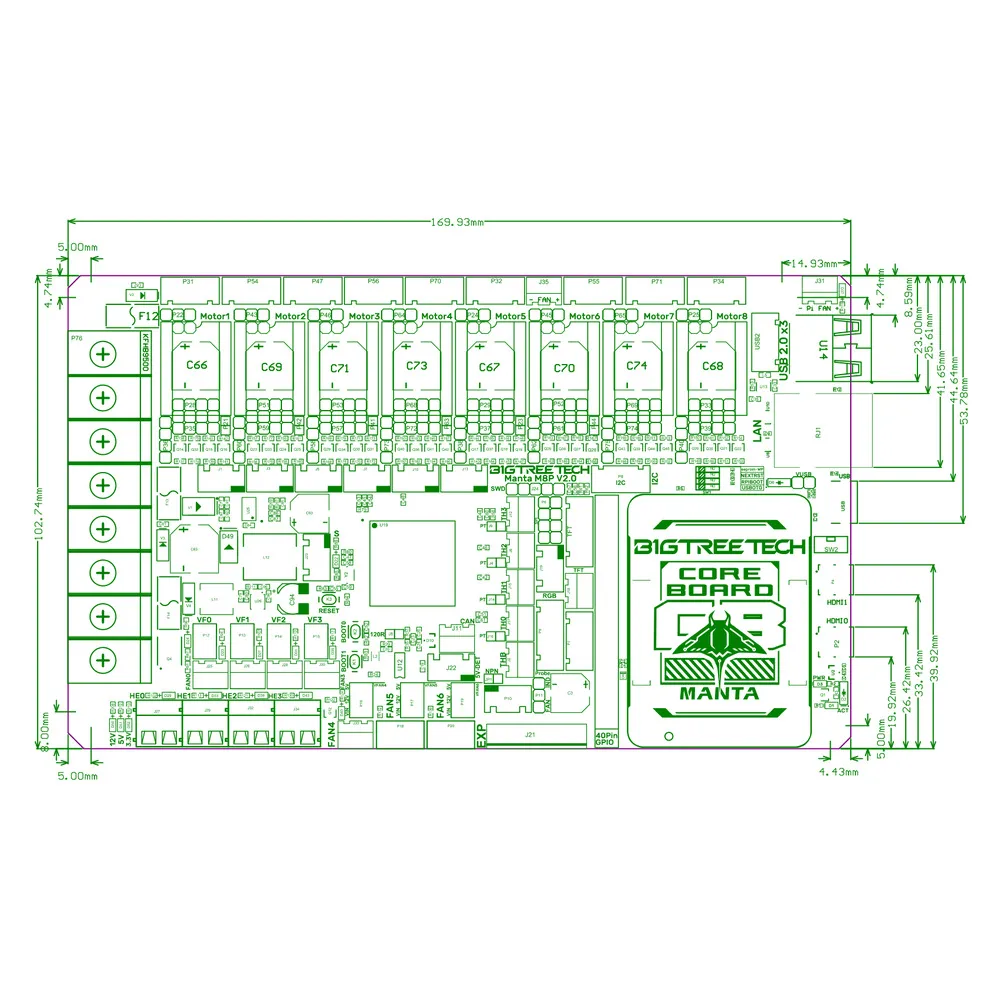
Eight drivers and nine motor connectors
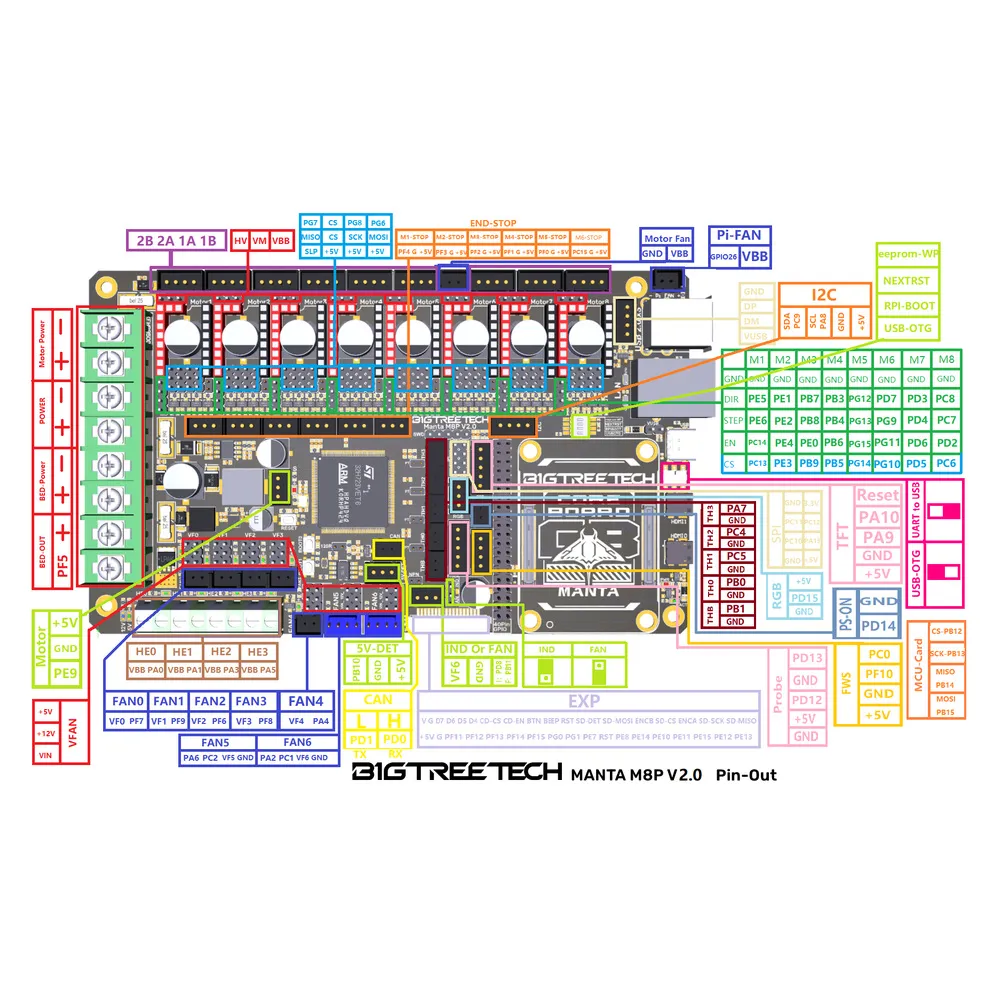
The board provides eight independent driver channels. Motor3 has two physical connectors, 3A and 3B, wired in parallel to the same driver. This is useful for two motors that must always move together, but does not provide independent motion, current or levelling. A machine requiring four independently controlled Z motors must allocate one driver channel to each motor.
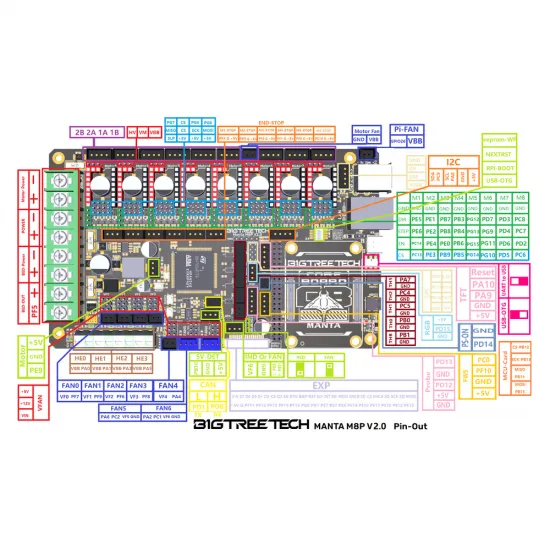
Supported examples include TMC2209, TMC2208, TMC2130, TMC5160, A4988, DRV8825, LV8729 and ST820, provided the module format, pinout, communication mode and voltage match. Jumpers beneath each socket configure STEP/DIR, UART, SPI and DIAG operation and must be set for the installed driver.
VBB and HV: board capability versus driver limit
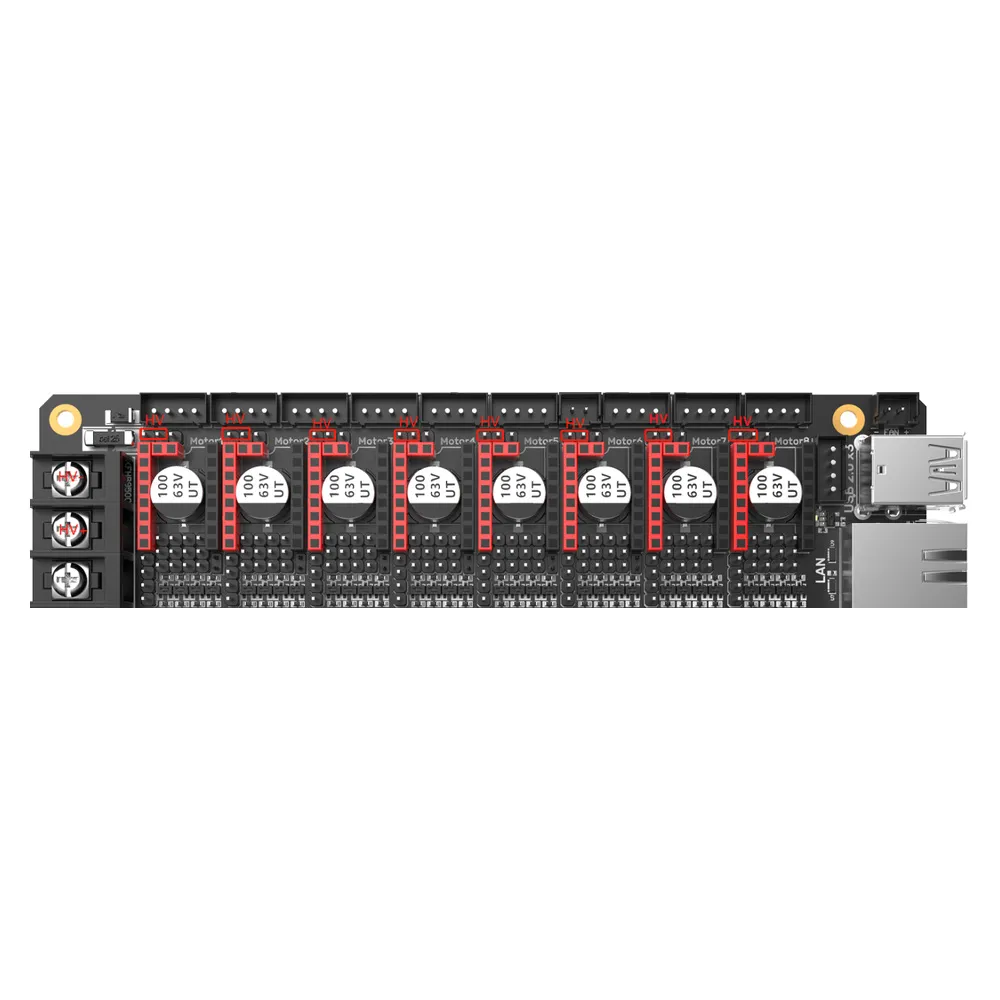
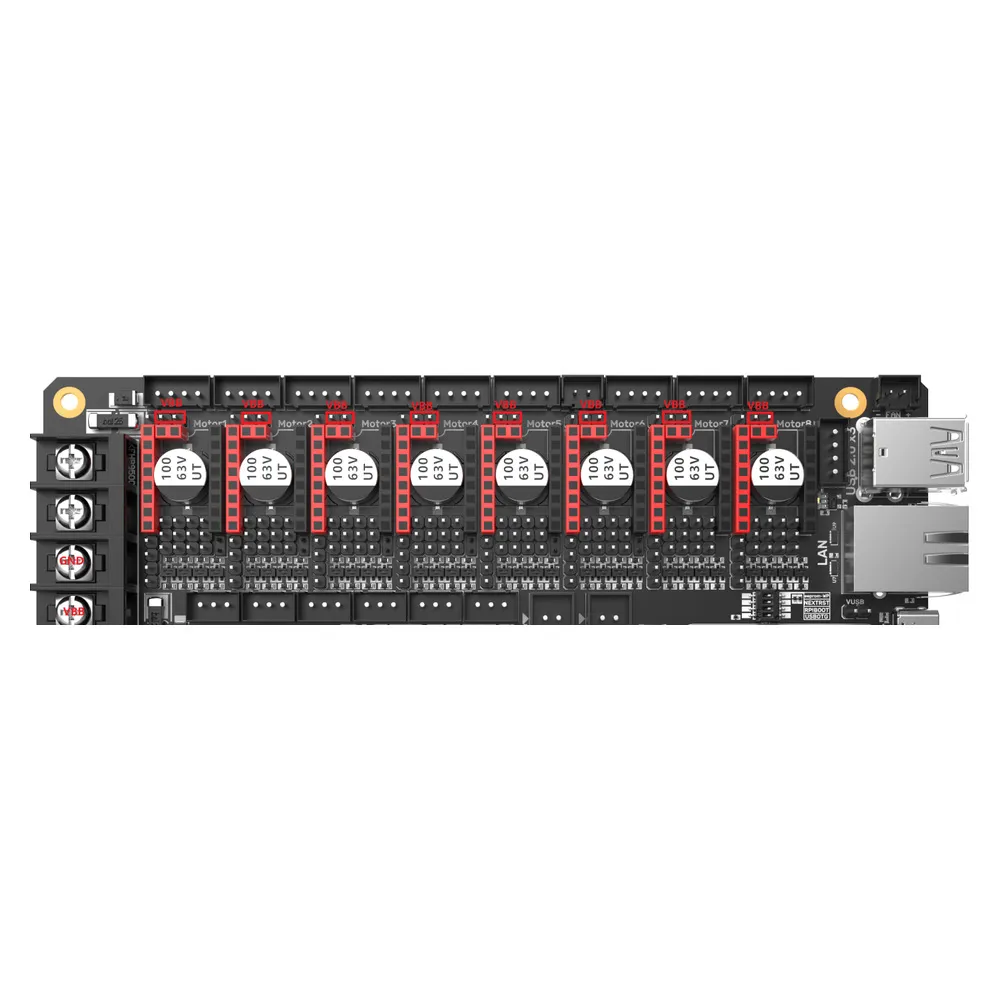
Each socket can draw power from VBB or the separate HV input. BIGTREETECH rates the HV input at 24-60 V, but this is a board-input rating: the installed driver determines the real limit for each channel. A module limited to 36 V, such as the BIGTREETECH TMC2240, must never receive a higher voltage even though the Manta itself supports more.
Heaters, bed and temperature sensors
The board has one bed output and four heater outputs. The manufacturer specifies 10 A for the bed with a 10.5 A peak, and 5.5 A for the heater output with a 6 A peak. It also specifies less than 12 A for the heater-cartridge, driver and fan group, with the bed listed separately. Power supply, fuses, wires, connectors and ferrules must be sized for the actual load; high-power beds may require a suitable external switching device.
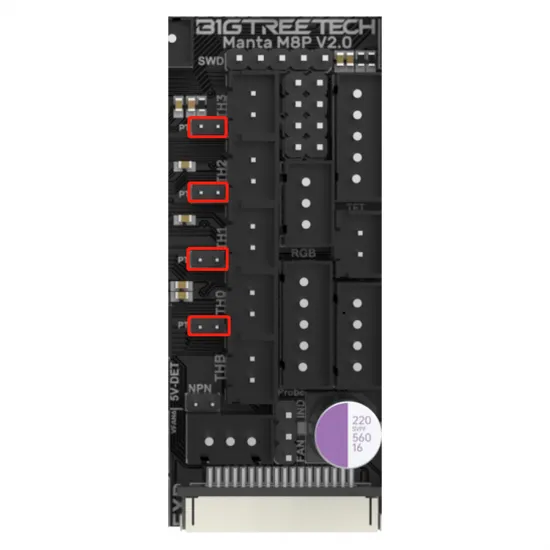
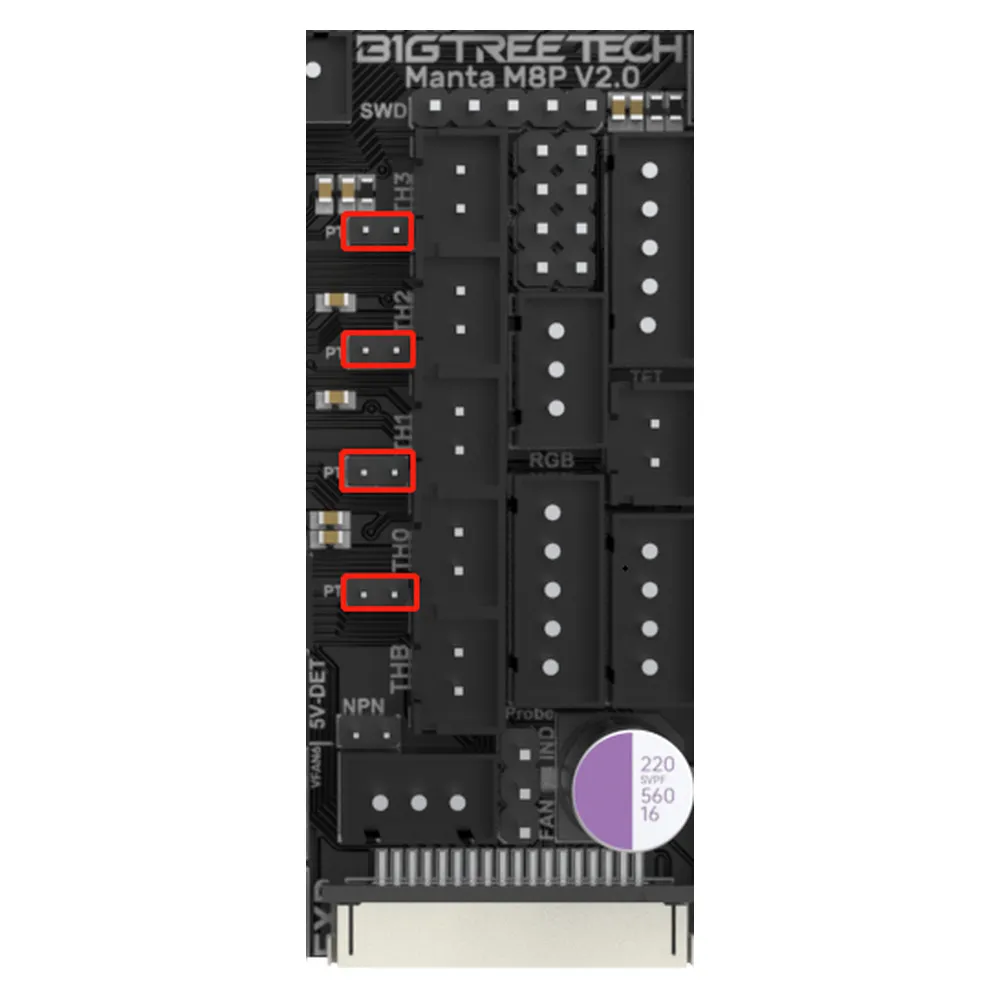
TB and TH0-TH3 accept 100 kΩ NTC thermistors. TH0-TH3 can add a 4.12 kΩ parallel resistor by jumper, producing an approximately 2.2 kΩ pull-up for direct PT1000 connection. BIGTREETECH notes that this method is less accurate than a dedicated MAX31865 interface. The electrical jumper does not replace selecting the correct sensor in firmware.
Fans and auxiliary connections
FAN0-FAN4 are two-pin PWM outputs, while FAN5-FAN6 are four-pin connectors with tachometer signals. FAN0-FAN6 allow 5, 12 or 24 V selection by jumper. A Linux-module fan output and an always-on output complete the group. Check the fan's rated voltage and corresponding jumper before connection.
Connections are provided for a BLTouch or compatible probe, servo, filament sensor, NPN/PNP inductive probe, RGB, I2C, SPI accelerometer, PS-ON, 5 V detection and display. CAN includes a transceiver and selectable 120 Ω termination for building a correctly configured CAN network with compatible toolboards.
Integrated Klipper host with CM4 or CB1
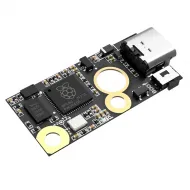
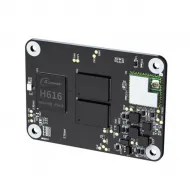
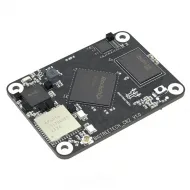
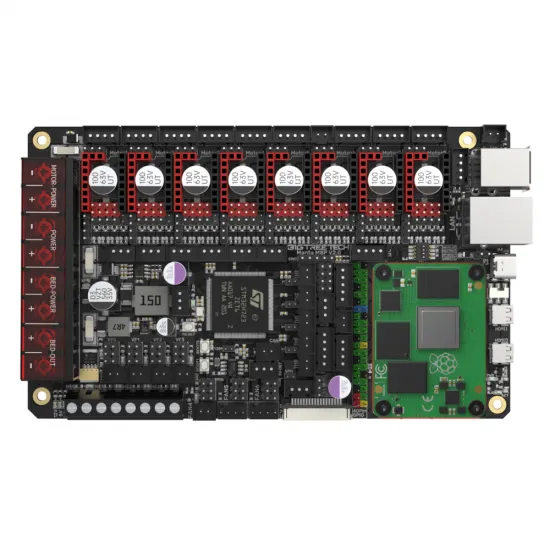
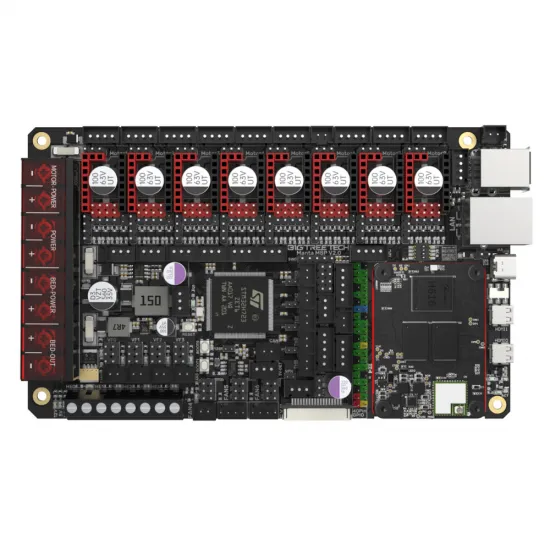
The BTB connector explicitly accepts a Raspberry Pi CM4 or BIGTREETECH CB1 V2.2. Sold separately, these modules provide the Linux system that runs Klipper, Moonraker, Mainsail or Fluidd. The three USB host ports, Ethernet, HDMI, DSI, CSI and part of the GPIO depend on the installed module; they are not autonomous STM32 resources.
Complete compatibility must not be inferred solely because another module follows the CM4 form factor. Power, signal mapping, operating system and peripheral support must all be verified. CM4 and CB1 also require suitable cooling and clearance around their heatsink.
Klipper configuration
BIGTREETECH supplies generic-bigtreetech-manta-m8p-V2_0.cfg as a pin map and starting point. Its dimensions, kinematics, currents, thermistors and PID values are examples and must be replaced with values for the actual printer.
For USB MCU firmware, the official build settings start with:
Micro-controller Architecture: STMicroelectronics STM32
Processor model: STM32H723
Bootloader offset: 128 KiB
Clock Reference: 25 MHz crystal
Communication interface: USB on PA11/PA12
The official configuration also supports CAN on PD0/PD1 or serial on USART1 PA10/PA9. For microSD updates, copy the binary as firmware.bin; a successful update renames it to FIRMWARE.CUR. Then obtain the actual board path under /dev/serial/by-id/ and replace the example identifier.
Marlin configuration
Current Marlin provides a board definition specifically for this revision:
#define MOTHERBOARD BOARD_BTT_MANTA_M8P_V2_0Drivers, currents, sensors, thermal protections, heaters, fans, probe, endstops and machine geometry must then be configured before compiling. In current Marlin support, the directly supported wired display for this pin map is the BIGTREETECH Mini12864 V2.0 through its FPC cable; other displays require interface and firmware-support checks.
3D printer compatibility
Its eight channels and broad peripheral set make it a suitable base for Voron 2.4 and Voron Trident, as well as other CoreXY and multi-axis machines. It can also be configured for Cartesian, Delta or Kossel kinematics. Compatibility is not plug-and-play: mounting, enclosure, wiring, drivers, display, sensors, power and firmware must match the exact machine revision.
It can be integrated into VzBot and other custom printer projects when the design accepts its size and a complete configuration is produced. It is not a drop-in replacement for proprietary Ender, Prusa or Bambu Lab boards.
This is for you if
- You need up to eight independent drivers and a broad peripheral set.
- You want to mount a CM4 or CB1 directly on the controller for Klipper.
- You require CAN or a separate supply for selected drivers.
- You are prepared to document and verify wiring, jumpers and firmware carefully.
This is not for you if
- You want a drop-in controller that requires no firmware compilation or wiring changes.
- You do not require this many motors, heaters or auxiliary connections.
- You intend to use high-voltage drivers without checking each module's individual limit.
- You expect the Linux module, drivers or accessories to be integrated into the controller itself.
Recommended commissioning sequence
- Visually confirm that the silkscreen identifies Manta M8P V2.0.
- With power removed, configure the communication mode and voltage for each driver.
- Check continuity, polarity, fuses, protective earth and terminal tightness.
- Power logic first and verify the MCU, endstops and sensors.
- Test motors at low current and fans at the correct voltage.
- Enable each heater separately under supervision with thermal-runaway protection active.
Drivers and the Linux module are separate components. The system can be completed with a CB1 V2.2, TMC2240, USB-to-CAN adapter or a wireless Klipper display, after checking the requirements of each build.
Technical documentation: official BIGTREETECH Manta M8P repository, current Marlin support and official Klipper documentation.